

Robert Toczycki, JD, MBA
bioboyscout.com
bioboyscout@gmail.com
847.227.7909
X: @BioBoyScout
1. The day they killed a drug that worked
On November 29, 2016, Arrowhead discontinued ARC-520, ARC-521 and ARC-AAT. The lead program, the follow-on, and the whole clinical pipeline, wiped out in a single announcement. Thirty percent of the staff went with them.
The drug was not failing. ARC-520 was in Phase 2 for hepatitis B and the antiviral activity was real. Five months after they killed it, Arrowhead stood up at the International Liver Congress and presented the data anyway: reductions in surface antigen of up to three logs after multiple doses, viral DNA undetectable in many patients. The drug had shown clear biological activity, even though clinical efficacy was not yet established.
The drug worked. They killed it anyway.
The problem sat underneath the drug. All three programs used EX1, an intravenously administered Dynamic PolyConjugate (DPC) delivery vehicle carrying a melittin-like peptide designed to help the siRNA escape the endosome, the membrane-bound compartment that traps it after it enters a cell. Without that escape the siRNA never reaches the cytoplasm and never silences its target. In early November a non-clinical primate study at doses above the human range produced deaths. The FDA put the Phase 2 on hold.
Arrowhead concluded the silencing mechanism was fine and the delivery component was not. That distinction saved the science. It saved none of the drugs.
2. What it cost
The stock closed at $1.44 on November 30, down 67 percent in a day. The company was worth about $87 million. Jefferies cut its target from $5 to $2. Piper went from $10 to $2 and downgraded. The low came in December at $1.24.
The decision did not cost a program. It cost most of the company’s market value, a third of its people, and roughly three years.
3. Why they did it anyway
Management said satisfying the agency on EX1 would take at least eighteen months and come with no guarantee at the end. They could have waited. Plenty of companies would have, and a few would have been right to.
What made waiting the wrong answer is that Arrowhead already had the replacement. Bruce Given, then head of research and development, put it about as plainly as anyone in this industry ever has: EX1 was good for intravenous administration, but it was not going to work for a shot under the skin.
They were not choosing between a damaged platform and empty hands. They were choosing between a damaged platform and a better one they had not finished yet.
That choice is harder than it sounds, because the damaged platform had a Phase 2 asset on it and the better one had none. One of them was on the slide deck. The other was a promise.
4. The sacrifice you cannot see on the board
Chess players have a name for this. A positional sacrifice is when you hand over a countable piece, a pawn or an exchange, for a gain you cannot count: an open file, a better structure, a square your opponent can never defend again. Beginners almost never play them, because the loss is visible immediately and the gain shows up ten moves later, if at all.
Arrowhead gave up three clinical programs and a third of its staff for a delivery system that had yet to produce a drug. Every analyst could see the first number. Nobody could model the second.
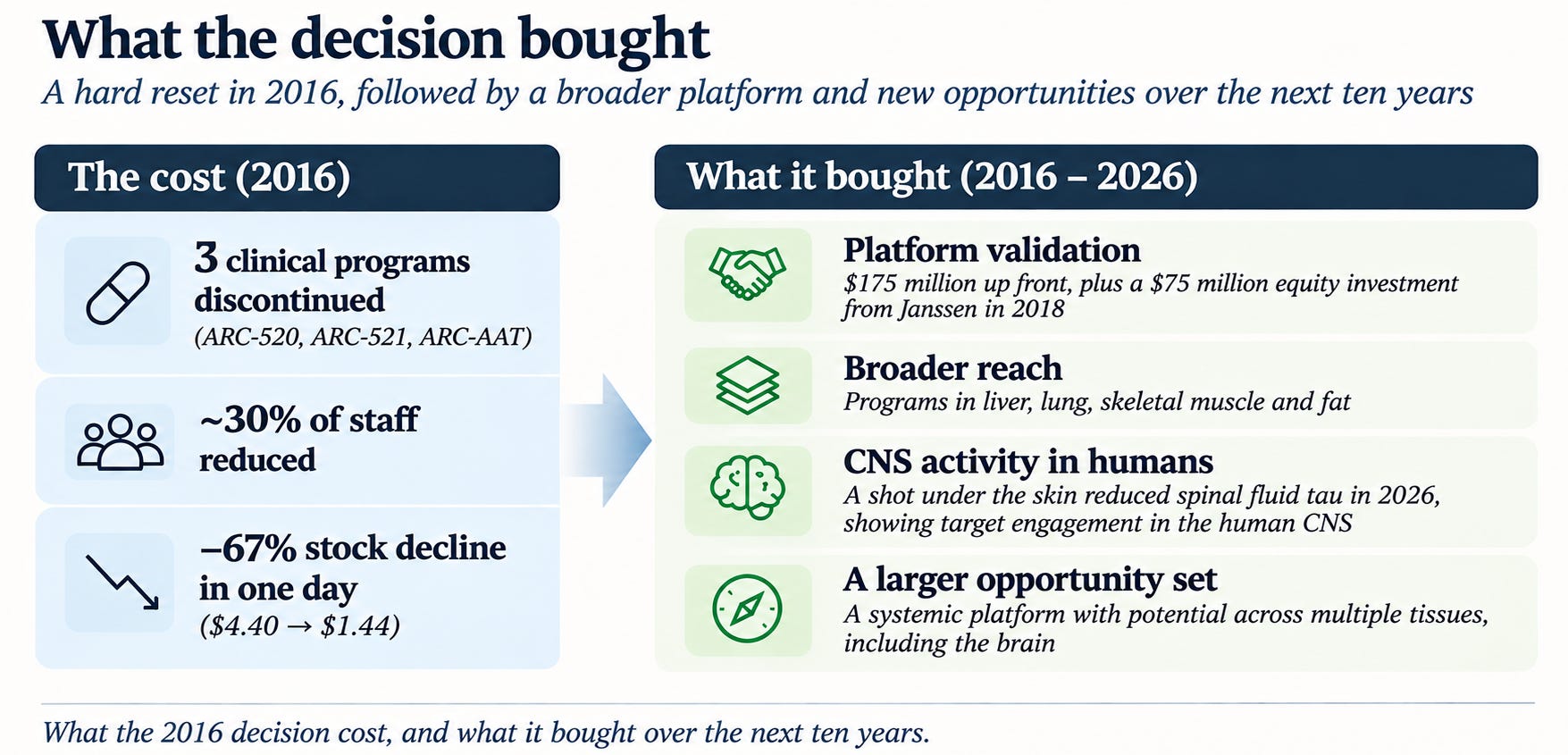
Figure 1. The ten years after the decision. The platform they moved to is the one that reached the brain.
Janssen paid $175 million up front, plus a $75 million equity investment, for the follow-on hepatitis B program in 2018, built on the new platform. Then the liver got crowded and they went to the lung, then skeletal muscle, then fat. In October 2026 a shot under the skin produced a sharp reduction in spinal fluid tau in healthy volunteers, the first clinical evidence that the platform could engage a target inside the human central nervous system (CNS).
The decision that nearly killed Arrowhead in 2016 helped build the platform that reached the brain in 2026.
None of it was visible on November 30, 2016. That is what makes it a sacrifice rather than a trade.
5. Two companies, standing where Arrowhead stood
Ionis has built one of the deepest neurological oligonucleotide franchises in the industry, including approved intrathecal therapies and a substantial pipeline of CNS programs delivered straight into the spinal fluid. The company also disclosed preclinical work on systemic delivery months before Arrowhead’s October readout, including a collaboration with ABL Bio on a shuttle that binds a different receptor, and its own work on transferrin-receptor shuttles carrying payloads into animal brains after a shot under the skin.
Alnylam’s clinical programs in CNS all arrive the same way. On its third-quarter call in October, asked directly whether it would pursue a receptor-based approach, the company defended intrathecal delivery for Huntington’s disease and then said work on a brain shuttle delivering peripherally was underway internally, with an update to come.
Both companies appear to see where the road is heading, and both are building the second one. The question is what they spend on the first while they finish it.
6. Why their decision is harder than Arrowhead’s was
Now the part that cuts against me.
Arrowhead got a clinical hold. The agency made the decision unavoidable and put a clock on it. No equivalent is happening to Ionis or Alnylam. Six weeks ago Ionis and Otsuka reported that ulefnersen, given by lumbar puncture, hit a Phase 3 primary endpoint combining functional impairment and survival. Alnylam has patient biomarker data in Huntington’s that Arrowhead does not yet have in a comparable program. Sarepta’s SRP-1005 is pursuing the same target through subcutaneous delivery and could eventually provide an important comparison between the two approaches.
Nobody is forcing them. That is the problem, not the reprieve.
A forced decision gets made quickly. An optional one gets made eventually. The difference is not courage, it is structure. When there is no deadline, every quarter offers a decent reason to decide next quarter, and the reasons are usually good ones. A trial is enrolling. A readout is close. A launch is going well.
A decision you can make tomorrow is a decision you will make tomorrow.
7. Being rich enough to wait
Arrowhead in 2016 was worth about $87 million, and its finances made sustaining two competing delivery platforms a steadily harder proposition. The clinical hold forced a choice that scarcity had already made difficult to avoid. Which means Arrowhead does not get full credit for the decision. It was largely made for them.
Arrowhead had neither the financial freedom nor the regulatory luxury to keep waiting. That turned out to be lucky.
Alnylam closed September with $3.6 billion in cash and product revenue of $1.29 billion in the quarter. Ionis has three launches and a royalty stream. Both can carry two platforms for years.
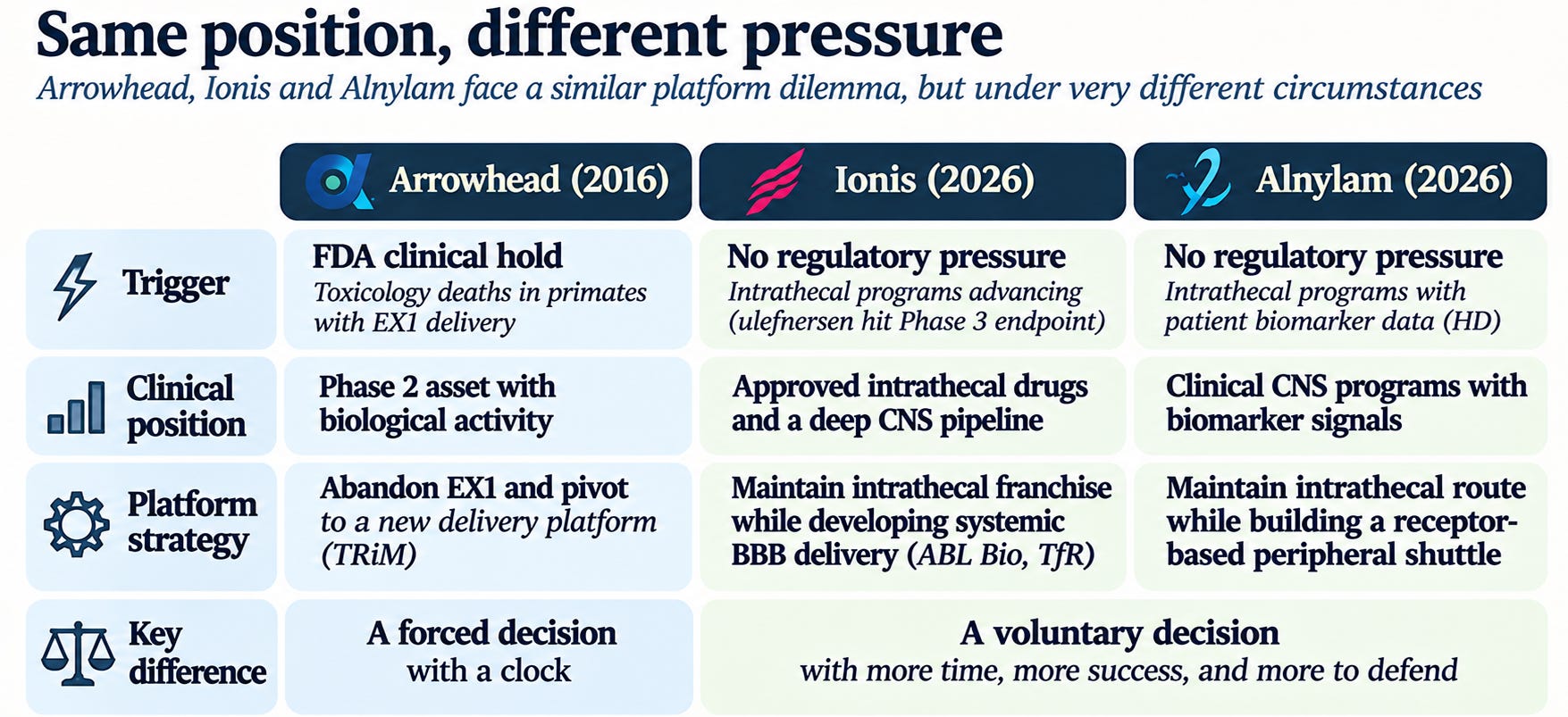
Figure 2. What each company had on the old route when the better one appeared, and what forced the decision.
There is a respectable argument for keeping both roads open. A company with billions in cash can protect the clinical value of one platform while it buys time to validate another, and if systemic delivery disappoints in patients, the company that kept its intrathecal pipeline will look wise rather than slow. That is portfolio management, not indecision.
That holds right up until it does not. A company that can afford to run both has less reason to force a choice, and every successful quarter makes the choice easier to postpone. The cost is not a write-off on a single day. It is spread across years of spending that rarely has to be defended as a single strategic decision.
The trouble starts when preserving an option becomes the reason never to exercise one.
Money buys time. It does not make time free.
One more event this week sharpens the point. On November 2 Arrowhead refinanced its Sixth Street facility, replacing fifteen percent payment-in-kind interest with a lower cash-pay rate, ending the mandatory sweeps of future partnership proceeds, and securing greater borrowing flexibility. The lender accepted roughly $68 million less than the contractual minimum repayment. The transaction improved Arrowhead’s position, though the new interest must be paid in cash and borrowing capacity is not money in the bank.
Arrowhead now has financial flexibility it lacked in 2016. What it does not have is an established intrathecal franchise worth defending, and that is the distinction. Money gives every company options. An installed base determines which options it is tempted to protect.
Arrowhead has more freedom to wait than it once did, and far less reason to protect the old road.
8. What the delay actually costs
A switch does not cost you the biology. The target survives. The therapeutic hypothesis survives. The molecule may have to change. ARC-520 and ARO-HBV went after the same virus with the same idea; the second one simply arrived by a different road. What does not survive intact is the clinical package. How much of it carries over depends on the construct and on what regulators will accept, but a new delivery system generally means new nonclinical work and a return to early human studies.
A platform switch does not cost you the idea. It costs you the years.
Which means the expense rises with the maturity of what sits on the old route. In 2016 Arrowhead’s lead was ARC-520 in Phase 2, painful and survivable. Now, Ionis has obudanersen enrolling a Phase 3 in Angelman syndrome and ulefnersen, which just finished one. Alnylam has brezosiran, with a pivotal study planned for 2027. The longer each of those runs on the old route, the larger the clinical package that a systemic construct would have to rebuild.
The money already spent is gone either way, and none of it should decide what happens next. The harder question is whether the next quarter of spending still earns its place. What rises with maturity is not the sunk cost but the pull of the evidence: a program with four years of clinical data behind it is much harder to argue against than one with four months, even when the road under it has changed.
A platform does not have to stop working to become obsolete. It only has to stop being the best place to put the next dollar. Intrathecal drugs can keep working, keep winning approvals and keep earning revenue long after the case for starting another intrathecal program has gone.
The danger is not that the old platform stops working. It is that the old platform keeps working long enough to make the new one somebody else’s advantage.
There is another cost, and it never shows up in a pipeline. A lumbar puncture can be a perfectly acceptable price for treating a devastating rare disease. It is a very different proposition for treating millions of people over many years, particularly before symptoms get bad.
If systemic delivery into the brain proves safe, effective and durable, its largest advantage may not be taking patients away from intrathecal drugs. It may be opening markets that intrathecal delivery could never serve at scale.
The cost of staying on the old road is not only the time spent there. It is the destinations never attempted.
Whether the new road turns out to be better depends on evidence not yet established in patients: enough target engagement in the brain regions that matter, safety, durability and clinical benefit, weighed against the practical advantage of avoiding a lumbar puncture. Convenience on its own settles none of that.
9. The part nobody puts in a model
The clinical cost of switching grows with each trial. The organizational cost grows with every system built to support it.
A delivery platform is not a molecule. It is a manufacturing process, a formulation group, a regulatory file, a set of clinical sites whose nurses are trained to do lumbar punctures, and several hundred people who know one specific way of getting a drug where it needs to go.
When Arrowhead switched platforms it cut thirty percent of its workforce. That number usually reads as cost-saving in a crisis. Read it the other way. A large part of the expertise the company had accumulated was built around work it was walking away from.
Switching platforms does not only make your pipeline wrong. It makes some of your people wrong.
That force defers these decisions and it never appears in a sum-of-the-parts. The people who would have to recommend the switch are often the people whose expertise the switch devalues. A company can know the right answer at the level of the strategy deck and be unable to produce it at the level of the organization, for years.
There is an asymmetry here that has no connection to the molecule. Arrowhead has no established intrathecal franchise to protect. Ionis and Alnylam do. The same evidence can therefore produce different decisions inside different companies, not because one management team reads the science better, but because each is protecting a different set of assets.
The company with the least to defend may be the one most willing to build what comes next.
10. What would make me wrong
The simplest one. Intrathecal delivery turns out to be good enough where the money is. If dosing into the spinal canal two or four times a year proves acceptable in the rare, severe diseases that reach the market first, the route is a feature of the setting rather than a handicap, and no switch is needed at all.
The one I would most like to be wrong about. The shuttles work and the transition is cheap. Ionis has already shown delivery into animal brains after a shot under the skin. If a construct moves off the lumbar puncture without having to rebuild most of its clinical package, much of the cost described here disappears.
The outcome I have not priced. They license rather than build. Either company could seek access to Arrowhead’s delivery technology instead of finishing its own. Novartis has already licensed Arrowhead technology for a brain target, which shows such deals are possible, though a single-target agreement is a long way from broad platform rights and the economics of those would be a different negotiation entirely. In that outcome Arrowhead wins without displacing a single incumbent drug. The value moves from owning the best pipeline to owning the road other pipelines need to travel.
Both roads survive. Systemic delivery proves better for some targets and populations while intrathecal keeps the advantage for others, and the two companies simply allocate new programs accordingly, protect the value of what they have already built, and make the shift without ever having to give up a program. If that is how it goes, Arrowhead’s 2016 experience was not a preview of their future. It was the consequence of a safety crisis they never had.
The obvious one, last. Arrowhead’s own evidence is an early human study in healthy volunteers and a spinal fluid biomarker. If the patient data in 2027 comes in materially weaker, the second road is not yet a road and nobody has to decide.
11. The bill arrives either way
I am not predicting that Ionis or Alnylam discontinues a program. That is the wrong shape for what they face. Arrowhead had a binary: kill the drugs or wait eighteen months. These two have a gradient, which is how much to keep spending on a route that works today while they finish a better one.
The real test may not be whether either abandons a successful intrathecal program. It may be whether either starts the next one on that route after a better alternative becomes credible.
A gradient has no day on which you must decide. It only has quarters in which you did not.
One day somebody may add up what went into a Phase 3 that reads out into a market whose economics have moved, and the number could be larger than anybody intended. Not because the management was foolish. Because every individual quarter of delay was defensible, and the sum of them was not.
Arrowhead already paid this bill. It knows that price firsthand.
They paid it at $1.44 a share with a third of the staff gone and the analysts cutting to two dollars. Ten years later, what they bought with it was a platform that could silence a target in the human central nervous system after a shot under the skin.
Nobody gets to say in advance whether that trade was worth it. You only get to say afterward, and by then the choice belongs to somebody else.

A Note on Supporting Independent Research
If this white paper has been valuable to you, whether it shaped your thinking, validated your conviction, or simply saved you the time of doing this work yourself, a voluntary contribution is genuinely appreciated and directly funds the next paper.
For individual investors and readers
Any amount you feel reflects the value you received is welcome and meaningful. A contribution in the range of what you might pay for a single premium research report is a thoughtful gesture that makes a real difference.
For family offices, investment funds, hedge funds, and research platforms
This paper is the caliber of work that institutional research desks bill significant retainers to produce. If your team referenced it, distributed it internally, or used it to inform a position, a suggested contribution of $1,500 reflects the professional value of the analysis, though any amount is meaningful. Your support makes it possible to continue publishing at this level without a paywall that limits the reach of the ideas. If your organization requires an invoice to process a payment, please reach out directly at bioboyscout@gmail.com and one will be provided promptly.
There is no obligation and no expectation. This is purely a thank you for work that meant something to you.
Zelle: (847) 227-7909
Thank you for reading, and for being part of a community that takes this thesis seriously.
— Robert Toczycki | BioBoyScout
Important Risks, Disclosures, & Disclaimers
The author, Robert Toczycki (aka BioBoyScout), certifies that:
all views expressed in this white paper accurately reflect his personal opinions about the topic discussed;
he was not compensated in any form for producing this white paper; and
he has not received and does not receive compensation from Arrowhead Pharmaceuticals.
This paper is provided for informational and analytical purposes only. It does not constitute investment advice, financial advice, legal advice, or a recommendation to buy, sell, or hold any security, and it is not a recommendation as to any corporate course of action. The author holds a long position in Arrowhead common stock. Past performance is not indicative of future results, and forward-looking analysis is inherently uncertain. The author and BioBoyScout are not registered investment advisors. The author assumes no obligation to update this paper. The characterization of what is and is not in the published literature, the probability judgments, and the chess analogy are the author’s own.
About the Author
BioBoyScout is the publishing name for Robert Toczycki, an independent biotech investment research writer based in Chicago. The BioBoyScout series publishes institutional-grade analysis of structural dynamics in RNA-class therapeutics, with particular focus on Arrowhead Pharmaceuticals’ TRiM platform and the broader competitive landscape. Robert is a registered US Patent Attorney with a JD, an Executive MBA completed at the top of his class, and a BS in Mathematics and Computer Science from the University of Illinois at Urbana-Champaign. He has a deep passion for financial analysis, particularly identifying valuation discrepancies and demonstrating them through rigorous, data-driven research and solid analytics.
Comments or questions: bioboyscout@gmail.com.
Copyright © 2026, BioBoyScout. All Rights Reserved.