

Robert Toczycki, JD, MBA
bioboyscout.com
bioboyscout@gmail.com
847.227.7909
X: @BioBoyScout
1. The number everyone is waiting for
On Wednesday morning, Arrowhead will report the first human data for ARO-MAPT, its brain drug. Somewhere in the presentation there will be a percentage: how much tau the drug removed from the spinal fluid of healthy volunteers. Management has said publicly it wants to see somewhere between 50 and 60 percent.
Within an hour, that number will be on every message board and in every analyst note, and it will be treated the way a test score is treated. Higher is better. A 60 is a triumph, a 45 is a disappointment, and the stock will move accordingly.
I want to make a narrower argument than that. Tau drugs have produced two impressive numbers in the past five years. Both were real and both were earned. In each case the inference the field drew from the number turned out to be wrong, and it was wrong in a different way each time.
This note is about those two mistakes, and what they should change about how you read Wednesday.
Three questions sit behind any drug like this, and they are easy to run together:
Did it reach its target?
Did it change the pathology?
Did it help the patient?
Each of the two trials below answered the first one cleanly and then came apart at a different point. Wednesday’s number speaks to the first question alone. That is not a retreat from what I have written before, which argued that evidence of central nervous system pharmacological activity after a subcutaneous dose would be a major event for this company. I still think so. The narrower point is that one percentage cannot answer three questions.
A bigger number on Wednesday is not a better result. It is a different result, and the difference has to be argued for.
2. The first number: ninety-eight percent
A few years ago, Biogen ran a trial of a drug called gosuranemab in progressive supranuclear palsy, a brutal disease in which tau builds up in the parts of the brain that control movement and balance. The drug was an antibody. It circulated in the fluid around the brain and grabbed loose pieces of tau floating there.
It worked. In the published results, unbound tau fragments in spinal fluid fell by 98 percent. In a field where getting any drug into the brain is the central problem, that is an extraordinary measure of target engagement. The drug found its target and removed essentially all of it.
The disease did not notice. On the rating scale used to track how fast patients decline, the treated group worsened by 10.4 points over a year. The placebo group worsened by 10.6. The p value was 0.85, meaning the difference was well within what chance alone would produce. With nearly 500 participants and almost identical outcomes between the groups, the trial provided no persuasive evidence of clinical benefit. That is not the same as proving the true effect was exactly zero, and it does not need to be. A drug cannot be developed on an effect that large a study cannot see.
The lead investigator published that conclusion himself, and his wording was careful. Neutralizing tau at that particular end of the protein, he wrote, does not translate into clinical benefit. Not that tau is the wrong target. That one way of reaching it fails.
Ninety-eight percent target engagement. A rating scale that moved from 10.6 to 10.4. In most fields, that ends the target.
3. Why it failed, which almost nobody writes about
Three patients who received gosuranemab were examined after they died. The findings explain what happened.
The antibody had clearly acted. Tau had accumulated inside the disposal compartments of cells wrapped around blood vessels, exactly where you would expect a protein to end up after an antibody tagged it for removal. The machinery worked.
What had not changed was the pathology. Compared with untreated patients, tangle burden was unchanged in the regions examined. Three brains is a small window, and the finding is an absence of observed reduction rather than proof that no tangle anywhere was cleared. The drug cleaned out one pool of tau and the tangles stayed.
Here is the part that makes it almost painful. In progressive supranuclear palsy, unlike in Alzheimer’s, total tau in spinal fluid is not elevated. The protein that causes the disease sits inside neurons and inside the support cells around them rather than floating in the fluid. The various tau measurements are not interchangeable, so this is a statement about the pool the antibody could reach, not about every form of tau in the body.
The antibody therefore cleared almost all of a pool that turned out to be too small, or too far from the pathology, to change the course of the disease. That is not proof that loose tau plays no part in progressive supranuclear palsy. It is proof that removing it was not enough. The drug was fishing in a nearly empty pond, and it caught almost every fish in it.
One more result closes the argument, and it comes from a different disease. The same antibody was also tested in Alzheimer’s, where spinal-fluid tau is elevated and the extracellular pool the drug targets is genuinely there. It engaged the target again. It failed on the clinical endpoint, failed on every secondary endpoint, and left tau PET unchanged after a year and a half. The company ended the program.
The argument therefore does not depend on a quirk of progressive supranuclear palsy. Clearing loose tau outside the cell did not change the pathology in either disease, including the one where there was plenty of it to clear.
Ninety-eight percent of one pool of tau. No measurable reduction in tangles, in either disease.
4. The obvious fix, and why it is harder than it looks
The natural response is to build a better antibody, one that goes after the misfolded tau rather than the loose fragments. The chief executive of Eli Lilly made exactly this point in an interview last week: tau is essential, he said, and what you really want is the misfolded kind.
That instinct is right, and the execution runs into two walls that have little to do with effort.
The first wall is that a shape is not a sequence. Misfolded tau is not a different protein. It is the same protein, from the same gene, with the same sequence of amino acids, folded into a different three-dimensional shape. Misfolding happens after the protein is built. There is no misfolded tau gene and no misfolded tau message, so a drug that works at the genetic level has no target to aim at. A shape cannot be silenced.
The second wall is geography. Over the past decade, researchers in Cambridge imaged tau filaments pulled from the brains of people who died of different tauopathies. Alzheimer’s folds tau one way. Pick’s disease folds it another. Progressive supranuclear palsy, corticobasal degeneration and the dementia seen in former boxers and footballers each have their own fold. The folds are so distinctive that the field now classifies these diseases by structure rather than by symptoms.
As one of those researchers put it, different folds mean different chemical surfaces. A drug precise enough to recognize the misfolded shape in Alzheimer’s has no guarantee of recognizing the misfolded shape in progressive supranuclear palsy, because it is a different surface. Some epitopes may turn out to be shared. The point is that cross-disease reach becomes a question to prove rather than a property you get for free.
Which produces a result nobody expects. The more precisely you aim at the bad tau, the harder it becomes to claim the rest of the board. Precision is usually free. Here it has to be paid for one disease at a time.
The more precisely you aim at the bad tau, the harder it becomes to claim more than one disease.
5. The other approach, and why it is cruder on purpose
The alternative gives up on telling good tau from bad. It lowers the production of all of it.
The logic rests on how tau pathology spreads. Misfolded tau does not sit still. It recruits normal tau and templates it into the same bad shape, and the pathology travels from region to region along the brain’s wiring. Lower the supply of normal tau and you starve the process of raw material.
If a fire spreads by catching nearby fuel, you can fight the fire or take away the fuel. Fighting the fire requires telling one shape from another. Removing the fuel does not.
It also works in the right place. These drugs act inside the neuron, on the message before the protein exists. That is the same compartment the tangles occupy. The antibodies were working primarily outside the cell, while much of the established pathology sits inside it.
Because every tauopathy is built from the same raw material, one drug has a claim on all of them. The crude approach keeps the whole board.
6. The second number: tangles, reduced
This is where the story gets genuinely good, and then genuinely complicated.
Biogen and Ionis built a drug called diranersen that does exactly this. It lowers the production of all tau. Because it is an antisense drug with no way of reaching the brain on its own, it has to be injected into the spinal canal.
In May, the Phase 2 study read out. Tau PET signal, which images aggregated tau in a living brain, fell in every dose group. The Alzheimer’s Association described this as the first Phase 2 evidence that a treatment can remove tangles from a living human brain, though a drop in imaging signal and the physical disappearance of individual tangles are related measurements rather than the same one. Decline slowed on multiple cognitive measures. Ninety-four percent of participants chose to continue into the extension study.
The trial also missed its primary endpoint.
7. How it missed, which is the whole point of this note
The primary analysis was designed to detect a dose-response relationship in clinical outcomes, not simply to determine whether any treatment group differed from placebo. It used a statistical method that compares the observed results against several pre-specified shapes a dose-response curve might take, measured on a standard dementia rating scale at week 76.
The trial did not establish that relationship. The rating scale favored the drug over placebo at all three doses. Higher doses were not associated with more benefit, and the strongest result came from the lowest dose tested, 60 milligrams every 24 weeks, where decline slowed by 26 percent on the rating scale, 42 percent on one cognitive test and 50 percent on another. The prespecified dose-response analysis did not meet its statistical success criterion.
Here is the detail that explains the rest. The company reported tau reductions across all three dose groups, described as generally consistent with the earlier Phase 1b, where all dose groups landed near a 60 percent reduction from baseline. Additional dosing produced no clear incremental suppression. The simplest reading is that tau lowering had already approached a plateau at or below the lowest dose studied. Similar averages across arms can also reflect differences in sampling time, exposure or assay behavior rather than a true ceiling. The available disclosures are consistent with a pharmacodynamic plateau, but without per-dose biomarker values from the Phase 2, the extent of dose separation on tau remains uncertain.
Which means the primary analysis implicitly depended on a chain of two relationships: increasing dose would produce greater tau lowering, and greater tau lowering would produce greater clinical benefit. The available biomarker disclosures do not establish the first relationship across the doses tested. Without that separation, the study could not meaningfully distinguish the second across its treatment groups either. What it did test directly was dose against clinical outcome, and higher doses were not associated with more benefit.
I want to be careful about what that does and does not prove. A failed dose-response analysis means the study did not establish the relationship it set out to find. It does not prove no such relationship exists at doses or durations outside the ones tested. What it establishes is narrower: across the doses tested, higher doses were not associated with greater clinical benefit.
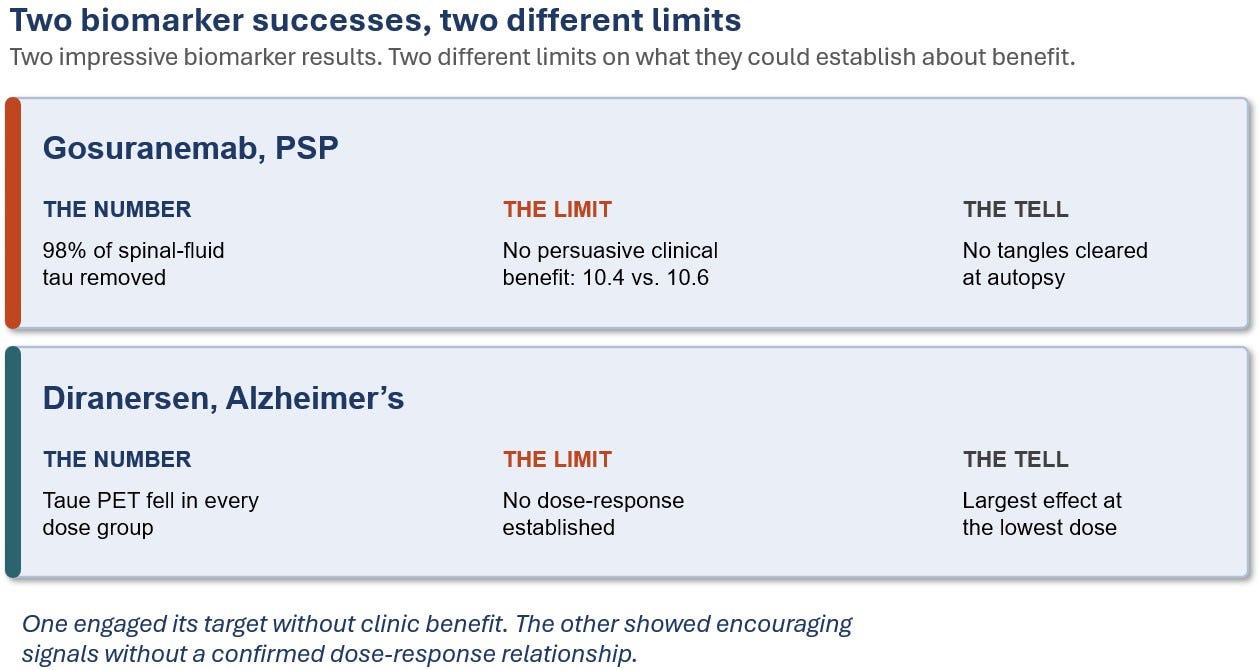
Figure 1. Two biomarker successes with different limits.
The primary analysis looked for more clinical benefit at higher doses. It did not find it.
8. What this changes about Wednesday
Put the two together. The first number was 98 percent, and it bought no benefit because clearing that pool was not enough to alter the course of the disease. The second number showed tau pathology genuinely falling on brain scans and decline slowing at every dose, and the trial still could not produce an orderly relationship between dose and benefit. An early plateau in tau suppression is one plausible explanation. The published biomarker data do not settle it.
On Wednesday a third number arrives. It will measure how much tau left the spinal fluid of healthy volunteers who do not have the disease, do not have tangles, and will not be followed for cognitive decline.
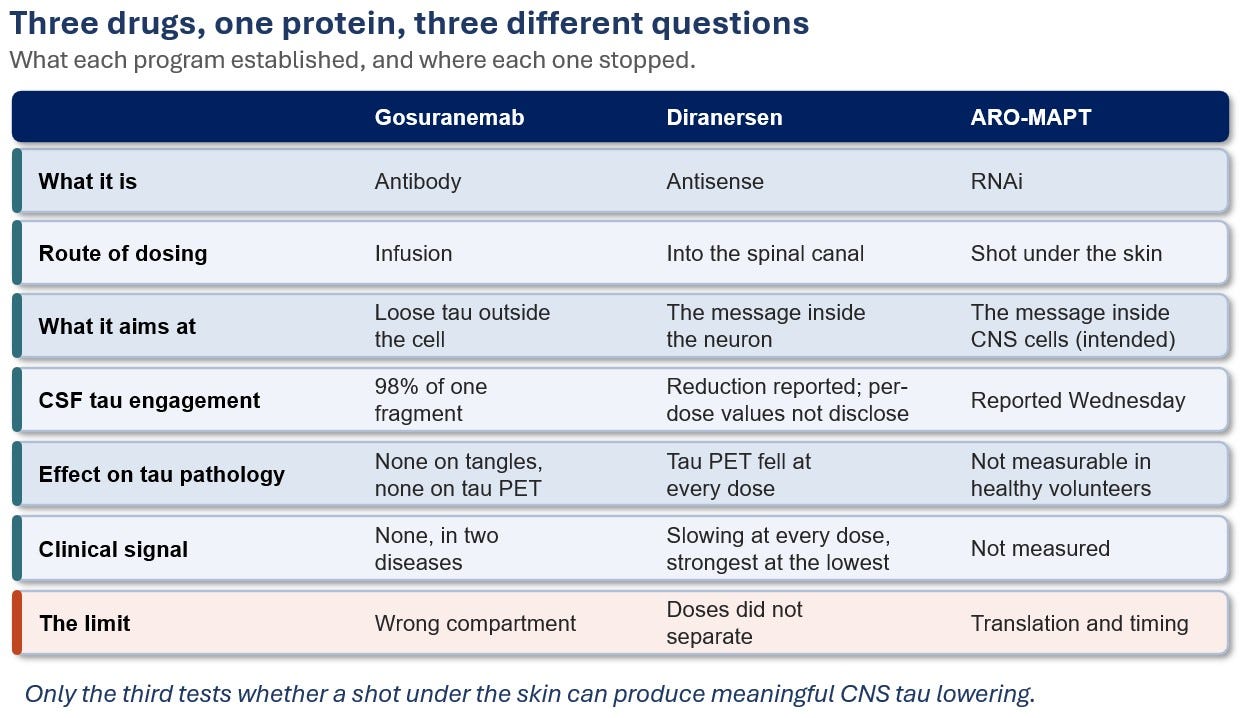
Figure 2. Compiled from the published trial results described above. The ARO-MAPT column describes what the study can and cannot measure, not a prediction.
Set the three programs side by side and the shape of the problem is visible. Two of them have been tried in people and neither settled the question. The third changes one variable, and it is the one nobody has solved.
I am not saying the number is meaningless. It is the first meaningful test of whether a shot under the skin can produce tau lowering in the human central nervous system, and that is a genuinely large question nobody has answered. It is the right question for this stage of development.
I am saying the number answers the first of the three questions and leaves the other two alone. It tells you a shot under the skin can lower tau in the human central nervous system. It does not tell you how widely the drug reached the neurons that matter, how much pathology would change, or whether a patient would be better off. A 60 would demonstrate greater tau suppression than a 50, and that is a real pharmacological result. It would not establish greater clinical benefit.
One corollary is worth stating plainly, because it cuts against the way this will be covered. ARO-MAPT could fail as an Alzheimer’s drug and still matter enormously to Arrowhead. If a shot under the skin produces real pharmacological activity in the human central nervous system, that result belongs to the delivery system rather than to tau, and the delivery system is what the company has spent a decade building. Whether it carries to other brain targets would still have to be shown, one target at a time. The competition sharpens the point.
Novartis has an antisense drug against the same gene, NIO752. In a Phase 1 trial in progressive supranuclear palsy, spinal-fluid neurofilament light held steady in treated patients while it climbed on placebo. That was presented at a conference rather than published, and I have not seen whether it was a prespecified endpoint or an exploratory one. A Phase 3 is planned, with a motor rating scale as the primary measure. It is delivered into the spinal canal. The point is that the two questions can be answered differently, and most coverage will treat them as one.
The target is not what separates these programs. The needle is.
The drug could fail and the delivery system still succeed. Most coverage on Wednesday will treat those as the same result.
9. Six readings worth more than the percentage
If the headline number carries less information than it appears to, the rest of the presentation carries more. Here is what I will be reading.
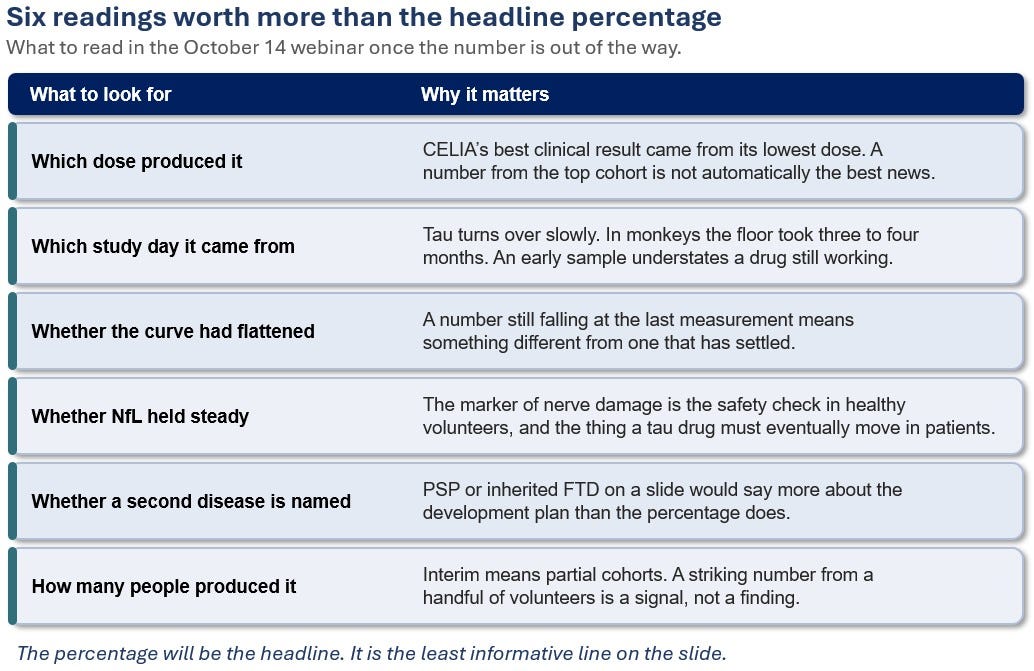
Figure 3. Author’s list, drawn from the trial registration, the primate data Arrowhead has published, and the two trials described above.
The study day matters more than most people realize. Tau is a long-lived protein and the pool turns over slowly. In Arrowhead’s primate work, knockdown took three to four months to reach its floor, though an animal timeline is a hypothesis about humans rather than a schedule. If Wednesday’s sample was drawn before the effect reached its maximum, the reported figure understates where the drug was heading. A 50 percent reduction on a curve still descending may be more informative than a 60 percent reduction that has already flattened.
The dose question is the direct lesson from the Phase 2 above, and it is worth setting out the possibilities before the data arrives rather than improvising at eleven in the morning.
The strong version. Cohorts separate on dose, the reduction holds at a later study day, and safety is clean. That is strong evidence the delivery system works, and the best case available from a study of this design.
The ambiguous version, which will be misread. Cohorts converge on a similar reduction regardless of dose, with clean safety. That looks like a disappointment and may not be one. It resembles the pattern the earlier antisense data suggests, and it would still establish pharmacological activity in the central nervous system from a subcutaneous dose, while limiting claims about how much further the effect can be pushed.
The bad version. A small reduction, or one that fades by the later sampling points. That raises a specific question about whether the primate results translate, or about whether the dosing schedule is right, and it is the version that would actually matter.
The middle case is the one to prepare for. It will look like a miss and may be the same ceiling the antisense drug approached.
10. Why the speakers tell you more than the slides
One more observation, and it is the kind that has served this newsletter well before.
Arrowhead did not book a generic expert for Wednesday. It booked Adam Boxer of the University of California, San Francisco. Boxer ran the trial described in section two. He published its failure and wrote the sentence concluding that neutralizing tau at the N-terminus does not work. He also leads the research program that established spinal-fluid neurofilament light as a measure of how fast these diseases progress, and he runs two government-funded platform trials where the next generation of tau drugs will be tested.
When the first results from the antisense approach appeared, Boxer called it a landmark study of human tau therapeutics, the first to target tau at the genetic level. The man who published the obituary for one approach called the other one a landmark.
His talk on Wednesday is titled Silencing MAPT in Alzheimer’s Disease and other Tauopathies. The last three words are the ones to notice.
In November, the full scientific data goes to a different conference, presented by Catherine Mummery of University College London. Mummery was first author on the first human study of the antisense drug and presented its Phase 2 results in July.
Between them, these two people ran the defining tau-lowering programs in the world. Their participation says a good deal about how seriously the field takes this drug. It does not establish that the drug works, that a particular indication is coming, or that any specific plan exists. Credentials are evidence of standing, not of outcome. Still, a company that books these two speakers has made a choice, and the choice is legible.
Arrowhead did not book a generic expert. It booked the man who buried the alternative.
11. What would make me wrong
The lowest-dose finding may not replicate. The dose-response result came from one Phase 2 with three arms. Statistical noise explains a great deal in studies that size, and a larger trial could show a perfectly orderly relationship between dose and benefit. If it does, the central argument here weakens considerably.
Antibodies are not dead. The first generation of antibodies aimed at the wrong end of the protein. A second generation aimed at the middle, and one of them slowed the rate of tau accumulation on brain scans by roughly a third to nearly 60 percent, with cognitive signals in some subgroups. It still missed its primary endpoint, and so did a competitor, but the selective approach is not finished. It may have needed a better target, not a different philosophy.
The crude approach has not won either. No tau-lowering drug has yet produced an unambiguous clinical win. Diranersen slowed decline and missed its primary. That is a result worth having, and it is not the same as proving that lowering tau helps people.
The seeding model could be wrong. The argument in section five depends on misfolded tau recruiting normal tau. If pathology propagates some other way, lowering the supply accomplishes little and only clearance matters.
Somebody may solve the selectivity problem. Targeted degraders, which hand misfolded proteins to the cell’s own disposal machinery, could eventually crack conformational selectivity from the other direction. They are early and the brain-penetration problem is real, but the geography argument in section four assumes nobody cracks it.
Lowering tau is not free. Reducing a protein the brain normally makes, by half, for years, is untested. Animals missing tau entirely do reasonably well, which is reassuring, but the data are not perfectly consistent and no human has lived decades with less of it.
Receptor-mediated delivery carries its own questions. Carrying a drug into the brain by binding a receptor on the blood-brain barrier raises questions outside the brain, because those receptors are rarely confined to it. Depending on which receptor a program uses and how the molecule is built, effects on blood counts and iron handling have been a live concern for others working in this area. This note does not establish that the same applies here. A clean tau number alongside a blood-count signal would be a different story than it first appears.
12. The third number
There is a habit in chess worth borrowing here. Beginners count material. A queen is nine, a rook five, a bishop three, and the position gets judged by adding. Stronger players know the count is only the beginning. They read where the pieces sit, whether the king is safe, which files are open, who moves first. Counting is easy and reading is hard, and reading is what decides the game. A player can be a piece up and completely lost.
Ninety-eight percent was a material count. The position never changed.
The field has been handed two impressive tau numbers in five years. One cleared almost all of a pool, and clearing it was not enough to alter the course of the disease. The other lowered tau pathology in living brains and slowed decline across every dose, and still failed to establish a dose-response relationship. Why remains unsettled, and the published data do not decide it.
Both drugs did what they promised. Both numbers were real. Neither number carried the information the field read into it, and in each case the reason was only obvious afterward.
On Wednesday, a percentage will appear on a slide and a great many people will decide what it means before lunch. The honest position is that if the number shows meaningful tau lowering, it establishes pharmacological activity in the human central nervous system from a shot under the skin, and that alone. If it does not, it raises a specific question about translation or dosing. Either way, that is the question Arrowhead has spent years and a great deal of money trying to answer, and nobody has answered it before.
The rest is for next year, when the patient cohorts can measure tau on a brain scan, track cognition, watch the nerve-damage marker, and run long enough for any of them to move. None of that is available from healthy volunteers, by design.
Two numbers, two wrong inferences. The third tells you whether a shot under the skin can produce meaningful tau lowering in the human central nervous system, and no more than that. It is still the only question worth asking this week.

A Note on Supporting Independent Research
If this white paper has been valuable to you, whether it shaped your thinking, validated your conviction, or simply saved you the time of doing this work yourself, a voluntary contribution is genuinely appreciated and directly funds the next paper.
For individual investors and readers
Any amount you feel reflects the value you received is welcome and meaningful. A contribution in the range of what you might pay for a single premium research report is a thoughtful gesture that makes a real difference.
For family offices, investment funds, hedge funds, and research platforms
This paper is the caliber of work that institutional research desks bill significant retainers to produce. If your team referenced it, distributed it internally, or used it to inform a position, a suggested contribution of $1,500 reflects the professional value of the analysis, though any amount is meaningful. Your support makes it possible to continue publishing at this level without a paywall that limits the reach of the ideas. If your organization requires an invoice to process a payment, please reach out directly at bioboyscout@gmail.com and one will be provided promptly.
There is no obligation and no expectation. This is purely a thank you for work that meant something to you.
Zelle: (847) 227-7909
Thank you for reading, and for being part of a community that takes this thesis seriously.
— Robert Toczycki | BioBoyScout
Important Risks, Disclosures, & Disclaimers
The author, Robert Toczycki (aka BioBoyScout), certifies that:
all views expressed in this white paper accurately reflect his personal opinions about the topic discussed;
he was not compensated in any form for producing this white paper; and
he has not received and does not receive compensation from Arrowhead Pharmaceuticals.
This paper is provided for informational and analytical purposes only. It does not constitute investment advice, financial advice, legal advice, or a recommendation to buy, sell, or hold any security, and it is not a recommendation as to any corporate course of action. The author holds a long position in Arrowhead common stock. Past performance is not indicative of future results, and forward-looking analysis is inherently uncertain. The author and BioBoyScout are not registered investment advisors. The author assumes no obligation to update this paper. The characterization of what is and is not in the published literature, the probability judgments, and the chess analogy are the author’s own.
The gosuranemab results, including the 98 percent reduction in unbound N-terminal tau and the PSP Rating Scale outcome, are from the Phase 2 trial published in Nature Medicine in 2021. The postmortem findings in three treated patients are from a separate 2021 neuropathology report. The observation that spinal-fluid tau is not elevated in progressive supranuclear palsy appears in published reviews of tau-targeted therapy.
The cryo-EM filament structures and the structure-based classification of tauopathies are from work published by the Medical Research Council Laboratory of Molecular Biology between 2017 and 2021. Diranersen results are from Biogen’s topline announcement of May 14, 2026, the detailed presentation at the Alzheimer’s Association International Conference on July 14, 2026, and the Alzheimer’s Association summary of that presentation. The company characterized the Phase 2 tau reductions as generally consistent with the Phase 1b, in which all dose groups reached approximately a 60 percent reduction from baseline. Biogen has not published a per-dose biomarker figure for the Phase 2 that I have found.
The earlier Phase 1b tau PET findings are from Biogen’s 2023 conference disclosures and the subsequent publication in Nature Aging. Bepranemab results are from UCB’s Phase 2 presentations in 2024 and 2025. Adam Boxer’s role, publications, and research programs are from his university profile, the published trial, his comments to Alzforum, and public trial registrations. The NIO752 Phase 1 neurofilament result and Phase 3 plan are from Alzforum’s conference coverage of the program in 2025, which reproduced the neurofilament figure courtesy of Gunter Hoglinger. I have not located a peer-reviewed publication of that result. The ARO-MAPT trial design and endpoints are from its ClinicalTrials.gov registration. The interpretation throughout is the author’s own.
About the Author
BioBoyScout is the publishing name for Robert Toczycki, an independent biotech investment research writer based in Chicago. The BioBoyScout series publishes institutional-grade analysis of structural dynamics in RNA-class therapeutics, with particular focus on Arrowhead Pharmaceuticals’ TRiM platform and the broader competitive landscape. Robert is a registered US Patent Attorney with a JD, an Executive MBA completed at the top of his class, and a BS in Mathematics and Computer Science from the University of Illinois at Urbana-Champaign. He has a deep passion for financial analysis, particularly identifying valuation discrepancies and demonstrating them through rigorous, data-driven research and solid analytics.
Comments or questions: bioboyscout@gmail.com.
Copyright © 2026, BioBoyScout. All Rights Reserved.