

Robert Toczycki, JD, MBA
bioboyscout.com
bioboyscout@gmail.com
847.227.7909
X: @BioBoyScout
1. What everybody says
Arrowhead is worth about seven billion dollars and has sold one drug to just over a thousand patients. Alzheimer’s has seven million patients in the United States alone. The arithmetic looks absurd, and the conclusion follows on its own. If ARO-MAPT works, Arrowhead partners it or sells the company, because a business this size cannot launch into a disease that size.
That belief is not lazy. It was earned by watching two launches fail in public.
Aduhelm had the most saturated news coverage any drug has received this century and sold almost none of it. Leqembi has real data, an approval, Biogen and Eisai behind it, and a launch that has moved more slowly than anyone modeled. If two of the largest companies in neuroscience could not make Alzheimer’s work, the reasoning goes, a company with one commercial product has no business trying.
Notice who holds that belief and what it is worth to them. The argument that a big indication requires a big partner is made most often by the companies that would be the partner. A biotech convinced it cannot commercialize alone negotiates differently than one that knows it can, and the difference shows up in the terms. Nobody is being dishonest here. The belief simply has a price, and the people who would collect it are the same people repeating it.
The most useful question about conventional wisdom is who profits from it staying conventional.
2. Most of that came from the molecule
Look at what those launches actually needed. A confirmed diagnosis by PET scan or spinal tap. An infusion chair and the nursing hours to staff it. Serial MRI scans to watch for ARIA, the brain swelling and bleeding seen with amyloid antibodies. A registry to satisfy Medicare. A patient willing to come back every two weeks, and a caregiver willing to drive them.
That is an enormous amount of infrastructure, and only a large company has it. The conclusion drawn from this was that Alzheimer’s is a big pharma disease.
The conclusion is wrong. Most of that burden came from the drug, not from the illness.
ARIA is the brain swelling and bleeding associated with amyloid-targeting antibodies, thought to involve vascular amyloid clearance and changes in blood vessel integrity. It belongs to that class of drug. The infusion requirement came from how the first amyloid antibodies were formulated and dosed, not from Alzheimer’s. Eisai proved that. The FDA approved a Leqembi autoinjector for maintenance dosing in August 2025 and for initiation in July 2026, and the chair went away. The MRI schedule did not. Neither did the biomarker confirmation or the registry, because those came from clearing amyloid rather than from the drip. None of it describes Alzheimer’s. All of it describes a particular set of drugs.
Alzheimer’s was never a big pharma disease. Amyloid antibodies were a big pharma drug.
A company already proved the point in a different disease. Madrigal launched Rezdiffra into MASH in March 2024, the first drug ever approved for the condition, and sold it itself. No partner. Net product revenue was $180 million in the first partial year, $958 million in 2025, and $1.1 billion over the first nine months of 2026, when it posted its first profitable quarter. The addressable United States population is north of five hundred thousand patients, which is not a rare disease by any definition.
Worth noting who else was trying. Pfizer, Gilead and others spent years and a great deal of money failing in MASH. The company that got there first had never sold a drug. Set that next to Leqembi. Biogen is many times the size of Madrigal and has been selling drugs for forty years. The larger company has the slower launch.
Whatever separated those two outcomes, company size alone does not explain it.
MASH concentrates in hepatology and gastroenterology, a tighter prescriber network than Alzheimer’s will ever be, and Madrigal launched with no competitor in the category. The comparison is not exact. What it establishes is that a company this size can build a commercial organization and point it at a large population, because one did it eighteen months ago.
3. What a shot deletes
ARO-MAPT goes in under the skin. On November 12th Arrowhead said the sustained tau reduction supports dosing once every three months or less frequently. The healthy volunteer study used two doses fifteen days apart, so the eventual regimen is still a clinical question. Call it quarterly.
Now take the Leqembi checklist and run it against that.
The chair is already gone from that checklist, and Eisai is who removed it. What stayed is the instructive part. Leqembi’s autoinjector is weekly, fifty-two injections a year against a quarterly four. The MRI schedule stayed. The biomarker confirmation stayed. ARO-MAPT does not clear amyloid, so the mechanism that drives ARIA monitoring with amyloid antibodies does not automatically apply. Whether it needs an imaging schedule of its own will depend on the safety data.
What is left could be a nurse, a syringe, an injection measured in seconds, and whatever safety monitoring the trials eventually require.
Building a national infusion network is slow and expensive. Moving a subcutaneous drug through a specialty pharmacy network that already exists is a considerably simpler undertaking.
That matters more in this disease than in almost any other. The patient population is old, often frail, frequently no longer driving, and dependent on a caregiver who has a job. A weekly injection is fifty-two occasions a year on which somebody has to remember, in a disease defined by not remembering. Four is four.
4. Four doses a year, not fifty-two
The part nobody models is what happens behind the prescription.
A drug company does not scale with patient count alone. It scales with how many finished doses it has to make, release, refrigerate, ship and dispense. A million patients on a daily pill is three hundred sixty-five million units a year. The same million patients on a quarterly injection is four million. That is not necessarily cheaper to manufacture, because chemistry, yield and the amount of drug in each dose all matter. Against a weekly injection, quarterly dosing means one thirteenth as many finished units to produce and move.
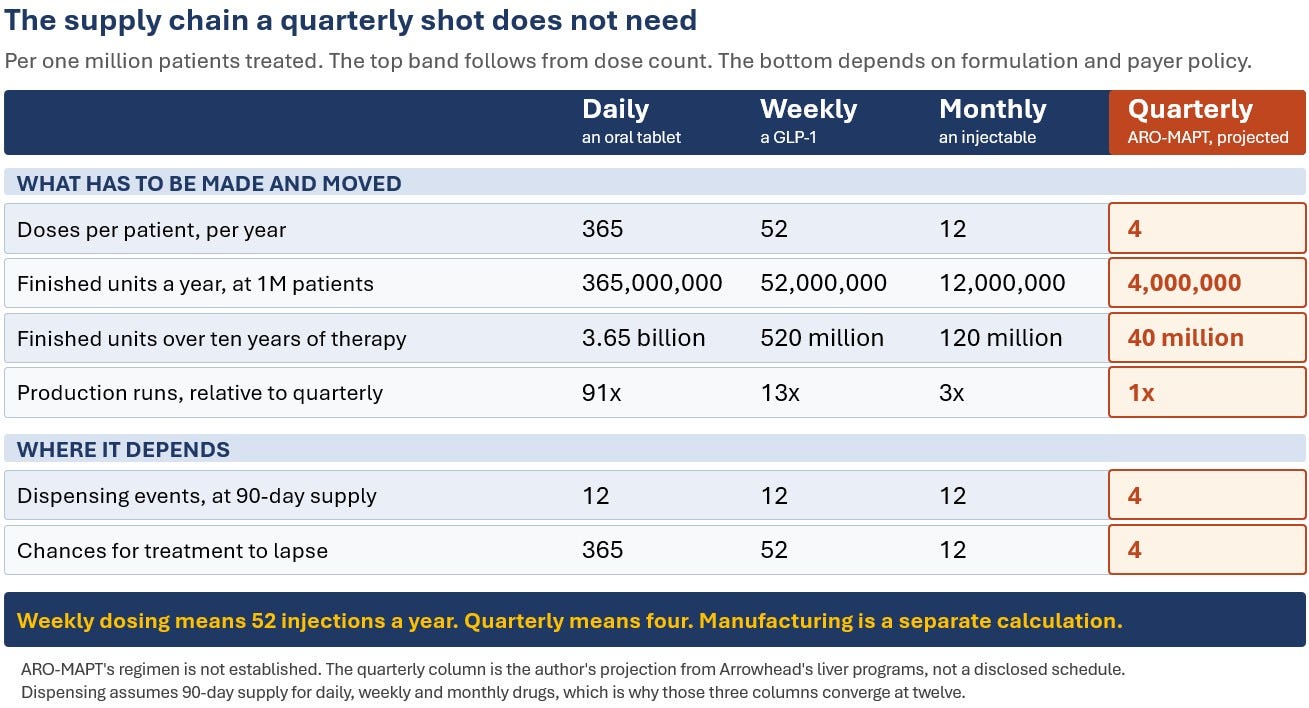
Figure 1. Per one million patients treated. Arrowhead has said the data support dosing once every three months or less frequently; the final regimen is not established.
Novo Nordisk and Lilly spent years expanding capacity while demand ran ahead of supply, across drug substance, sterile filling and devices. A weekly injection means fifty-two finished units per patient per year. A quarterly regimen means four. Production cost across different chemistries is a separate question. The number of units that has to reach patients is not.
That is the objection this argument has to clear, and it does not clear it entirely. The hard part about manufacturing siRNA at Alzheimer’s scale is that nobody has done it. Quarterly dosing leaves that question open. What it changes is the number of finished units per patient, one thirteenth as many as a weekly drug, which is a real logistical advantage even though the manufacturing problem itself stays unproven.
The advantage can run downstream, though not every cost scales directly with dosing frequency. Fewer administrations can mean fewer dispensing events and fewer shipments. Prior authorizations depend on payer policy, and cold chain, the refrigerated handling a biologic needs from the factory to the clinic, depends on formulation. The underlying point survives the qualifications: every administration is another operational step, and quarterly dosing creates far fewer of them.
Every administration is another chance for treatment to lapse. A quarterly drug creates four of those a year. A monthly drug creates twelve.
5. The patients are already there
Most launches begin with a search. The company has a drug and the patients are out there somewhere, undiagnosed or misdiagnosed or seeing the wrong specialist, and finding them takes years and consumes real money. That is what disease awareness campaigns are. They are expensive because the work is genuinely hard.
Alzheimer’s does not work that way. Roughly seven million Americans are estimated to be living with the disease. Not all of them have a formal diagnosis, and only a subset would qualify for an early-disease treatment. What Alzheimer’s already has, which a scattered rare disease does not, is a clinical ecosystem. Memory clinics, neurologists and geriatric practices are already caring for the people who would eventually qualify.
The hardest part of most launches is finding the patients. In Alzheimer’s they have been waiting in the waiting room for forty years.
A drug that measurably slowed Alzheimer’s would also be the biggest medical story in a decade. Front pages, network news, an hour of prime time. Aduhelm proves coverage is not the same as uptake, and the paper opened on exactly that. What coverage removes is a specific line item. Many launches spend heavily building awareness of a disease before they can build demand for a treatment. Nobody has to be taught to care about this one.
They are also concentrated, which is the part that decides whether a company this size can do it alone. Patients already under specialized Alzheimer’s care cluster in memory clinics, academic medical centers, movement disorder programs and large geriatric practices. That could make the initial commercial footprint manageable, even if wider adoption later needs a much larger network.
A commercial organization aimed at several hundred high-volume neurology and memory centers is far smaller than a mass-market field force. How far that network reaches depends on where eligible patients actually get treated.
The economics of building that organization may also be changing. Drug companies have used claims data, prescription analytics and physician targeting for years, so AI did not invent commercial targeting. What AI adds is the potential to do more of that work with fewer people, and to help prepare the field training, the medical information, the payer dossiers and the enormous volume of material a launch consumes far faster than a team could write it. The technology does not remove the need for a commercial organization. It may let a smaller one do more.
None of which touches the hard parts, and the distinction matters because every underpowered company in every industry is currently claiming that artificial intelligence closes the gap. A plant that makes siRNA at this scale still has to be built and inspected. Payer negotiations remain conversations between people with budgets. Promotional material still goes through medical, legal and regulatory review. AI can prepare the work. It cannot sign off on it.
The opportunity is not to replace a pharmaceutical sales force with software. It is to field a smaller one that does more than its size suggests, which is exactly what a concentrated launch into several hundred neurology centers would ask for.
Two qualifications matter here. The first is that seven million people living with Alzheimer’s is not seven million candidates for this drug. ARO-MAPT is being studied in early disease, and a label will almost certainly be narrower than the full prevalence. The second is that if ARO-MAPT requires biomarker confirmation the way Leqembi requires confirmed amyloid, part of that population needs a test first. Blood-based p-tau217 assays are making Alzheimer’s pathology easier to identify and reducing reliance on PET scans and spinal taps. Whether they would satisfy an eventual ARO-MAPT label is unknown.
The blood test is not how you find these patients. It is how you clear the ones already sitting in front of you.
6. The small diseases may hold the key
None of that requires Arrowhead to wake up one morning in 2032 and launch into seven million patients. The company would not get there in one step, and the reason is sitting in the trial registry.
On November 5th Arrowhead amended the ARO-MAPT protocol to add two more groups. Patients with frontotemporal dementia (FTD) caused by a mutation in the tau gene, and patients with progressive supranuclear palsy (PSP). Enrollment went from a hundred twelve to a hundred sixty. The amendment also excludes patients previously treated with lecanemab or donanemab, which could help keep prior anti-amyloid treatment from confounding the read on what ARO-MAPT is doing.
Those two diseases have no approved treatment. Both are orphan-sized. Both progress fast enough to offer the possibility of interpretable results on a shorter timeline, depending on trial design and enrollment. Both are treated inside specialized neurology networks that overlap with Alzheimer’s care, though how much of that infrastructure could actually be shared is uncertain.
You do not build a field force for Alzheimer’s. You build one for PSP and then point it down the hall.
That creates a possible sequence. Arrowhead could pursue an orphan indication first, if the data and the regulatory path support that order, building a specialized neurology organization around a smaller population before attempting a broader launch. If the results, the approval timing and the economics cooperate, that organization becomes the foundation the larger market inherits. The protocol amendment does not establish the plan. It makes the plan worth considering.
The bridge only works on two conditions. The orphan indications have to earn enough to carry the organization, and the specialists treating those patients have to overlap enough with the ones who would prescribe in Alzheimer’s. That depends on the size of the treatable population, the price the market bears, and the benefit Arrowhead can show. None of it is established. What is established is that Arrowhead thinks this way. On the November 12th call Chris said the company intends to build an organization that can support several products through much of the same infrastructure, and that the specialties being called on for Redemplo are the same ones it expects to engage for plozasiran in severe hypertriglyceridemia. Whether that logic extends from one liver franchise to a neurology one is the open question.
The FTD arm is doing a second job at the same time, and it is the more important one. In those patients a mutation in the tau gene causes the illness. The link between the target and the disease is as direct as it gets in neurology.
If substantial tau lowering cannot help a patient whose disease is caused by a tau mutation, the biological case for the program gets much harder to defend, though dose, timing and disease stage would all still matter. A clear result the other way would be powerful human evidence that silencing tau changes a tau-driven disease. It would not prove the Alzheimer’s case. It would make that case considerably more interesting.
Which makes the small diseases the gate as well as the training ground. They may offer the earliest read on whether suppressing tau changes the course of a disease, while building the organization a larger launch would inherit.
7. Vertex already ran this play
None of this is entirely theoretical. A company built a major franchise out of a small initial population, starting from a valuation remarkably close to Arrowhead’s today.
Vertex got Kalydeco approved on January 31, 2012. Its market capitalization closed that day at $7.7 billion. Arrowhead is worth about $7 billion. Kalydeco treated roughly a thousand patients in the United States, the ones carrying one particular mutation, at a list price of $294,000 a year. That orphan pricing is part of what made the initial commercial footprint viable, and it is an economic advantage Arrowhead would have to establish for itself.
Vertex sold it themselves. They built a commercial organization around a few thousand patients, kept it, and spent the next decade developing additional medicines that widened the franchise to most of the disease. Every expansion ran through commercial infrastructure, specialist relationships and payer experience already in place.
Vertex built its commercial organization around four percent of the disease. Then it used that same organization to reach ninety.
They are worth north of a hundred billion dollars today and they never sold the franchise. The partner they did not need was the partner everyone assumed they would have to find.
The structural resemblance is not loose. A small, concentrated patient population seen by a small number of specialists at a small number of centers. A drug nobody else had. An orphan launch a mid-cap could afford, followed by expansion into a much larger population using commercial infrastructure already in place.
Swap cystic fibrosis for tauopathies and the commercial logic starts to look familiar.
Kalydeco gave Vertex a commercial foothold it could expand from. PSP could give Arrowhead the same kind of starting point.
Two differences cut against the comparison and the paper should name them. Cystic fibrosis is treated across more than a hundred thirty accredited care centers, a network a foundation spent sixty years building, which is tighter and better organized than the network Alzheimer’s has. Vertex also had a drug that corrects the underlying defect, which makes a payer conversation very different from one about slowing decline.
8. What the GLP-1s settled
Vertex proves a small company can build a commercial organization and keep it. The obesity drugs illustrate another principle, which is that a shot under the skin can reach millions of people without anyone building a single new clinic.
Before Ozempic and Mounjaro, the received wisdom held that injectables were for specialists and serious disease, and that volume belonged to pills. Millions of people now inject themselves every week. The drugs move through retail and specialty pharmacy like any other prescription. No infusion suites were constructed. No new category of provider was invented.
The GLP-1s settled the question of whether a needle can scale. It can. Tens of millions of people are proof, and they are doing it to themselves at home.
What they settled is that subcutaneous administration can scale, not that every subcutaneous drug gets to use the same commercial model.
Two differences matter, and both could favor Arrowhead.
Administration. Subcutaneous drugs are routinely given at home. GLP-1 patients inject themselves every week. Millions of people manage Humira, Dupixent and Repatha without ever seeing a nurse. Arrowhead already sells one: Redemplo’s label says self-administered via subcutaneous injection once every three months, which is the same route and the same interval ARO-MAPT is pointed at. A quarterly injection, if the clinical program supports one, would ask far less of a patient in dosing frequency than any of those, and in Alzheimer’s there is almost always a caregiver already handling the pills, the appointments and the driving. Whether a patient, a spouse, an adult child or a visiting nurse ends up holding the syringe depends on formulation, volume, device and the eventual label.
The route makes home administration possible. The clinical program decides whether Arrowhead gets to use it. The difference matters more than it sounds: a drug given at home is a prescription and a delivery, while a drug given in a clinic is a prescription, an appointment and a trip. Appointments are where launches go to die.
The question was never whether patients can take this drug. It is whether anyone has to drive them somewhere to get it.
Obesity drugs had to prove their benefit, fight for coverage and expand access against a condition many patients are reluctant to discuss. Alzheimer’s is the diagnosis families fear most, and the demand for a drug that works has been sitting there, unanswered, since before most of the current patients were born.
Lilly had to prove the benefit, fight for coverage and build access from a standing start. Nobody has to be convinced that Alzheimer’s is worth treating.
9. They already made this choice once
The most interesting clue about the options Arrowhead is preserving for this program is what it did with the one next to it.
In 2025 Novartis paid $200 million dollars up front for a collaboration led by ARO-SNCA, Arrowhead’s Parkinson’s program. Novartis is one of the largest neuroscience organizations on earth. The relationship was established and the diligence was done, and Novartis knew the CNS platform. ARO-MAPT stayed with Arrowhead.
Arrowhead licensed Novartis its Parkinson’s program. It kept Alzheimer’s.
The terms are worth sitting with. Novartis signed in August 2025 and closed in October, paying $200 million up front with up to $2 billion in milestones behind it. ARO-SNCA was preclinical. The delivery route it depends on had never been shown to work in a human, and the history of getting oligonucleotides into the brain is a long record of failure. The first evidence that any of it works arrived on October 14, 2026, a year after the money changed hands.
A buyer who wanted certainty could have waited twelve months and paid more for a de-risked asset. Novartis paid before the data. Whatever the reason, that is not a company worried about overpaying. It is a company worried about what happens if it waits.
Two hundred million dollars before anyone knew the delivery worked is not a price on one program. It is a price on the platform.
On its own that proves little. Partnering decisions turn on valuation, timing, and which programs a partner actually wants, and MAPT in 2025 had no human data at all, which is a hard asset to price. Arrowhead may simply have been holding it until it was worth more. That reading is entirely available.
What the deal establishes is that Arrowhead licensed one CNS program and kept another. Whether ARO-MAPT was ever part of those conversations is unknown.
The sharper reading is not that Arrowhead has decided to commercialize this drug. It is that Arrowhead kept the right to decide after the human data rather than before, which is the difference between negotiating from a position and negotiating from a hope.
Chris Anzalone has also been describing the company a particular way for two years. On the Sarepta call in November 2024 he said Arrowhead could be an AND company, not an OR company. At the Bank of America healthcare conference last May he used the same phrase about the commercial build, and added that research is great but unless you can bring the medicines to patients there is no point in it.
Partner or sell is an OR. Build it and keep it is an AND. He has been telling anyone who asks which kind of company he wants Arrowhead to be.
On November 12th he went further, and about this drug. Asked where new deals might happen, Chris started with what was off the table. Redemplo he called a cornerstone of a burgeoning commercial infrastructure in cardiometabolic and beyond, and said that at least in the United States the company has no appetite to partner it. Then ARO-MAPT. He described the ability to deliver oligonucleotides to the brain as a capability of real scarcity, and said it is hard for us to imagine doing a partnership around ARO-MAPT at this point.
He named where partnering does make sense in the same answer: obesity, MASH, complement, and discovery-stage central nervous system targets, where he said there is room to do partnerships as the company has with Novartis so far. He closed by naming the two franchises Arrowhead is building, cardiometabolic and CNS.
A management eager to partner its Alzheimer’s drug does not ordinarily describe partnering it as hard to imagine, and does not call the territory around it a franchise it is building. Those are not the words of a company preparing to give away what may be its most valuable option.
10. Keep the States
Partnering is not a yes or no question, and treating it that way is how this discussion usually goes wrong. The interesting version is geographic.
Regeneron did it with Eylea. Bayer took everywhere outside the United States and Regeneron kept the American market, which is where the pricing is. Eylea became one of the largest drugs in the world, Regeneron collected the economics in the market that pays, and somebody else carried the cost of building a commercial organization in forty countries.
You do not have to choose between a partner and no partner. You have to choose which half of the map you want.
The United States accounts for a disproportionate share of global branded pharmaceutical spending, on prices generally well above what other developed markets pay. It is also the market Arrowhead could most plausibly serve directly, starting from a concentrated network of specialized neurology and memory centers rather than trying to reach every Alzheimer’s patient at launch.
Building a global commercial organization is the part a company this size would struggle to finance and execute on its own. Building an American one around a concentrated network of neurology centers is more plausible, particularly starting from a narrower population. A focused American organization may be within reach. Supplying and financing a national Alzheimer’s launch is a separate test.
Arrowhead also appears to think in exactly these terms. The credit agreement it signed on November 2nd specifically carves out the right to license plozasiran outside the United States without asking the lender. Not the right to sell the program. The right to license the rest of the world while keeping the home market.
Three weeks after the brain data read out, Arrowhead preserved the option to keep the American market and license the rest.
That is a reading, not a disclosure, and a credit agreement is written for flexibility rather than intention. A company protects options it may never exercise. What the clause does show is that Arrowhead has preserved this kind of flexibility before. The choice was never sell it or keep it. It is keep what you can serve and license the rest.
The money at stake in that choice is not small. A partner pays up front and in milestones and leaves Arrowhead a royalty on sales. Keeping the American market means retaining the product revenue, along with the commercial cost, the capital and the execution risk required to earn it. Which trade is better depends entirely on the terms offered and the odds of success.
There is a second answer to where the money comes from, and Arrowhead has been using it for years. On the November 12th call Chris described every new tissue the platform reaches as creating additional opportunities for partnerships. That sounds like an argument against this paper until you look at which programs get partnered. Muscle went to Sarepta. Lung went to Sarepta. Liver went to Takeda and GSK. The other brain program went to Novartis. The cardiometabolic franchise and MAPT stayed home.
The 10-K says the quiet part plainly: Arrowhead licenses programs it does not intend to commercialize independently, and does so to provide a source of non-dilutive capital to support its wholly owned programs through commercial stage. Sarepta paid five hundred million dollars up front and committed another two hundred fifty million in annual installments. It also bought three hundred twenty-five million dollars of Arrowhead stock, which brought in capital but was not non-dilutive. Novartis paid two hundred million. That is substantial financing raised without licensing MAPT itself. It does not establish what a national neurology launch would cost. It does show how Arrowhead has been funding the programs it intends to keep.
Partnering is not the alternative to going alone. It is how Arrowhead has been paying for it.
What matters is that Arrowhead may not have to accept those terms out of necessity. The ability to walk away has value even when the deal gets signed anyway.
The most valuable commercial asset Arrowhead may be building is not a sales force. It is a credible alternative to giving the drug away.
11. What it costs to go alone
All of that is an argument that Arrowhead could do this. None of it is an argument that doing it is free, and the bill comes due before the revenue does.
A partner writes a check at signing. Arrowhead going alone writes the checks instead, for several years, against a product that is not approved. Sales infrastructure, medical affairs, market access, distribution, inventory, the manufacturing scale-up. That spending happens while the clinical risk is still live.
A partner pays you to share the risk. Keeping it means paying for the risk yourself, in cash, years before you know whether the drug works.
The list of ways this goes wrong is not short.
Tau may not work. Lowering tau in spinal fluid is not the same as helping a patient. A string of anti-tau antibodies have engaged the target and failed to change the disease. Biogen and Ionis’s diranersen missed its primary endpoint on dose response, though secondary measures suggested possible cognitive benefit alongside substantial reductions in spinal fluid tau and tau on imaging. Biogen is advancing the program to Phase 3 regardless. That makes the biology promising rather than settled.
Payers still get a vote. Leqembi’s problem was never only the infusion chair, and the autoinjector proved it. Payers did not loosen when the drip went away. Payers restricted it, CMS wrote conditions around it, and health systems rationed access. The honest counter is that they restricted a drug whose benefit they doubted, at twenty-seven percent slowing, against brain bleeding and an infusion suite to pay for. A drug that clearly beats that, four times a year, without the same imaging burden, is a different conversation. Stronger efficacy and simpler administration would make the coverage argument considerably easier. They would not end it. Arrowhead has already built this function once, reaching a hundred sixty million covered lives in roughly a year on the least persuasive pitch in the business, a very expensive drug for a few thousand patients. Payer contracting is the hardest capability to rent, and the people who did it are employees. Chris Anzalone also called the conversion from written prescription to paid claim a chokepoint with substantial work still to do, which is a part of the Redemplo launch the chair never touched.
Manufacturing is genuinely unproven. Nobody has manufactured siRNA for millions of chronic patients. Quarterly dosing cuts the number of finished units thirteenfold against a weekly drug and leaves the production question itself exactly where it was.
Redemplo is a small sample. The entire commercial case rests on one launch, in a few thousand patients, that is still in its first year. Redemplo is the only evidence this company can sell at all, and it is thin evidence for a seven million patient claim. A cheaper Alzheimer’s launch would still be a launch on a scale Arrowhead has never attempted.
Madrigal had one asset. Madrigal put all of it into Rezdiffra, which is a different exercise from running liver, lung and central nervous system programs at the same time. Arrowhead would be building a neurology organization while funding four other franchises. Concentration is part of what made the Madrigal launch work.
The one that worries me. A company with the ability to go alone can also talk itself into going alone when a partner would have been the better trade. Independence is a position, not a virtue.
12. The question nobody is asking
The debate about ARO-MAPT has been running for a month and it has been the wrong debate. Everybody is arguing about whether tau lowering works. Almost nobody is arguing about what follows if it does.
That is backwards. The clinical question gets answered by patient outcomes, not by arguments about how far tau fell. The commercial question can be examined now, before those outcomes arrive, and it matters because a drug Arrowhead can credibly sell itself is worth more than the same drug it has no choice but to license.
If tau fails, none of this matters. If tau works, the rest of this paper is the only part still undecided.
The answer to the second question turns out to be more favorable than the conventional wisdom suggests, for reasons that start with how the drug is delivered rather than how well it works. Start with what is usually hard and here is not. Selling into Alzheimer’s begins with an existing network of memory clinics, neurologists and geriatric practices already caring for the people who may qualify. Those patients still have to be identified, tested and treated. The clinical infrastructure is already standing. No market has to be created. No demand has to be manufactured. Whether that network has the capacity to treat at Alzheimer’s scale is a separate question.
What stays genuinely hard is making the drug at scale. Quarterly dosing would cut the number of finished units that have to reach patients by more than an order of magnitude against a weekly drug, without resolving the production problem underneath. The smaller tauopathies could provide an earlier foothold, building the organization a later launch inherits. Retaining the American market while licensing the rest could keep a disproportionate share of the economics without building a global commercial operation.
The marketing may be the easy part. The hard questions are whether Arrowhead can make the drug economically, get it paid for, and build the organization before the opportunity outgrows it.
The company that did this last started from the same market capitalization and never sold its franchise. Arrowhead had Novartis across the table in 2025 and licensed them the other brain program.
The assumption was always that Arrowhead would need somebody bigger to sell this drug. The assumption was built on a molecule Arrowhead is not making.
None of which means they will go alone. A company that cannot commercialize its own drug negotiates because it has to. A company that credibly can negotiates because it chose to, and the value of that difference survives even if it signs the deal anyway. The reason everybody believes Arrowhead cannot was never about Alzheimer’s. It was about antibodies, and Arrowhead does not make those.

A Note on Supporting Independent Research
If this white paper has been valuable to you, whether it shaped your thinking, validated your conviction, or simply saved you the time of doing this work yourself, a voluntary contribution is genuinely appreciated and directly funds the next paper.
For individual investors and readers
Any amount you feel reflects the value you received is welcome and meaningful. A contribution in the range of what you might pay for a single premium research report is a thoughtful gesture that makes a real difference.
For family offices, investment funds, hedge funds, and research platforms
This paper is the caliber of work that institutional research desks bill significant retainers to produce. If your team referenced it, distributed it internally, or used it to inform a position, a suggested contribution of $1,500 reflects the professional value of the analysis, though any amount is meaningful. Your support makes it possible to continue publishing at this level without a paywall that limits the reach of the ideas. If your organization requires an invoice to process a payment, please reach out directly at bioboyscout@gmail.com and one will be provided promptly.
There is no obligation and no expectation. This is purely a thank you for work that meant something to you.
Zelle: (847) 227-7909
Thank you for reading, and for being part of a community that takes this thesis seriously.
— Robert Toczycki | BioBoyScout
Important Risks, Disclosures, & Disclaimers
The author, Robert Toczycki (aka BioBoyScout), certifies that:
all views expressed in this white paper accurately reflect his personal opinions about the topic discussed;
he was not compensated in any form for producing this white paper; and
he has not received and does not receive compensation from Arrowhead Pharmaceuticals.
This paper is provided for informational and analytical purposes only. It does not constitute investment advice, financial advice, legal advice, or a recommendation to buy, sell, or hold any security, and it is not a recommendation as to any corporate course of action. The author holds a long position in Arrowhead common stock. Past performance is not indicative of future results, and forward-looking analysis is inherently uncertain. The author and BioBoyScout are not registered investment advisors. The author assumes no obligation to update this paper. The characterization of what is and is not in the published literature, the probability judgments.
About the Author
BioBoyScout is the publishing name for Robert Toczycki, an independent biotech investment research writer based in Chicago. The BioBoyScout series publishes institutional-grade analysis of structural dynamics in RNA-class therapeutics, with particular focus on Arrowhead Pharmaceuticals’ TRiM platform and the broader competitive landscape. Robert is a registered US Patent Attorney with a JD, an Executive MBA completed at the top of his class, and a BS in Mathematics and Computer Science from the University of Illinois at Urbana-Champaign. He has a deep passion for financial analysis, particularly identifying valuation discrepancies and demonstrating them through rigorous, data-driven research and solid analytics.
Comments or questions: bioboyscout@gmail.com.
Copyright © 2026, BioBoyScout. All Rights Reserved.