

Robert Toczycki, JD, MBA
bioboyscout.com
bioboyscout@gmail.com
847.227.7909
X: @BioBoyScout
1. The problem nobody solved for thirty years
siRNA has a delivery problem, and that problem is the whole problem. The molecule works. Put it inside the right cell and it will silence the gene you aimed at, reliably, for months. Getting it inside the right cell is where the field has spent its entire existence.
Chris Anzalone described the sequence in a BioCentury interview this month, and it is worth laying out, because the public conversation treats delivery as a single step.
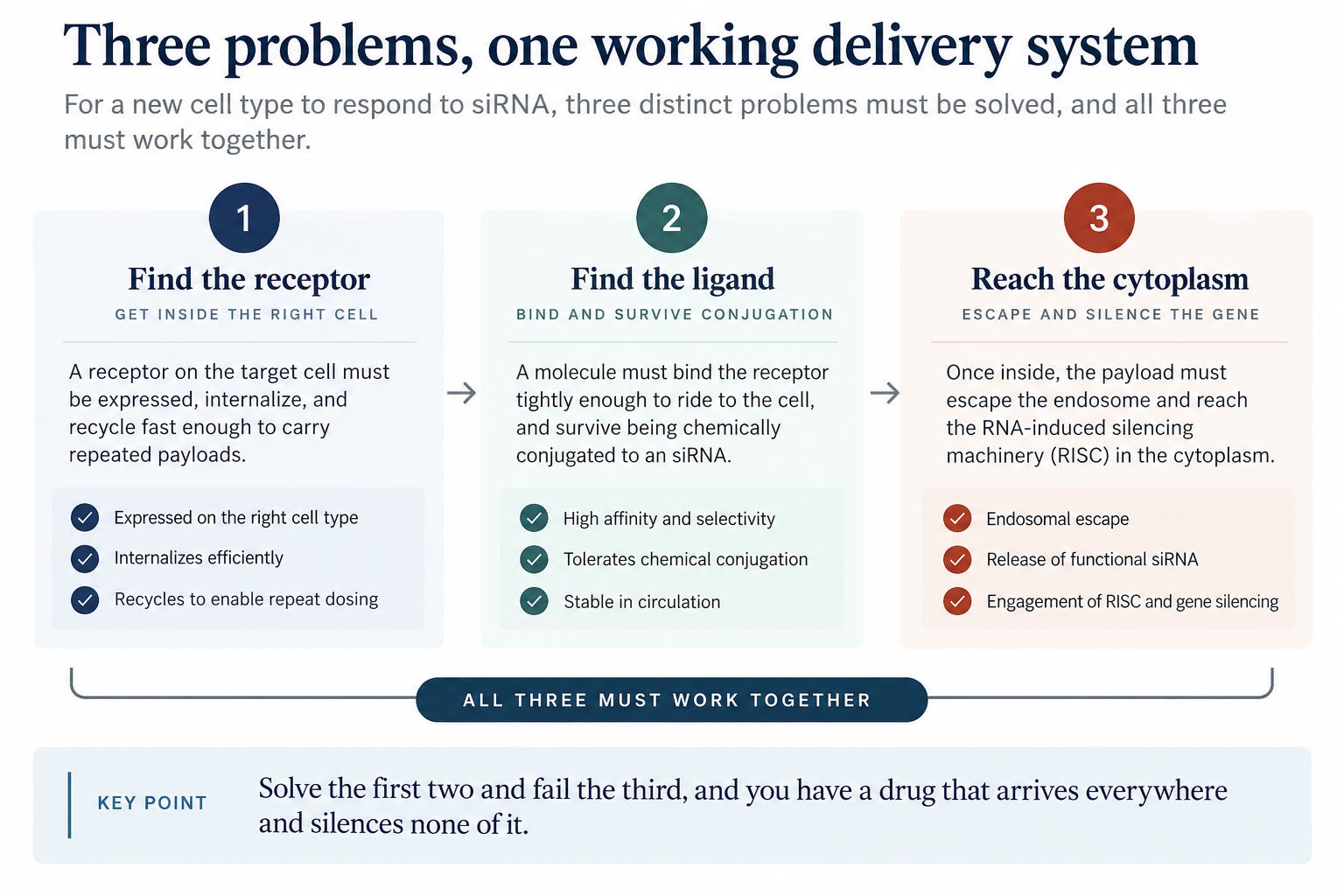
Figure 1. The three problems that have to be solved together before any new cell type opens to siRNA.
Three problems, in order. You need a receptor that sits on the cell you want, that internalizes, and that recycles fast enough to carry repeated doses. Then you need a ligand that binds it and survives being conjugated to an oligonucleotide. Then, once inside, the payload has to leave the endosome and reach the silencing machinery, because a cell is not a bag of water and concentration in a tissue is not activity in a cell.
Solve the first two and fail the third, and you have a drug that arrives everywhere and silences none of it.
The liver came first because the biology cooperated. Hepatocytes already carried a high-capacity receptor for clearing circulating glycoproteins, one that internalized and recycled efficiently. A sugar called GalNAc gave the field a way to use machinery nature had already installed. Even with that head start the field spent the better part of a decade getting from idea to approved medicine.
The liver is opening theory. The moves are published, the position at the end is known, and anybody can play it. Past the liver the book runs out.
Every organ after the liver has been found rather than followed, and the brain is the hardest of them.
That is what made October 14 worth attention. Arrowhead reported that ARO-MAPT, given under the skin on Days 1 and 15, lowered spinal fluid total tau by a mean of 73 percent at Day 105, ninety days after the second dose, with a maximum individual reduction of 85 percent. No spinal injection to deliver the drug, and no infusion into the central nervous system. Lumbar punctures were still needed to draw the samples.
That is not proof that Alzheimer’s can be treated. It is narrower and prior to it: evidence that a subcutaneously delivered siRNA can engage a target in the human central nervous system. A working delivery system is not a working medicine. Without the first there is no second.
2. What Alnylam said when somebody asked
At a roundtable this morning on Brezosiran, its intrathecally administered siRNA for Huntington’s disease (also known as ALN-HTT02), Alnylam was asked directly whether dosing into the spinal canal is a commercial problem and what the company is doing about brain shuttles.
Christi Kelsey, Senior Vice President, Value & Pipeline Commercialization at Alnylam, took the first half and gave a good answer. In Huntington’s, efficacy drives treatment decisions rather than convenience, and specialists have indicated that dosing into the spinal canal twice a year is acceptable. In a fatal disease with no approved disease-modifying treatment, she is right.
Toby Ferguson, Senior Vice President, Neuroscience Therapeutic Area Head at Alnylam, took the shuttle question. He confirmed that Alnylam is working on a number of brain shuttle platforms across its CNS portfolio, said the company would talk about those in the future when it has data to share, and framed the choice between a shuttle and an intrathecal approach as a trade-off to be weighed target by target. Then he said the present focus is establishing proof of concept with brezosiran, after which Alnylam would be well positioned to optimize from there.
Plural platforms. No publicly disclosed shuttle results. No announced timeline. A company that would very much like to tell you about this if it had a result to show.
Read that against who is saying it. Alnylam has worked on CNS delivery for years and produced the C16 conjugate, which is a real piece of chemistry and the reason brezosiran reaches the brain at all. They have the people and the money. If a subcutaneous route into the brain were solved, or nearly solved, I would expect them to be presenting it rather than deferring. That is an inference about disclosure behavior rather than a fact about their laboratory.
Alnylam is not arguing that the spinal canal is the right route for every disease of the brain. It is arguing that intrathecal dosing is workable where patients will tolerate a great deal, and building a different route for the rest.
3. What each route has actually been shown to reach
Claims about brain delivery are simple to make and hard to check. I published the map below separately last week on X; it collects what has been measured, region by region.
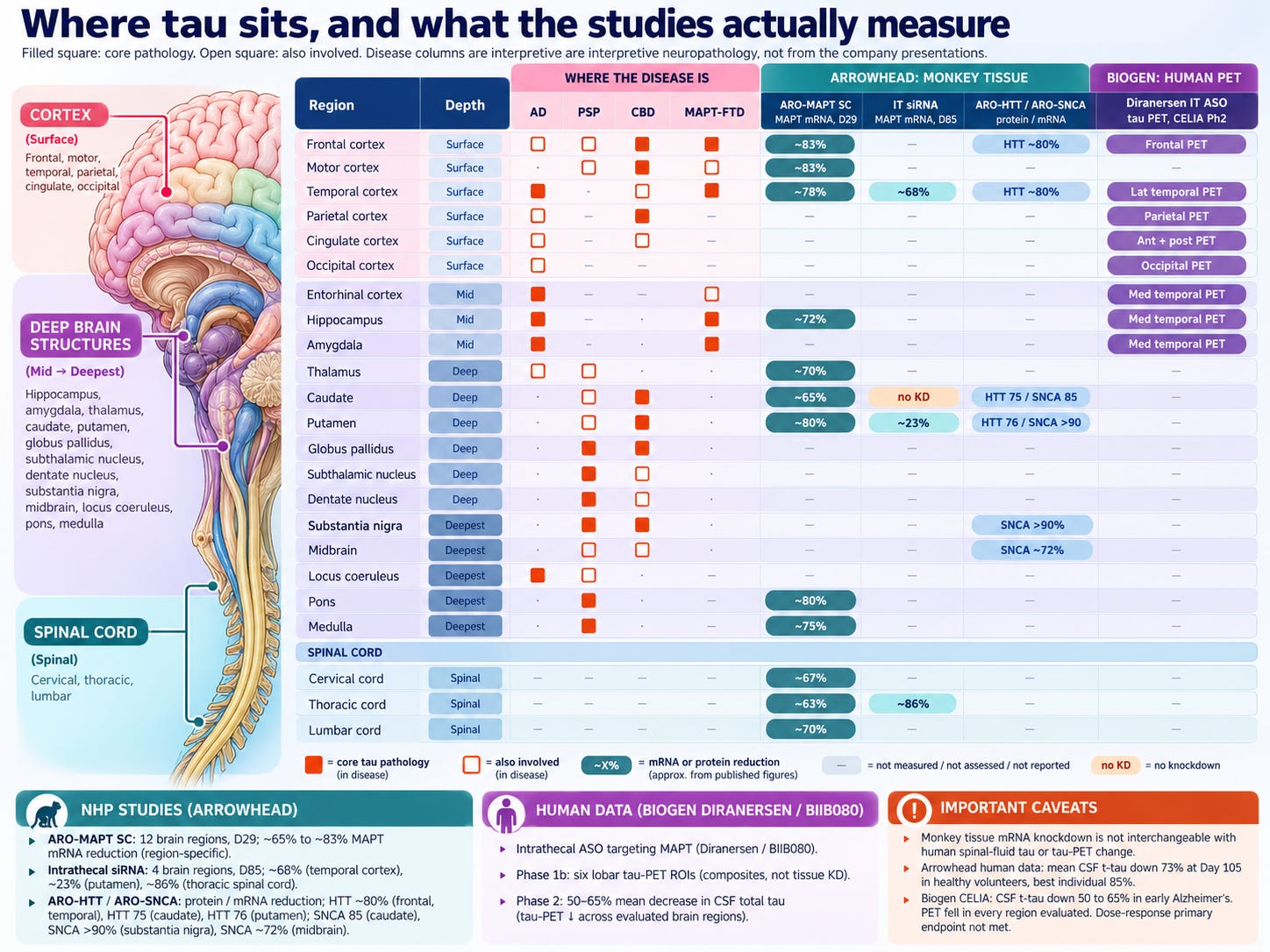
Figure 2. Regional evidence map. Tau pathology by disease against measured knockdown by route, compiled from company presentations and published releases.
One caveat before the numbers. The regional knockdown percentages all come from monkey studies, and those studies differ in target, formulation, dose and measurement method. The pathology columns describe human disease. These are not interchangeable datasets. The human ARO-MAPT result is spinal fluid tau alone, so regional uniformity in a person remains an inference from the animal work rather than an observation.
Two findings matter. Arrowhead’s subcutaneous construct reached all twelve regions it was tested in, between roughly 63 and 83 percent on charts presented at TIDES, RNA Leaders and the CNS Delivery Summit, with no depth-dependent decline across the regions measured. Its intrathecal comparator reached 86 percent in thoracic spinal cord, 68 percent in temporal cortex, 23 percent in putamen and no measurable knockdown in caudate.
That second result is a comparison between two Arrowhead formulations, not a verdict on intrathecal delivery as such, and the distinction matters. Alnylam’s own intrathecal chemistry does reach the striatum. Roughly half of huntingtin protein cleared from caudate and putamen in monkeys three months after a single dose, with cortex above eighty percent. The route is not incapable. It is uneven, and the unevenness runs the wrong way for diseases that live in deep structures.
One limitation applies to Arrowhead as much as to anybody. Spinal fluid is an imperfect guide to what is happening inside brain tissue. The animal data suggest the regional advantage. The human data establish that the delivery system is pharmacologically active. How completely those two overlap is the open question, and it is the same question every company in this paper has to answer.
4. The honest case for the spinal canal
Intrathecal delivery bypasses the blood-brain barrier by putting the drug straight into cerebrospinal fluid. It still has to penetrate brain tissue from there, and distribution is not uniform, but it avoids the problem of carrying a payload across the barrier from the bloodstream. Lower doses, less systemic exposure, and no requirement that the drug survive a trip through the circulation. Alnylam reports no dose-dependent rise in spinal fluid neurofilament and no ventricular enlargement, which were among the safety concerns that troubled earlier huntingtin programs, and up to sixty percent mean reduction of mutant protein in its Phase 1b.
That matters more than it sounds, because Alnylam’s own framing of the field’s history is that exposure-related tolerability prevented anyone from exploring deep lowering. Earlier programs ran into rising neurofilament as doses climbed. That is one ceiling earlier programs ran into, and Alnylam’s argument is that its chemistry has raised it.
Systemic delivery carries a cost that intrathecal delivery does not. A drug circulating through the body can silence its target in tissues no one aimed at. Toby Ferguson named this directly as part of the trade-off and he was right to. Arrowhead’s answer so far is healthy-volunteer safety data showing no serious treatment-emergent events and no persistent anemia. Encouraging, and not evidence of long-term safety under chronic dosing.
The strongest argument for the spinal canal is not Alnylam’s, though. It is Biogen’s.
Diranersen is an intrathecal antisense drug against the same target Arrowhead is chasing, and in July it reported Phase 2 results in early Alzheimer’s. Spinal fluid tau down 50 to 65 percent. Tau on brain scans down in every region evaluated. Twenty-six percent slowing on the clinical dementia scale at the 60 milligram dose, with larger effects on the cognitive measures.
The trial missed its primary endpoint, which was dose response, and showed no separation on daily function. That miss is worth sitting with. Higher doses did not produce greater slowing, even though tau fell substantially across the dose groups. Perhaps there is a plateau. Perhaps distribution and exposure matter more than the percentage suppressed. Perhaps the clinical differences are less reliable than they look, coming as they do from secondary analyses after a failed primary. Nobody knows. What the result does establish is that deeper biomarker lowering cannot be assumed to carry greater clinical value, and 73 percent should not be read as automatically better than 60. The efficacy question is open, and Biogen intends to advance into registrational development regardless. Set the two side by side, though, and the comparison is uncomfortable. A drug delivered by lumbar puncture has produced clinical signal in patients. Arrowhead has produced a biomarker in healthy volunteers.
Convenience is an argument about who will take a medicine. It is not an argument about whether the medicine works.
Twice a year into the spinal canal is tolerable in a fatal disease. It is a different proposition in a disease with more than seven million patients in this country alone and a community neurologists managing most of them.
5. The counterexample worth taking seriously
Receptor-mediated transport into the human brain is no longer theoretical. Denali has an approved medicine that crosses using the transferrin receptor. The approval was accelerated and rests on a spinal fluid biomarker, with confirmatory evidence still being collected, which is worth noting before anybody treats it as settled.
What that validates is the crossing, and more than the crossing. The enzyme is taken into cells and trafficked to the lysosome, where it does its work. That is a real intracellular destination. An siRNA needs a different one: it has to escape the endosome and reach the silencing machinery in the cytoplasm. That is the third problem on the list above, and it is where most of this difficulty lives. Denali proved a door opens. It did not prove an siRNA can get from the doorway to the room it needs to reach.
6. Where everyone actually stands
Five positions, and not one belongs to a company that has decided the problem is solved.
Arrowhead. ARO-MAPT is the wholly owned brain program in the clinic. Two more are there through Sarepta, one intrathecal against ataxin-2 and one subcutaneous against huntingtin. The company has said it intends to put at least four more CNS candidates into the clinic by the end of 2027. It also holds the only clinical evidence yet produced that a shot under the skin can lower a target in the human central nervous system.
Alnylam. Brezosiran in the clinic by the spinal canal, real chemistry behind it, and brain shuttle platforms in the laboratory with no publicly disclosed data and no date attached.
Novartis. NIO752, an intrathecal tau drug, is in Phase 3 for progressive supranuclear palsy, a primary tauopathy rather than Alzheimer’s. Separately, Novartis paid Arrowhead to license a subcutaneous program against alpha-synuclein. One company, both routes.
Denali. An approved medicine shows receptor-mediated delivery into the brain works for an enzyme payload. DNL628 now tests whether the same transport concept can carry a tau-lowering oligonucleotide. It is given intravenously rather than under the skin, so the burden is an infusion rather than a shot, with human biomarker data expected in the first half of 2027.
Biogen. Intrathecal tau lowering demonstrated in patients, regional reductions on tau imaging, and clinical signals that are encouraging and not conclusive. A failed primary endpoint and a stated intention to go registrational regardless. The most advanced direct comparator anybody has.
Four of the five are building or buying a way past the spinal canal. Biogen is the exception, and Biogen is the one with clinical signal. One company has shown the subcutaneous route working in a person.
7. What would change my mind
The obvious one. Alnylam presents shuttle data. They have the chemistry group and the capital, and the day they show a subcutaneous construct reaching a primate brain, the technical part of the gap starts closing. It would not close the rest of it. The distance between discovering a delivery system and developing a medicine with it is measured in clinical studies rather than laboratory announcements.
The quieter one. Arrowhead’s patient cohorts read out in 2027 and the knockdown comes in materially below what healthy volunteers showed. A diseased brain may differ in barrier integrity and in distribution, and Arrowhead has not yet reported whether the same depth and durability reproduce in patients.
The longer-term one. ARO-MAPT turns out to be the exception rather than the rule. The chemistry works for tau and proves hard to reproduce against unrelated brain targets. Endosomal escape is not a property of the delivery vehicle alone; payload, sequence and conjugate chemistry all bear on it, so success against one target does not automatically carry to the next. That would leave Arrowhead with a promising drug rather than the reusable platform the argument here depends on, and the next distinct CNS target to reach human knockdown is the proof point.
The one that matters most. Arrowhead reproduces deep tau lowering in patients and the clinical benefit proves no better than what an intrathecal competitor achieves. Delivery can be a competitive advantage without being a clinical one, and the market would then have to decide what the easier route is worth on its own.
The nearest one. Denali's DNL628 produces deep, durable tau lowering in people after intravenous dosing. That would not erase a lead in subcutaneous siRNA, and it would show that a second delivery platform reaches the same destination, which is a different kind of problem than a competitor catching up on the same approach.
8. The part that is actually hard
Two of the largest pharmaceutical companies in the world ran RNAi delivery programs and sold them after deciding not to continue the work internally. Arrowhead bought both. That is a fact about the difficulty of this problem more than about anyone’s foresight, and I have written about the strategic reading of it in my other papers.
What the last month has added is a view of where everyone else is standing.
The field is not arguing about whether to reach the brain without a spinal needle. It is arguing about who gets there first.
Alnylam has intrathecal data and shuttle platforms it has not yet shown. Novartis is paying for both routes. Denali has crossed the barrier with a different payload and is now trying it intravenously with an oligonucleotide. Biogen has a spinal-dosed drug with promising clinical evidence.
Arrowhead has what none of them has publicly demonstrated with subcutaneous siRNA: substantial target engagement in the human central nervous system.
That result is not a medicine. It is a key that turned once, in a lock no one else has opened.

A Note on Supporting Independent Research
If this white paper has been valuable to you, whether it shaped your thinking, validated your conviction, or simply saved you the time of doing this work yourself, a voluntary contribution is genuinely appreciated and directly funds the next paper.
For individual investors and readers
Any amount you feel reflects the value you received is welcome and meaningful. A contribution in the range of what you might pay for a single premium research report is a thoughtful gesture that makes a real difference.
For family offices, investment funds, hedge funds, and research platforms
This paper is the caliber of work that institutional research desks bill significant retainers to produce. If your team referenced it, distributed it internally, or used it to inform a position, a suggested contribution of $1,500 reflects the professional value of the analysis, though any amount is meaningful. Your support makes it possible to continue publishing at this level without a paywall that limits the reach of the ideas. If your organization requires an invoice to process a payment, please reach out directly at bioboyscout@gmail.com and one will be provided promptly.
There is no obligation and no expectation. This is purely a thank you for work that meant something to you.
Zelle: (847) 227-7909
Thank you for reading, and for being part of a community that takes this thesis seriously.
— Robert Toczycki | BioBoyScout
Important Risks, Disclosures, & Disclaimers
The author, Robert Toczycki (aka BioBoyScout), certifies that:
all views expressed in this white paper accurately reflect his personal opinions about the topic discussed;
he was not compensated in any form for producing this white paper; and
he has not received and does not receive compensation from Arrowhead Pharmaceuticals.
This paper is provided for informational and analytical purposes only. It does not constitute investment advice, financial advice, legal advice, or a recommendation to buy, sell, or hold any security, and it is not a recommendation as to any corporate course of action. The author holds a long position in Arrowhead common stock. Past performance is not indicative of future results, and forward-looking analysis is inherently uncertain. The author and BioBoyScout are not registered investment advisors. The author assumes no obligation to update this paper. The characterization of what is and is not in the published literature, the probability judgments, and the chess analogy are the author’s own.
The three-step delivery description is as given by Chris Anzalone in a BioCentury interview of October 16, 2026. Alnylam’s remarks and the tolerability framing are from its brezosiran roundtable of October 2026, where the slide on technical challenges in the field refers to tominersen and WVE-003 rather than to brezosiran; the brain shuttle comments are Toby Ferguson’s and the intrathecal commercial remarks are Christi Kelsey’s. Brezosiran primate and Phase 1b figures are from that same presentation. Arrowhead regional knockdown figures are from its TIDES USA 2025, RNA Leaders USA 2025 and CNS Delivery Summit presentations and the ARO-MAPT release of October 14, 2026, and are read from published charts rather than tabulated values. Denali’s approved medicine uses transferrin-receptor-mediated transport of an enzyme and is not an oligonucleotide. DNL628 is an antisense oligonucleotide on an engineered Fc fragment, given intravenously, with first patient dosed in March 2026. The regional map was published separately by the author.
About the Author
BioBoyScout is the publishing name for Robert Toczycki, an independent biotech investment research writer based in Chicago. The BioBoyScout series publishes institutional-grade analysis of structural dynamics in RNA-class therapeutics, with particular focus on Arrowhead Pharmaceuticals’ TRiM platform and the broader competitive landscape. Robert is a registered US Patent Attorney with a JD, an Executive MBA completed at the top of his class, and a BS in Mathematics and Computer Science from the University of Illinois at Urbana-Champaign. He has a deep passion for financial analysis, particularly identifying valuation discrepancies and demonstrating them through rigorous, data-driven research and solid analytics.
Comments or questions: bioboyscout@gmail.com.
Copyright © 2026, BioBoyScout. All Rights Reserved.