

Robert Toczycki, JD, MBA
bioboyscout.com
bioboyscout@gmail.com
847.227.7909
X: @BioBoyScout
1. The option that expired
For the past few years, anyone working on getting drugs into the human brain has held a free option. The option was to wait.
Not wait on Arrowhead specifically. Wait on the question. Could a drug injected under the skin cross into the brain and shut off a gene, or was that going to stay a monkey result forever? While the answer was unknown, every company with a brain program could proceed at its own pace, because a result that might have changed the whole field might equally have led nowhere.
On October 14 that option expired, because the question got answered. I wrote most of what follows in the days after, and it has had two weeks to be tested against what the rest of the field did next.
Who was holding that option, what it cost them when it expired, and the part almost nobody said out loud at the time. Some of this is now a matter of record rather than prediction, and I have marked where.
The question was open, so waiting was free. On October 14 the question closed.
2. What Arrowhead actually won
Arrowhead is the first company to show that a drug given as an injection under the skin can sharply reduce the protein output of a gene in the human central nervous system. Healthy volunteers given 12.8 milligrams per kilogram on Day 1 and Day 15 had a mean 73 percent reduction in spinal-fluid tau at Day 105, which is ninety days after the last injection. The measurement is tau protein in spinal fluid, which is the standard readout in this field and an indirect one. The cohorts are eight people each, six on drug and two on placebo, so that 73 percent is the average of six. The interim safety profile was encouraging: most reported events were mild, with no serious treatment-emergent adverse events, no discontinuations attributed to those events, and no persistent anemia or neurobehavioral adverse events.
It matters which part is first. Carrying a drug into the human brain by binding a receptor on the barrier was done before, and done well enough to win an approval. The receptor route had taken an enzyme and antibodies across. What it had never taken was a gene-silencing drug given under the skin, with knockdown to show for it. That is a real first and it is worth exactly what it says.
Worth being blunt about what the result does not show. Spinal fluid tau is an indirect readout, not a measurement of what happened inside brain tissue. The cohorts carried six people on drug. Regional distribution in a human brain, which cell types the receptor actually reaches, and whether the pathological forms of tau fall along with the total are all untested in people. Durability to Day 105 supports the idea of quarterly dosing and does not establish a maintenance regimen, nor what happens after years of repeated injections.
The human data strongly support gene silencing in the central nervous system. They do not yet show clinical benefit. Closing that gap takes more than a biomarker and more than one trial.
3. Everyone else arrives by appointment
The receptor Arrowhead uses to get into the brain is the transferrin receptor, which normally ferries iron across the barrier. Hijacking it is not a new idea, and Arrowhead is not the only company doing it.
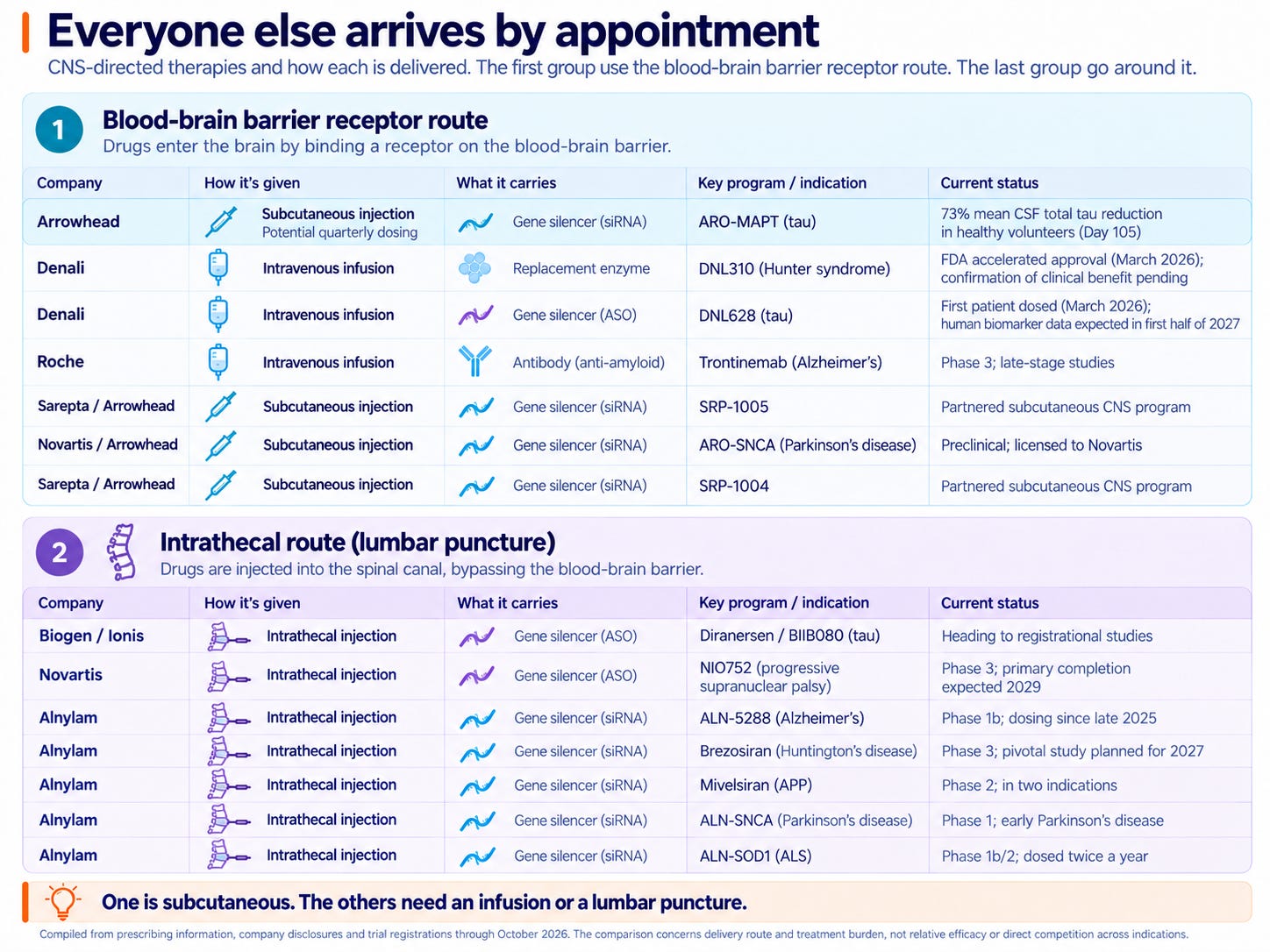
Figure 1. Compiled from prescribing information, company disclosures and trial registrations through October 2026. The comparison concerns delivery route and treatment burden, not relative efficacy or direct competition across indications.
Denali has an approved medicine that uses that receptor to carry a replacement enzyme into the brains of children with Hunter syndrome. The FDA granted it accelerated approval in March on the strength of a reduction in a spinal-fluid disease marker, which means confirmation of clinical benefit is still outstanding. It is meaningful human evidence that this receptor can deliver a payload into the brain at a dose that matters, and it arrived before today.
Denali also has a tau oligonucleotide using the same receptor. DNL628 dosed its first patient in March, is given intravenously, and expects human biomarker data in the first half of 2027. Roche has an antibody shuttle on the same receptor in Phase 3 for Alzheimer’s.
Seven others reach the brain by the older road. Biogen’s tau drug goes into the spinal canal, and so does Novartis’s, which has been recruiting a Phase 3 in progressive supranuclear palsy since June. One of Arrowhead’s own partnered programs goes that way too, SRP-1004 against ataxin-2, because the route is a choice made target by target rather than a doctrine. Alnylam goes there five times. Every clinical program in its central nervous system pipeline arrives by lumbar puncture: a tau siRNA called ALN-5288 dosing Alzheimer’s patients since late 2025, brezosiran in Huntington’s disease with a pivotal study planned for 2027, mivelsiran against the amyloid precursor protein in Phase 2 in two indications, ALN-SOD in ALS dosed twice a year, and ALN-SNCA in early Parkinson’s disease.
That last one is worth pausing on. It is the cleanest comparison in the field.
Alnylam’s ALN-SNCA and Arrowhead’s ARO-SNCA silence the same gene, alpha-synuclein, for the same disease. Same modality, same target, same biology. Alnylam delivers it through a needle in the spine and is dosing Parkinson’s patients now. Arrowhead designed its competing program for delivery under the skin and licensed it to Novartis in late summer 2025 for two hundred million dollars up front, more than a year before its platform had human validation. ARO-SNCA is still preclinical.
Two companies, one gene, two roads. One of those programs has already helped anchor a two-hundred-million-dollar upfront deal. Which road produces the better medicine is still unknown.
That comparison tells you nothing about which drug will work. Alnylam is in patients and Arrowhead is not, and ARO-MAPT is human evidence for the platform rather than for ARO-SNCA. It tells you this instead: the route was a choice, both companies made it deliberately, and only one of them now has human evidence about what that kind of choice is worth.
Denali’s approved drug is an intravenous infusion, once a week, running about four hours each time. That is a morning in a chair with a line in your arm, fifty-two times a year. Its tau program is infused. Roche’s antibody is infused. The two tau programs in the spinal canal need a lumbar puncture each time.
Arrowhead’s is a shot, and the durability data suggests it may be given four times a year. That is a difference in kind rather than in count, and the case against reading it as decisive comes later in this note.
None of that diminishes what Arrowhead reported, and the route is why. The sentence I would defend is that Arrowhead was first to show gene silencing in the human brain from a subcutaneous dose, not that Arrowhead is the only company that can reach the brain. Others got there first. They got there by appointment.
The receptor was proven before October 14. What was not proven is that you can use it with a syringe instead of an infusion chair.
4. The installed base
Treating the human brain by acting on RNA is not new. Three drugs already do it, all approved, and all delivered through a needle between the vertebrae.
What they share is the route, and the route is not a choice. These molecules are large and carry a strong negative charge, and they do not cross from the blood into the brain. Going in through the spine is not the preferred way. It is the only way that worked.
The Spinraza label spells out what that costs the patient. Five milliliters of spinal fluid are withdrawn. The drug is injected into the space around the spinal cord over one to three minutes. Loading doses first, then maintenance every four months, for life. The patients are often children.
The scale is real. Spinraza was approved at the end of 2016, more than fourteen thousand patients have been dosed with it worldwide since, and it brought in 374 million dollars in the first quarter of this year alone.
Fourteen thousand people have taken a drug that works, and the price of taking it is a needle in the spine every four months, for as long as they need it.
Now the part an investor should care about. Spinraza was the established treatment when a daily pill and a one-time gene therapy gave patients other choices, and its sales have come down from their peak since. Not every dollar of that decline belongs to the lumbar puncture, and the argument does not need it to.
The drug did not stop working. The market acquired a choice.
That is what every intrathecal program has to think about now. The question is no longer whether patients will tolerate a needle in the spine. They demonstrably will. The question is what happens when they might not have to.
5. An open line is open for both sides
The chess idea that organizes all of this is simple.
When a file or a diagonal opens in a chess game, it does not open for one player. The pawns come off and the line is simply there, available to whoever has a piece ready to occupy it. Players spend whole middlegames maneuvering to be the one with a rook pointed down the file at the moment it opens, because the opening of the line is not the achievement. Being positioned on it is.
Arrowhead opened a line on October 14. It proved, in people, that the systemic route into the brain carries a gene-silencing payload deep enough and long enough to matter. That proof cost years of work and an enormous amount of money to produce.
Every company holding a receptor-based delivery platform and a nucleic acid payload woke up on October 15 with better information than it had the day before, and none of them paid for it. One important scientific uncertainty, the one that kept boards cautious about those programs, just diminished for all of them at once.
The experiment de-risked a route, not every molecule that might someday travel it.
The proof was expensive to produce. It is free to read. That asymmetry is what to think about.
6. Why Arrowhead is still better placed than that sounds
The open-line problem is real and it is not fatal, because being positioned on a line is different from knowing the line exists.
Several advantages separate it from a company that merely knows the route works. It has the only human data showing gene silencing in the brain from this route, and data is what moves regulators and partners. It manufactures its own material, which matters in a field where chemistry, process control and reproducibility decide whether a promising construct ever becomes a scalable medicine. A shot instead of an infusion is a difference patients feel and payers eventually price. It also has two rare tauopathies already in regulatory conversations, which gives it a development path beyond Alzheimer’s, though Novartis is further along clinically in one of them.
A large partner had also committed to this platform in the brain before anyone could be sure it worked. Novartis signed a deal in late August of last year carrying a two hundred million dollar upfront payment for the alpha-synuclein program and further collaboration rights, more than a year before the human validation arrived.
The deeper advantage is less visible. A delivery platform is not one invention. It is a receptor binder, a linker, a payload chemistry, a dosing schedule, and a manufacturing process that can make it at scale without ruining it.
The binder choice alone helps decide what the product can become. Arrowhead built its construct around a receptor-binding antibody fragment rather than a whole antibody or a fusion protein. That architecture may help with a subcutaneous route, though size alone does not explain it: payload, formulation, dose and tolerability all bear on how a drug can be given. The point is narrower and more useful. Arrowhead did not find a different way to administer an existing drug. It engineered a construct meant to make systemic dosing practical.
Knowing the route works tells a competitor little of that. It tells them the destination exists.
The result is free to read and the patents are free to read too. Arrowhead has an issued patent covering specified receptor-binding antibodies and their conjugates, including the linker chemistry, plus pending applications reaching for the fragment format and the cap that stabilizes the construct.
Reading them gives nobody the right to practice them. That is what a claim is for. It is also not a wall: issued claims protect particular constructs, pending ones protect little until they issue, and a competitor can build outside them. What the estate does not do is close the route. Denali, Roche and others have their own binders and have had them for years. The protection sits around Arrowhead’s construct, not around the idea of going in this way.
Arrowhead now has clinical proof of delivery into a fifth organ system, after the liver, the lung, skeletal muscle and fat, and says it expects to reach a new cell type every eighteen to twenty-four months. On the call Chris Anzalone described the brain platform as feeling like a company’s worth of potential value on its own. That is management’s assessment rather than an independent valuation, and it captures the scale of what a buyer would be evaluating.
The lead Arrowhead holds today is technological. Whether it becomes clinical, regulatory and commercial is the work ahead.
7. Arrowhead was holding the option too
Here is what the coverage missed.
Arrowhead said publicly that if early ARO-MAPT data were encouraging, it would substantially expand its central nervous system pipeline beginning at the end of this year. That was sensible to say when the data might not arrive. That morning it became a plan with numbers on it: two clinical trial applications by year end or early next, at least three new wholly owned brain candidates into the clinic within twelve months, and another partnered candidate behind them in 2027.
Expanding a CNS pipeline means naming targets, running toxicology, building supply, and spending money, in the same window the company is commercializing Redemplo for familial chylomicronemia syndrome and preparing a supplemental application to take the same drug into severe hypertriglyceridemia.
The scientists answered their question. The finance department gets the next one.
That cuts the other way too. Every program Arrowhead adds costs money. Every potential buyer inherits a decision about whether that program deserves more.
Arrowhead is not starting from an empty treasury. At the end of June it reported roughly 1.6 billion dollars across cash, restricted cash and available-for-sale securities. The question is not how to finance the first few brain programs. It is which ones deserve the capital, how aggressively to advance them, and which ones Arrowhead should fund itself rather than partner.
That is what success looks like in this business, and I am not complaining about it. I mention it because a reader who treats the readout as pure upside will be surprised by the next earnings call. The clock that started on October 14 started for everyone, and Arrowhead is standing on the same board.
The good news and the obligation arrived in the same press release.
8. What waiting costs now
Large pharmaceutical companies can still wait. No part of a healthy-volunteer readout forces a purchase, and it puts no clock on a corporate development team.
What changed is not whether they can wait. It is what waiting costs.
Take the central nervous system expansion Arrowhead has said it intends to pursue on encouraging data. Its patent filings describe a world of possible brain targets extending well past tau, across diseases where a protein needs lowering and nobody has been able to reach it. Those disclosures are not a funded development plan. They show how broadly the company is thinking, and the decisions ahead are about which of them deserve real money.
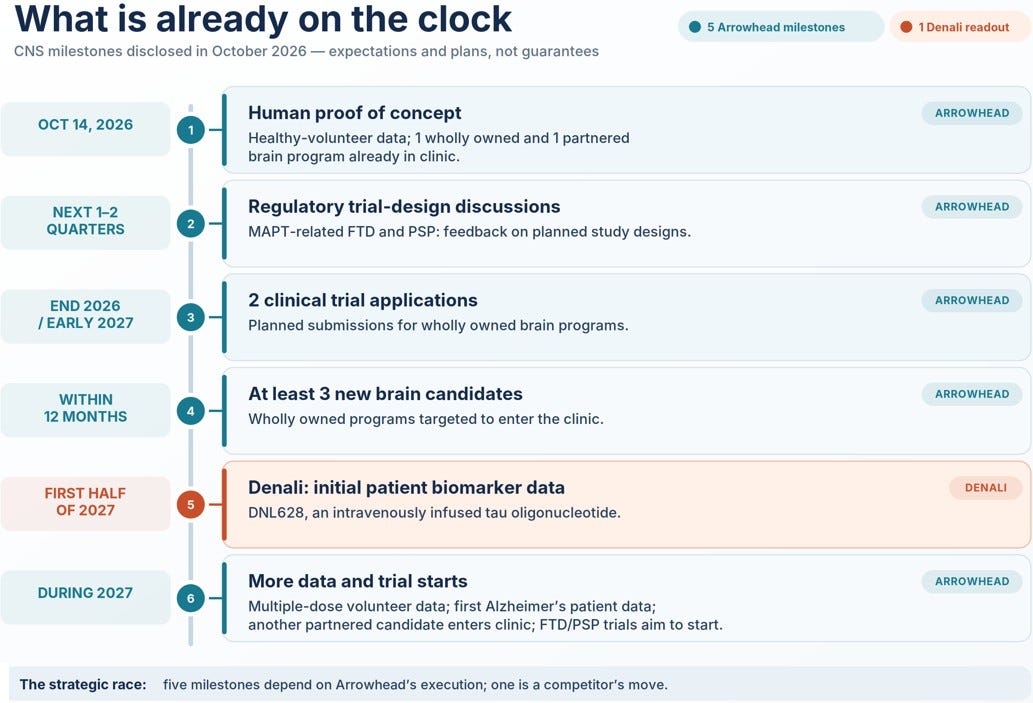
Figure 2. Compiled from Arrowhead’s October 14 presentation and webinar remarks, and from Denali’s 2026 disclosures.
Three new wholly owned brain programs are meant to enter the clinic inside a year. Two applications go in by year end or early next. Regulators are already in conversation about frontotemporal dementia and progressive supranuclear palsy, with a further one to two quarters of back and forth on trial design and studies aiming to begin in 2027. Patient data arrives that year too.
A buyer looking at Arrowhead a year from now is looking at a different company. More programs in the clinic. More capital committed. Some risk retired, some newly exposed. Whether that company is worth more or less turns on what gets proved along the way. Every favorable result retires another piece of scientific risk, and a buyer who waits for that evidence may find itself negotiating over a more valuable asset. The next result could also disappoint. That is the bargain: certainty has a value, and so does the chance to buy before certainty arrives.
The best disclosed reference point is the Novartis agreement. In the late summer of last year it committed two hundred million dollars up front for exclusive rights to Arrowhead’s alpha-synuclein program and the right to select further targets, against as much as two billion in milestones. That is not a clean price for one drug, and it should not be read as one. What it tells you is that a large pharmaceutical company was willing to commit serious capital before the central question had an answer.
That question has now been answered. Whether the next agreement commands better economics is unknown. What is not unknown is that Arrowhead walks into those conversations holding evidence it did not have when Novartis signed.
Waiting buys certainty and may cost opportunity. Moving early buys opportunity and carries the risk patient data will eventually expose. Nobody gets both the early price and the late evidence.
It is worth saying plainly when waiting stays the right call. Patient data is still ahead and could disappoint. Competing architectures are advancing on their own timelines, and a buyer that waits may find a second supplier rather than one. Arrowhead’s own spending raises what the asset costs. A large company that sits still through 2027 is not being slow. It is pricing an option that still has time on it.
There is a quieter consequence to waiting. Every program Arrowhead licenses changes what a future buyer can acquire. Exclusive development rights leave the company, while cash, milestones and royalty interests stay. Whether any given deal raises or lowers what the company is worth depends on its terms, and a buyer prices the retained economics rather than pretending they are gone. Novartis has already selected additional targets under its Arrowhead collaboration, so the portfolio available to a future buyer is changing before the next major readout.
Against that, these companies have shown how they would rather handle it. In the past two weeks Novartis committed 575 million dollars up front to license from a Chinese biotech, and Roche put up to a hundred million into an obesity program from Suzhou. Those are substantial commitments. Neither is an acquisition. Both show that a large company can buy exposure to promising science without buying the company that produced it, and the readout does not take that option away.
What may disappear is the chance to negotiate on the terms that existed before human validation. The next agreement will turn on the data, on who else is interested, and on which rights Arrowhead still controls. Nobody knows that price yet.
The option to wait still exists. Nobody gets it for free anymore.
That was the argument when this was written. Fifteen days later the largest company in RNAi made it for me, without being asked to.
On its third-quarter call, Alnylam was asked directly whether it would pursue a receptor-based approach for the central nervous system. The answer defended the spinal canal on terms worth reading closely: the company does not see intrathecal delivery as a barrier in this disease, with the infrequent administration it anticipates. Then it said that work is underway internally to find a brain shuttle that can deliver peripherally, and that an update would come in the not so distant future.
Put the two halves side by side. The defense is specific to Huntington’s disease, where patients face a fatal diagnosis and no approved disease-modifying treatment exists. The shuttle work is a platform investment, and a platform need not be limited to one indication.
A company that believes the spinal canal is the destination does not fund a way around it.
Alnylam did not say when that work began, and there is no basis for attributing it to October 14. The program may have been running for years. The two positions are not in conflict either. They are what sober portfolio management looks like when the route you have works today and another route may change the economics later. Arrowhead did not necessarily start Alnylam’s clock. It made the clock visible.
9. Who cannot wait at all
The buyers have a price problem. The programs have a different one, and theirs is harder to solve with money.
Novartis sits on both sides of the argument, which is the rarest position in this field. It holds exclusive rights to Arrowhead’s alpha-synuclein program and further collaboration targets, all built on subcutaneous delivery. It is also running its own tau silencer into the spinal canal, in a Phase 3 that has been enrolling since June, targeting three hundred patients, with primary completion expected in 2029. That is the same disease Arrowhead just told regulators it wants to enter, with a drug that would not require a lumbar puncture.
Different drugs, different proteins, but competing answers to the same question about how RNA medicine gets into the brain. Novartis is paying for both. That is an interesting place to be standing when the evidence starts to move.
The people who genuinely cannot wait are not the buyers. They are the programs that now have to explain themselves against a potentially less burdensome alternative.
October 14 did not make the existing drugs worse. It made the alternatives harder to ignore. Every future conversation about an intrathecal tau drug, with a regulator, a payer, a trial site or a patient choosing between two studies, now contains a question that did not exist on Monday. Asked about this directly, Adam Boxer said the lumbar puncture is already a barrier to enrolling patients in trials, and sometimes a barrier to a patient accepting a drug after it is approved. For inherited tauopathy families scattered across countries with thinner health systems, he said a spinal route may simply put the treatment out of reach. There is a version of this that is a shot. That question does not go away, and it gets louder with every data release from the other side.
The most interesting clinical question of the day came from Adam Boxer, the UCSF neurologist Arrowhead invited to present. Boxer knows this field from the inside, including research on Novartis’s own intrathecal tau program and disclosed paid consulting for Novartis. His question was not whether tau can be lowered. It was about what might be limiting the benefit when it is.
Boxer pointed to neurological events reported during treatment with Biogen’s drug, including confusion and falls, most often in the week following an injection, and raised the possibility that they offset some of the benefit. What caused them was left open. The procedure itself, through inflammation or otherwise? The drug? The biology of removing tau? Some combination?
If the spinal route contributes materially to those events, it may be more than a burden on patients. It may limit the benefit a drug can safely deliver.
The two readings point in opposite directions. If the route contributed materially, a subcutaneous drug offers more than convenience. It may deliver the same biology without part of the tolerability cost. If the trouble came from lowering tau itself, Arrowhead meets the same ceiling, and changing the needle does not change the target.
Boxer said plainly that the data cannot separate those explanations. Neither can I. These drugs differ in far more than the needle, in chemistry, exposure, dose and the patients who got them, so comparing separate trials cannot isolate the route. What has changed is that the question can now be put to two very different ways of reaching the same target.
Two slides later Arrowhead’s chief medical officer reported no neurobehavioral adverse events, using the same word Boxer had used. Healthy volunteers over a few months is not the same test as patients over eighteen, and nobody should pretend otherwise.
Ionis shows this better than anybody. The company has built the deepest neurology franchise in this modality, and every medicine in it arrives through a needle between the vertebrae. All three approved drugs discussed above originated with Ionis. Zanvastro, their zilganersen for Alexander disease, was approved in September 2026 and became the first neurology medicine Ionis launched on its own. Obudanersen for Angelman syndrome and ulefnersen for FUS-ALS are both in Phase 3. The tau drug with Biogen is theirs as well.
Approved medicines and a deepening clinical pipeline, built around one established route. Ionis is not standing still about it, though, and this is where the story turns.
Months before October 14, Ionis had already disclosed preclinical work on systemic delivery, including a collaboration with ABL Bio on a brain shuttle that binds the insulin-like growth factor 1 receptor rather than the transferrin receptor Arrowhead uses. Its own researchers also posted preclinical work on transferrin-receptor shuttles carrying both siRNA and antisense across the barrier after intravenous and subcutaneous dosing in animals. In monkeys, a tau-targeted construct of theirs reached better than seventy percent knockdown of MAPT across several brain regions after repeated intravenous dosing. That work is a preprint rather than a peer-reviewed paper, and none of it is human.
None of that is human validation, and none of it is a subcutaneous product. It establishes a different point. Arrowhead did not prove to the rest of the field that a second road was worth looking for. Some of them were already well down it.
A franchise built on one road is a strength. Building the second one before somebody else occupies it is how a company keeps that strength.
Which puts one line in their own annual filing in an interesting light.
Their own annual filing says they are not aware of any other medicine in clinical development for Alexander disease. That is very likely correct. Clinical competition is a snapshot, though, and the systemic delivery work now running across the industry shows how fast the picture outside that snapshot can move. The absence of a competing drug today says little about the delivery technology that might support one in a few years.
The route also keeps producing medicines. In September, Ionis and Otsuka reported positive Phase 3 results for ulefnersen in FUS-ALS, hitting a primary endpoint that combined functional impairment and survival. The spinal canal did not prevent that. Whatever systemic delivery eventually offers, convenience alone does not displace a drug that demonstrably helps people.
I should say what kind of pressure this is and is not. No trial has to be redesigned on this account, and a healthy-volunteer result does not establish a new regulatory comparator or standard of care. The pressure is on the next conversation rather than the current protocol.
The buyers can wait. The programs cannot. Sometimes both sit inside the same company, and the clock runs at different speeds in different rooms.
The strongest answer from the other side came nine days later, and it should be stated at full strength. Alnylam reported that brezosiran, delivered by lumbar puncture, lowered mutant huntingtin in spinal fluid by 60 to 64 percent at three months, with a maximum individual reduction of 83 percent, durability supporting twice-yearly dosing, and none of the three findings that ended an earlier huntingtin program. No rise in neurofilament, no inflammatory signal, no ventricular enlargement. A pivotal study follows in 2027.
In patients. For a fatal disease with no approved treatment. That is more clinically relevant evidence, because the knockdown happened in patients rather than in healthy volunteers. It is not yet evidence of clinical benefit, and it is not a basis for ranking the two drugs.
Convenience is an argument about who will take a medicine. It is not an argument about whether the medicine works.
10. The assumption inside the price
Every company running a gene-silencing drug into the spinal canal now holds an asset whose value rests on an assumption. The assumption is that the route does not matter, or that the systemic alternative will not reproduce in patients. That is a perfectly respectable position. It is also now a testable one, and it has a date attached, because Arrowhead’s patient cohorts report in 2027.
An investor holding those companies is pricing that assumption whether or not anyone has stated it. It pays to ask what has to stay true for each of these routes to hold its value.
Three assumptions hold the intrathecal position up. Each one is now testable. How much of that risk the market has already priced is a separate question.
Novartis is where the gap shows most plainly. Its Phase 3 runs to a primary completion in 2029 while it holds a license to the other route, and the assumption inside that is specific: that the first program keeps its value even if the second answer wins.
It may well. The trial may read out positive, the drug may help people, and the burden may prove irrelevant in a disease that kills within a decade. Those are the assumptions, and they are reasonable. They are also what an investor should be tracking rather than taking on faith.
The case overreaches without the other side of it, so here it is. No company owes the market an opinion on a competitor’s healthy-volunteer data. Forty-one volunteers is not a patient population, a biomarker is not an outcome, and Biogen has clinical signal in Alzheimer’s patients where Arrowhead has spinal-fluid tau in healthy people. A board that reads October 14 and concludes the route is a detail is not being dishonest. It is making a judgment.
The three, plainly. That systemic delivery will not reproduce in patients. That a lumbar puncture will not materially constrain adoption where an alternative exists. That efficacy and safety advantages will be large enough to outweigh the procedure if it does. The first begins to face a human test in 2027. The others take longer, and by the time they are answered a great deal of capital will already be committed.
The reason this matters is timing. Programs on a losing route do not get discontinued on the day the route loses. They get discontinued years later, after more capital and more patients enrolled, and the investors who exit worst are the ones who never knew which assumption they were holding.
An assumption with a date on it is not a risk until the date arrives. It is a risk the whole time.
11. What would make me wrong
The proof is narrower than the argument. Healthy volunteers are not patients, one target is not a platform, and the headline average rests on six people. The argument above assumes the route generalizes, and that has not been shown.
The competitor is closer than people think. Denali is also advancing DNL422, a systemically delivered oligonucleotide against alpha-synuclein, in IND-enabling work, so three companies now pursue that target by three competing delivery strategies. Ionis has disclosed preclinical work on systemic oligonucleotide delivery with ABL Bio using an IGF1R-targeted shuttle, and separate preclinical work of its own on transferrin-receptor shuttles.
The narrower version of that worry is the likelier one. DNL628 is expected to report human biomarker data in the first half of 2027, while Arrowhead expects patient data during that year. The order and strength of those two results could do a lot to shape how investors judge the platforms. If it comes in competitive on knockdown and tolerability, Arrowhead’s lead gets harder to define by the biomarker alone. Route, duration, brain distribution and the cost of giving the drug all move toward the middle of the comparison. A similar number in spinal fluid does not mean two drugs behave alike in the brain, and it does not mean patients experience them alike.
The open line may also be narrower than I think. Knowing a route works is a long way from working it. If Arrowhead’s specific chemistry, linker and manufacturing turn out to be the hard part, the open-line worry in Section 5 matters much less than I have made it sound.
The price argument can fail. Large companies have waited through stronger signals than this one, and no part of this forces a decision. A company spending hard on expansion can also get cheaper rather than dearer, if the market decides the spending is undisciplined. Appreciation is not urgency, and buyers have watched assets appreciate and sat still before.
More tau lowering may not be required, and nobody knows how much tau a person can spare. Boxer described early results for the Novartis drug in PSP where a far more modest reduction in spinal fluid tau came with encouraging neurofilament findings. Those are patients rather than volunteers, at different doses and times, in small numbers, so the percentages do not line up. The question does. Tau does real work in a neuron and ARO-MAPT lowers all six forms of it. Boxer called the therapeutic window the key question in the field right now, and said plainly that the Biogen results are producing questions nobody can answer yet.
Convenience is not the same as dosing frequency. Biogen studied its drug at intervals as long as twenty-four weeks. A less invasive procedure four times a year is not obviously better than a more invasive one twice.
A shot is not automatically a simple product. The dose that validated the route was substantial, and commercial development still has to solve formulation concentration, injection volume, manufacturing cost and the minimum dose that does the job. A quarterly injection that takes several syringes or carries a heavy cost of goods gives back part of the advantage the route appears to offer. The 6.4 mg/kg cohort reached a 69 percent mean reduction against 73 percent at 12.8, on different schedules, so the figures are not a controlled comparison. They are a hint that the top dose may not be the product.
The question is not how much tau Arrowhead can lower at the highest dose tested. It is how little drug it takes to matter.
The receptor may reach less of the brain than the regional data suggests. Bret Bostwick, who co-invented CNS-targeted RNA therapeutics at Alnylam, has said publicly that transferrin receptor shuttles will solve delivery for only a subset of the brain, because some cells worth targeting do not carry the receptor. Twelve regions is not every cell type inside them. If he is right, the route opens part of the brain rather than the whole of it, and the companies now looking at CD98, LRP1 and IGF1R are looking for the right reason.
The target is still unproven, though not untested. Biogen’s tau-lowering drug reduced tau on brain scans in patients and produced encouraging cognitive signals, and still missed its primary endpoint. That is more human evidence than Arrowhead has on whether lowering tau helps, and it remains unsettled. Tau genetics links strongly to the primary tauopathies and much less to Alzheimer’s, which is the reverse of where the money has gone. Failure in Alzheimer’s alone would not settle the question for MAPT-related frontotemporal dementia or progressive supranuclear palsy. If lowering tau fails across those too, this drug loses its rationale. The delivery system could still hold real value against other targets.
12. The file is open
A line opens once. After that the position is simply different, and every player on the board adjusts to a world where that line exists.
Arrowhead did the opening. It put in the years, took the risk, and produced a result that told an entire field what it did not know the day before. That deserves more credit than it will get.
One reader saw it immediately. Within an hour of the webinar, Bret Bostwick, who had co-invented CNS-targeted RNA therapeutics at Alnylam, called the durability profile best in class, named biodistribution rather than convenience as the true differentiator, and wrote that subcutaneous blood-brain-barrier-penetrating siRNA was officially validated in the clinic. A transformative milestone, he said, for the entire neurodegeneration field. He reached that judgment in sixty minutes.
One of the field’s best-placed readers called it transformative. The stock closed up 0.41 percent and the week moved on.
In the days that followed, the stock even traded below where it had closed before the data. It has since recovered. Neither movement settles the scientific argument. It is a reminder that proving a thesis and being paid for proving it are separate events, and that the second one runs on its own schedule.
The file does not belong to the player who opened it, however. It belongs to whoever has a rook on it.
Arrowhead has the only human data on this route, its own oligonucleotide manufacturing, and two rare diseases already in front of regulators. That is a reasonable claim to the file. It is not a permanent one.
The next twelve months come down to one question for Arrowhead: whether it occupies the line it opened, or simply shows everyone where it was. That is the smaller question, though, and it belongs to one company.
The larger one belongs to everybody else. A field spent thirty years treating the spinal canal as the price of reaching the brain. On October 14 that stopped being the only price. Nobody has to move. Everybody now has to explain why they are not moving, and the first company asked that question in public answered it by saying a brain shuttle is under research and an update is coming.
The file is open. Everyone can see it. The arguing from here is about who gets to stand on it.

A Note on Supporting Independent Research
If this white paper has been valuable to you, whether it shaped your thinking, validated your conviction, or simply saved you the time of doing this work yourself, a voluntary contribution is genuinely appreciated and directly funds the next paper.
For individual investors and readers
Any amount you feel reflects the value you received is welcome and meaningful. A contribution in the range of what you might pay for a single premium research report is a thoughtful gesture that makes a real difference.
For family offices, investment funds, hedge funds, and research platforms
This paper is the caliber of work that institutional research desks bill significant retainers to produce. If your team referenced it, distributed it internally, or used it to inform a position, a suggested contribution of $1,500 reflects the professional value of the analysis, though any amount is meaningful. Your support makes it possible to continue publishing at this level without a paywall that limits the reach of the ideas. If your organization requires an invoice to process a payment, please reach out directly at bioboyscout@gmail.com and one will be provided promptly.
There is no obligation and no expectation. This is purely a thank you for work that meant something to you.
Zelle: (847) 227-7909
Thank you for reading, and for being part of a community that takes this thesis seriously.
— Robert Toczycki | BioBoyScout
Important Risks, Disclosures, & Disclaimers
The author, Robert Toczycki (aka BioBoyScout), certifies that:
all views expressed in this white paper accurately reflect his personal opinions about the topic discussed;
he was not compensated in any form for producing this white paper; and
he has not received and does not receive compensation from Arrowhead Pharmaceuticals.
This paper is provided for informational and analytical purposes only. It does not constitute investment advice, financial advice, legal advice, or a recommendation to buy, sell, or hold any security, and it is not a recommendation as to any corporate course of action. The author holds a long position in Arrowhead common stock. Past performance is not indicative of future results, and forward-looking analysis is inherently uncertain. The author and BioBoyScout are not registered investment advisors. The author assumes no obligation to update this paper. The characterization of what is and is not in the published literature, the probability judgments, and the chess analogy are the author’s own.
About the Author
BioBoyScout is the publishing name for Robert Toczycki, an independent biotech investment research writer based in Chicago. The BioBoyScout series publishes institutional-grade analysis of structural dynamics in RNA-class therapeutics, with particular focus on Arrowhead Pharmaceuticals’ TRiM platform and the broader competitive landscape. Robert is a registered US Patent Attorney with a JD, an Executive MBA completed at the top of his class, and a BS in Mathematics and Computer Science from the University of Illinois at Urbana-Champaign. He has a deep passion for financial analysis, particularly identifying valuation discrepancies and demonstrating them through rigorous, data-driven research and solid analytics.
Comments or questions: bioboyscout@gmail.com.
Copyright © 2026, BioBoyScout. All Rights Reserved.