

Robert Toczycki, JD, MBA
bioboyscout.com
bioboyscout@gmail.com
847.227.7909
X: @BioBoyScout
1. Start by giving them their due
I want to be clear about something before anything else, because notes like this usually get read by people looking for a villain.
Goldman understands this company well. Plozasiran is Arrowhead’s drug for dangerously high triglycerides. Goldman expects it to reach four and a half billion dollars a year at its peak in that use alone. That is nearly a billion above the average Wall Street estimate the note itself cites, and Goldman gives it a ninety percent chance of success. They credit it with deeper triglyceride lowering and a shot every three months instead of every month. They also credit it with a cleaner liver picture, no platelet problem, a broader label in Europe, and more room for error when a patient is late for a dose.
That is not a skeptic. That is most of the case a shareholder would make, written by somebody paid to be careful.
Their obesity section is good too. They understand that the kind of weight you lose matters more than the number on the scale. They also picked up the early data from small groups of patients. Adding Arrowhead’s drug to a leading weight-loss shot roughly doubled weight loss and tripled the loss of visceral fat, the harmful fat packed around the organs.
The rating is Neutral and the target is seventy-four dollars. Goldman’s previous published target, in January, was eighty-five. The pages I reviewed do not explain the difference.
The question worth asking is not whether Goldman missed something. It is how that many favorable observations produce a seventy-four dollar target.
2. The number I cannot get past
Here is how Goldman gets to seventy-four. It builds two estimates of what a share is worth and blends them.
The first is a discounted cash flow, the standard Wall Street method. You forecast the cash a company will earn over the years, then work out what that stream of cash is worth in today’s dollars. Goldman’s comes to seventy-two dollars a share.
The second is what the note calls a theoretical acquisition value, and it comes to seventy-seven. Goldman does not call that a takeover price, and I am not going to put words in their mouth. It is their estimate of what owning the whole company is worth, and it sits only about seven percent above what they think the company is worth on its own.
Weight the first at seventy percent and the second at thirty, and you get seventy-three and a half, rounded up to seventy-four.
Now put the seventy-seven next to where the stock itself has been trading.
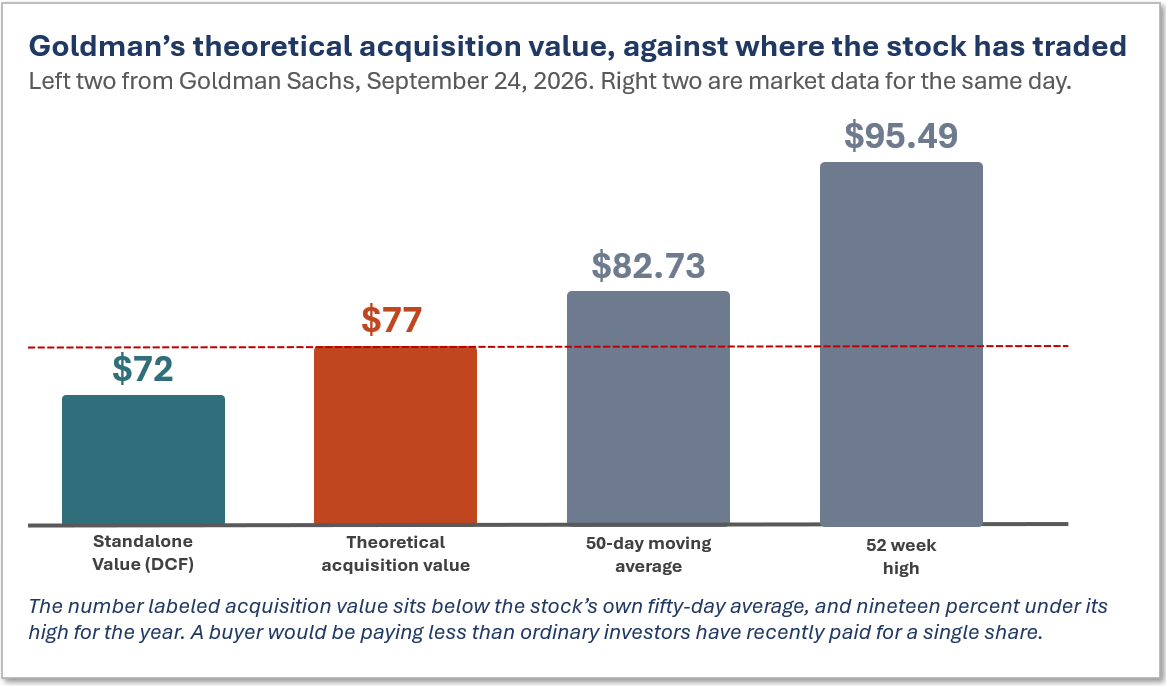
Figure 1. The first two figures are from the Goldman note. The moving average and fifty-two week high are market data for September 24.
Seventy-seven dollars is below the stock’s fifty-day moving average. It is nineteen percent under the stock’s high for the past year. Whatever the number is meant to represent, that produces an odd result. The price put on owning the entire company sits below what ordinary investors were recently paying for a single share.
That does not make a sale at seventy-seven impossible. Stocks move, and boards weigh offers against wherever the share price sits that week. It does make seventy-seven a strange stand-in for what a buyer would pay. Getting a board to say yes usually takes a meaningful premium, and seven percent over Goldman’s own standalone value is unusually thin. It is hard to imagine a banker building a recommendation around a price the stock has already traded above.
The weighting is the part I keep coming back to. The acquisition estimate gets thirty percent of the weight and moves the final target by about a dollar and a half. Thirty percent of the weight, a dollar and a half of effect.
An alternative that changes almost nothing is not much of an alternative. It is the same forecast with a different ending bolted on.
3. What a buyer would actually be buying
Nobody acquires a company only for its 2030 revenue. They acquire it for what it will still be producing in 2040, and for the ability to keep producing it.
Arrowhead has advanced drugs into human trials across five tissue types by the company’s own account, with an eye program, ARO-033, now appearing on the public trial registry as a sixth and not yet announced. Its dimer program, ARO-DIMER-PA, put two separate gene-silencing instructions on one molecule and showed both worked in humans nine days before this note was published. It also has a drug designed to reach the brain from a shot under the skin. In primate studies it spread widely through the brain and kept lowering its target long after dosing, and the first human data is due any day.
Goldman’s acquisition value comes from taking the company’s estimated 2030 sales and multiplying by eleven. A single multiple like that does not break out any of the above. Whatever credit it gives the platform is buried inside the eleven rather than attached to anything you can point to. By 2030, some of the most interesting things a buyer would be paying for may still not be revenue. They may still be capabilities.
This is the one place in a research note where a bank openly tries to price what a company is worth to someone who wants to own it. The method it reaches for cannot isolate that value.
There is a deeper problem with running the two estimates side by side, and it takes a minute to explain. Any valuation model forecasts a company’s sales for a set number of years. After that it needs one last assumption to cover everything beyond the forecast, because the company does not stop existing when the spreadsheet ends. That last piece is called terminal value, and it often makes up a large share of the answer.
Goldman’s discounted cash flow handles it by assuming the business grows three percent a year, forever, once the forecast runs out, and the note says that three percent is where the platform’s value sits. The acquisition estimate handles it by putting a multiple on one year of sales. Both rest on the same sales forecast. They are not two different views of the company. They are one view with two different endings, and they land only five dollars apart.
A second estimate built on the same forecast cannot independently pick up value that never made it into that forecast in the first place.
Which brings me back to that three percent. A platform does not behave like three percent a year forever. It behaves like nothing, nothing, nothing, then a new tissue opens and an entire family of drugs becomes possible. Goldman is not refusing to value the platform. It is valuing the platform as terminal growth, and those are not the same.
4. The rows and the gaps
Goldman’s note includes a table listing the drugs it expects to earn money from and how much each might sell. Look at what gets counted and what does not.
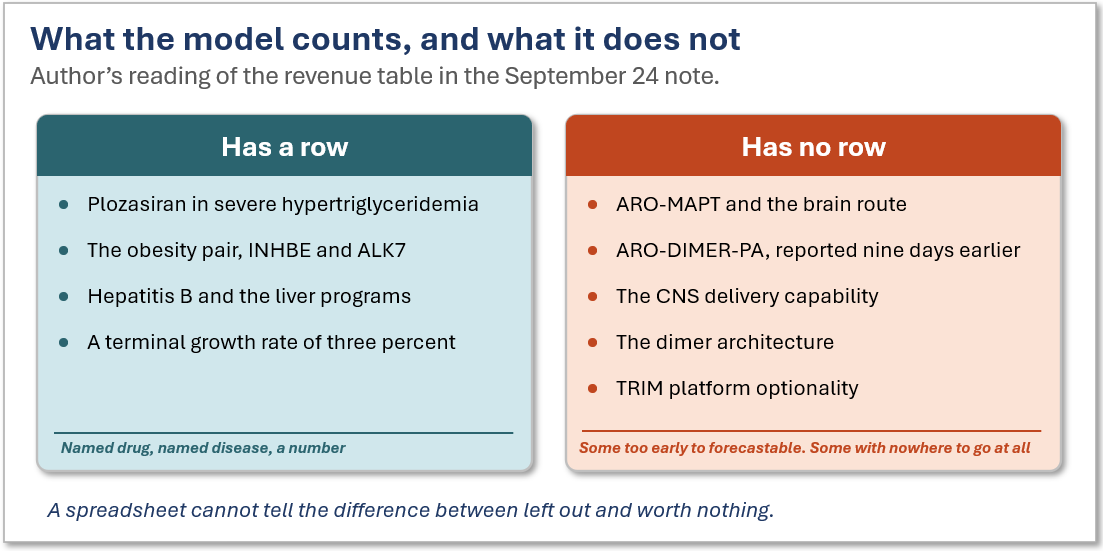
Figure 2. Author’s reading of the note. Programs may appear elsewhere in exhibits not reproduced here.
I do not think leaving out a program with no human data is a scandal. That is ordinary practice and defensible on its own terms. What is harder to defend is the pattern once you stack this note against the others.
JPMorgan put no value on the dimer in its model. Morgan Stanley published sixty dollars a share for the brain drug and then left it out of its price target, writing in plain words that it does not model the program. Now the revenue table Goldman shows has no row for the brain drug, the dimer, or the delivery technology that produced both.
Three banks, one answer. The models are not disagreeing about the science. None of them has a row for it.
5. The partnered programs, and what Arrowhead actually owns
Drugs Arrowhead shares with partners are where a table like this gets tricky, and this one deserves a closer look than it usually gets.
The hepatitis B program is licensed to GSK. Arrowhead gets milestone payments along the way and a percentage of GSK’s sales, not the sales themselves. Fazirsiran works differently again. Arrowhead and Takeda split United States profits fifty-fifty and sell it together, and outside the United States Arrowhead gets a percentage of sales that steps up as sales grow. Neither is the same as selling a drug yourself, which is what Arrowhead does with plozasiran.
The table is headed peak sales, meaning each drug’s sales in its best year. It may well be showing total worldwide sales as a starting point, with Arrowhead’s actual share worked out elsewhere in a model I have not seen. If so, no error. My point is narrower. A table that puts those three side by side without marking which dollars actually reach Arrowhead is easy to read wrong, and plenty of people will.
Olpasiran is the case worth spending a paragraph on, because everybody assumes it belongs on a list of omissions and it does not. Olpasiran is Amgen’s heart drug, built on Arrowhead’s technology. Arrowhead sold its percentage of olpasiran sales to Royalty Pharma in 2022. What it has left is milestone payments. A peak sales line for olpasiran would not represent money Arrowhead collects on sales.
There is a second reason on top of that one. Olpasiran lowers Lp(a), and so does pelacarsen, a drug Novartis has been developing. Three weeks ago Novartis reported that pelacarsen, while lowering Lp(a), missed its main goal in a heart trial of more than eight thousand patients. That raised real uncertainty about whether lowering Lp(a) with a drug will translate into fewer heart attacks and strokes. An analyst who declines to build meaningful revenue from an Lp(a) drug into the model after that result is exercising judgment.
Which is the distinction this note turns on. Leaving something out because the money belongs to somebody else, or because the evidence just turned, is judgment. Leaving something out because there is nowhere to put it is architecture.
6. Where the model is not conservative at all
Here is the part I would want a reader to hold against everything above, because it cuts the other way.
Goldman gives Arrowhead’s pair of obesity drugs, counted together, a fifty-five percent chance of success. Both are in early human trials, Phase 1 and Phase 2. Historically, drugs at that stage have succeeded far less often than that, though obesity treatment has changed so much in the last few years that old success rates deserve some caution.
Take each drug in Goldman’s table, multiply its peak sales by the odds Goldman gives it, and the obesity pair comes to roughly thirty percent of the total. That is not the same as thirty percent of the price target, and I am not going to pretend otherwise. What it does show is that Goldman is not cautious across the board. A big share of the speculative value it is willing to count sits in two early obesity programs.
If you are going to accuse a model of being too cautious about the platform, you have to say where it is being generous. This is where.
Which sharpens the point rather than blunting it. The obesity drugs are already in Goldman’s revenue table. ARO-MAPT, the brain drug, is not.
7. What would make me wrong
Three things, and I would rather put them in writing now.
The platform never pays off. If Arrowhead keeps opening new tissues but those openings keep failing to produce drugs people will pay for, the value I think the model is missing was much smaller than I thought. I was pricing a capability that never turned into money.
Goldman adds it once the evidence is in. Suppose the brain data is good and Goldman’s next note adds a line for the brain drug, with odds and a market size. That would show its model can count platform value once there is human proof. That would weaken the stronger version of my argument. Goldman would not have been unable to value it. It would have been waiting for evidence first, which is a defensible place to stand.
Obesity delivers and the target holds up. If the obesity data due at year end justifies the fifty-five percent, the generous assumption I just flagged turns out to be a good call. The model would look better than I am making it sound.
8. Counting the pieces
Early chess engines counted material. A pawn was worth one, a knight three, a rook five. Add them up and you had the engine’s verdict on who was winning. Material was countable, so material was what got counted.
What those engines were famously bad at was position. A knight planted on a square nobody could ever chase it from, a clear lane for a rook, a wall of pawns that would decide the game forty moves later. Every strong human player knew those were worth something. Nobody could say precisely how much, so the engine scored them near zero and cheerfully traded a winning position for a pawn, because the pawn came with a number attached.
The position did not stop existing because the engine could not score it. The engine simply could not see it until it turned into a piece.
A research model counts drugs. Drugs have names and markets and odds. A delivery technology that might produce drugs nobody has named yet has no square on the board.
Goldman has not missed Arrowhead’s drugs. They have the drugs, in detail, and they are more positive on the lead product than the Wall Street average they cite. What the model cannot reach is the consequence of those drugs succeeding, because that consequence is not a product. It is a capability, and capabilities do not have rows.
The seventy-seven dollar acquisition value is the tell. Asked to put an acquisition value on the company, the model reached for the only tool it had, and came back with the same company at a rounding error above where it started.
The brain data is due any day. Whatever it says, the next note will tell you something useful about all of this, because either a new row appears or it does not.

A Note on Supporting Independent Research
If this note has been valuable to you, whether it shaped your thinking, validated your conviction, or simply saved you the time of doing this work yourself, a voluntary contribution is genuinely appreciated and directly funds the next paper.
For individual investors and readers
Any amount you feel reflects the value you received is welcome and meaningful. A contribution in the range of what you might pay for a single premium research report is a thoughtful gesture that makes a real difference.
For family offices, investment funds, hedge funds, and research platforms
This paper is the caliber of work that institutional research desks bill significant retainers to produce. If your team referenced it, distributed it internally, or used it to inform a position, a suggested contribution of $1,000 reflects the professional value of the analysis, though any amount is meaningful. Your support makes it possible to continue publishing at this level without a paywall that limits the reach of the ideas. If your organization requires an invoice to process a payment, please reach out directly at bioboyscout@gmail.com and one will be provided promptly.
There is no obligation and no expectation. This is purely a thank you for work that meant something to you.
Zelle: (847) 227-7909
PayPal: paypal.me/bioboyscout
Thank you for reading, and for being part of a community that takes this thesis seriously.
— Robert Toczycki | BioBoyScout
Important Risks, Disclosures, & Disclaimers
The author, Robert Toczycki (aka BioBoyScout), certifies that:
all views expressed in this note accurately reflect his personal opinions about the topic discussed;
he was not compensated in any form for producing this note; and
he has not received and does not receive compensation from Arrowhead Pharmaceuticals.
This note is published by BioBoyScout and is intended for informational and educational purposes only. It does not constitute investment advice, a solicitation to buy or sell securities, or a guarantee of future results. The author holds a long position in Arrowhead common stock. Arrowhead Pharmaceuticals (ARWR) is a publicly traded company; investments in its shares involve material risks, including the risk of total loss. All financial projections, acquisition price estimates, and valuation analyses herein are hypothetical frameworks for analytical purposes and do not represent predictions of actual outcomes. Readers should conduct their own due diligence and consult a registered investment advisor before making investment decisions.
Figures attributed to Goldman Sachs are from its research note on Arrowhead dated September 24, 2026, as reviewed by the author. References to JPMorgan and Morgan Stanley are from their published notes of September 2026. Exhibit contents are the author’s reading of the pages reviewed and programs may appear in exhibits not examined here. Historical probability of success rates by development phase are drawn from published industry analyses. The characterization of research methodology, the interpretation of the terminal growth assumption, and the chess analogy are the author’s own and are not attributed to any analyst.
About the Author
BioBoyScout is the publishing name for Robert Toczycki, an independent biotech investment research writer based in Chicago. The BioBoyScout series publishes institutional-grade analysis of structural dynamics in RNA-class therapeutics, with particular focus on Arrowhead Pharmaceuticals’ TRiM platform and the broader competitive landscape. Robert is a registered US Patent Attorney with a JD, an Executive MBA completed at the top of his class, and a BS in Mathematics and Computer Science from the University of Illinois at Urbana-Champaign. He has a deep passion for financial analysis, particularly identifying valuation discrepancies and demonstrating them through rigorous, data-driven research and solid analytics.
Comments or questions: bioboyscout@gmail.com.
Copyright © 2026, BioBoyScout. All Rights Reserved.