

Robert Toczycki, JD, MBA
bioboyscout.com
bioboyscout@gmail.com
847.227.7909
X: @BioBoyScout
1. A number that should not be possible
At an R&D day in 2023, Chris Anzalone said something I went back and listened to twice, because the number sounded wrong. In 2017 the company had optimized its TRiM platform for liver delivery and had not yet advanced a single TRiM candidate into the clinic. By the end of 2023, six years later, it expected to have advanced eighteen.
Eighteen drugs into human studies in six years. Call it one every four months, from a company with a fraction of the people and the money that the big firms in this field have.
That was three years ago and the count has kept climbing. Chris put the number at twenty-one or twenty-two candidates in clinical studies at a conference on September 16, and the company guides to two or three new clinical programs a year. The cumulative total since 2017 is higher still, since programs have entered while some of the original eighteen finished, stopped or went to partners. I have not tried to add it up.
The clock starts in 2017 for a reason, and skipping past it would make this story tidier than it deserves to be. Arrowhead’s first delivery approach was a different chemistry entirely, and it had candidates in human trials years earlier. Those programs were discontinued in late 2016 after a safety finding in a primate study. The company then rebuilt around the platform it has now.
The eighteen were therefore not built on an unbroken run. They were built after an approach that reached the clinic had to be abandoned, which is worth remembering when reading anything about accumulated knowledge. Some of what accumulates is the knowledge of what did not work.
The standard explanation is that RNAi is somehow easier. It is not. Every one of those eighteen went through the same work any drug goes through. What changed is how much of that work had to be done from scratch. The difference is not speed. It is repetition avoided.
2. What actually happens
Start with the part everybody assumes is hardest, which is finding the molecule in the first place.
Say you want to switch off a gene. A computer reads the message that gene puts out and lists every spot along it where a short piece of RNA could grab on. For an ordinary gene that is hundreds of spots.
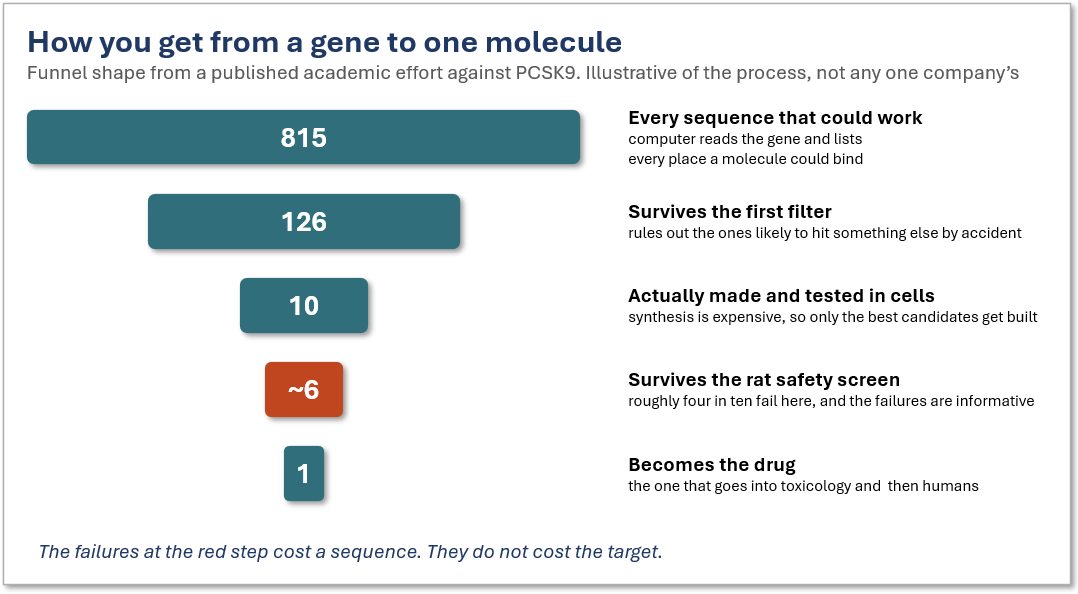
Figure 1. Funnel from a published academic effort against PCSK9, shown to illustrate the shape of the process.
Then you start throwing them out. Most get discarded because the same sequence appears somewhere else in the genome, and a drug that switches off your target plus two genes you were rather fond of is not a drug. A handful actually get built and tested in cells, because making these drugs is not cheap. The best of those go into animals.
Then comes the real filter, which is less elegant than everything before it. You give rats far more drug than any person would ever receive, and then you go look at their livers.
3. The forty percent that is not what it looks like
Alnylam has published its experience with this step. Roughly forty percent of sequences fail the rat screen, typically with liver damage showing up as elevated enzymes and dead cells under a microscope.
Forty percent sounds like a disaster. It is not, and the reason is the best thing about this whole business.
They can routinely find both toxic and non-toxic sequences against the same gene. In those experiments the damage was not generally caused by silencing the intended target. It was sequence-dependent, and came from the particular sequence hitting something it should not.
Which means the failure costs you a sequence. It does not cost you the target. You go back to your list of ten and pick another one.
Sit with that for a second, because it is genuinely unusual. In most of drug development, a toxicology failure can end the program. The molecule is the program. Here the molecule is one of several shots at the same target, and what you actually care about, the gene, is untouched by the failure.
That one property changes the whole shape of the risk. You are not betting on a molecule and hoping. You are betting on a target and running a search, and searches you can run again.
4. What gets built fresh and what gets inherited
Here is the part that actually explains the four months.
Every one of these drugs passes through the same stations. Pick the target, design the sequences, screen for what else they might hit, animal work, toxicology, manufacturing, the regulatory filing. Nobody skips any of it.
What changes is how many of those stations you have to build yourself.
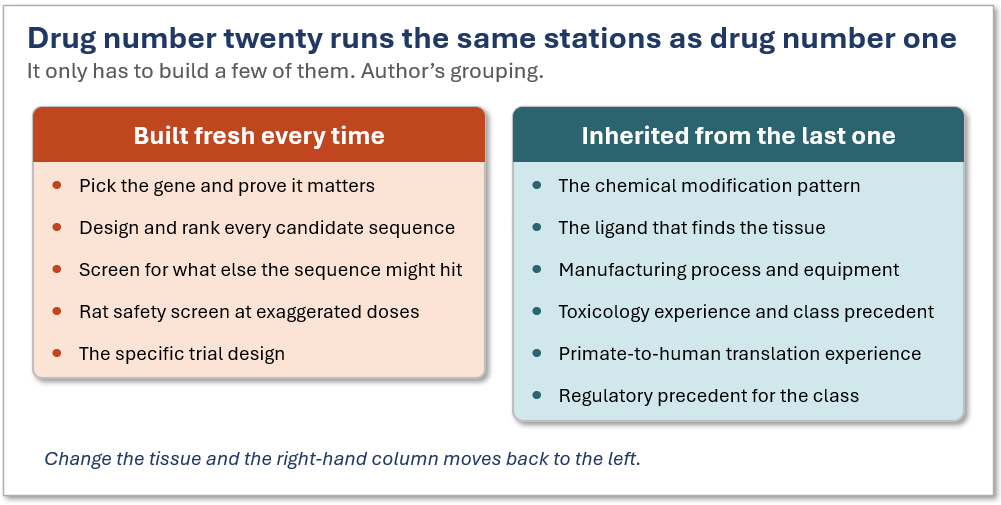
Figure 2. Author’s grouping of which development steps recur and which carry over.
The chemistry is the clearest example, and Alnylam has documented its own version of this more openly than anybody. Bare RNA falls apart in the bloodstream within minutes, so the molecule has to be armored first. Alnylam arrived at its pattern through what the literature describes as a comprehensive screening effort across both strands of the duplex, optimizing where to place each modification.
That work was enormous and it was done once. Every drug after it inherits the template. Nobody sits down and works out where the fluorines go all over again. Arrowhead runs different chemistry on a different platform, and the principle is the same. The hard optimization happens at the start and is then applied.
Same story with the piece that finds the tissue. A little cluster of sugar molecules called GalNAc latches onto a receptor that sits on liver cells and almost nowhere else. Working that out took years. The twentieth liver target does not require working it out again, because it is the same chemistry attached to a different sequence.
The platform is not a shortcut through the work. It is knowing which work does not need doing again.
Chris put it more bluntly at a conference this September, when somebody asked whether artificial intelligence lets a newcomer leapfrog a company like his. Arrowhead has made hundreds of thousands of RNAi molecules over the years, he said, and has learned a great deal about what makes some potent and some not. An engine is only as good as the data fed into it. Brute force, in his phrasing, is a hell of a thing.
There is a third category the figure above does not capture. Every so often the platform does not simply produce another drug. It acquires a capability, and the capability itself becomes inheritable.
ARO-DIMER-PA is the current example. Getting two silencing triggers onto one molecule and showing that both work in a person took years and had never been done. Arrowhead reported it on September 15. Chris said the same day that several more dimers are already in development and some should reach the clinic in 2027, including work on both of the obesity and liver targets the company has been running.
He was also unambiguous about whether it worked. The goal going in was LDL lowering in the range of the existing PCSK9 drugs and triglyceride lowering in the range of plozasiran.
His verdict on whether they got there was that they hit both in spades, which is not the language of a man hedging.
The first dimer was expensive. The ones behind it inherit what the first one paid to learn.
The output of the first program was therefore not just a drug. It was a method.
5. Nobody sets out to build a platform
Worth pausing on how a platform actually comes into existence, because the word platform suggests somebody drew it up first.
They did not. You have a drug to make. You solve the delivery problem because that drug needs solving, and the solution turns out to work for the next one. You settle the chemistry because this molecule falls apart in blood, and the pattern holds for everything after. Each piece gets built to finish a specific job, and only later does anybody notice it keeps getting reused.
A platform is not designed. It accumulates, and you find out you have one.
Which means it is a ratio rather than a status. Look back at the two columns. Five things built fresh, six inherited. Early on that split runs the other way and almost everything is bespoke, and you are a company with a drug. Somewhere along the line the right-hand column outgrows the left, and the label starts to mean something.
The efficiency lands somewhere people usually miss, too. It is not that any single drug moves faster, because Chris was not claiming that and neither am I. It is that the twentieth program asks far less of the organization than the first one did. Less bespoke chemistry, less novel safety interpretation, less arguing with a regulator about a class nobody has seen.
That is why twenty-odd programs can run at once. Not because each one is quick, but because each one costs the company less of its attention than the one before it.
A company where every program needs its own delivery system cannot carry twenty. It does not have twenty programs worth of bespoke effort to give.
Which raises the question nobody asks about platforms. If they are this useful, why does almost nobody have one?
Look at the shape of the cost. You pay for that right-hand column years before it starts paying you back, by running program after program at full bespoke price while the ratio is still pointed the wrong way. Most companies cannot survive that stretch. They run one asset, or two, and get bought or run out of money long before the inherited column outgrows the other one.
A platform only becomes cheap after you have paid for it many times over, and the paying comes first. That window is where most of them die.
Arrowhead nearly did. Nine years in, with candidates already in human trials, the whole delivery approach came apart and everything built on top of it went too. What makes the eighteen worth noticing is not only the pace. It is that they came after that.
It runs the other way too, and this part gets missed. The inherited column only grows while programs are moving through it. The first nineteen tell you how to read the twentieth. Only running the twentieth gives you something new to learn. Stop running programs and the accumulating stops with them, which makes all this a flow rather than a stock.
6. Which is why you cannot start with one
Turn that around and you get the problem facing anybody trying to enter this field now, and there are a great many of them. Chris counted roughly a dozen Chinese siRNA companies at one point, and said several are fast.
They can buy speed. What they cannot buy all at once is history. Every item in that right-hand column was paid for by somebody, and a company standing up its first program pays for all of them at once while also doing the work in the left-hand column.
The obvious objection is that the chemistry is published, and it is. Alnylam has been unusually open about where the modifications go and why. You can read it this afternoon.
What gets published is what worked. Nobody publishes the two hundred thousand molecules that did not, and those are most of the dataset.
Chris describes the accumulating end of this less delicately than I would. Fifteen years of banging their heads against the RNAi wall, in his phrase, and no substitute for history to get there.
The literature hands you the answer. It does not hand you the map of wrong answers that had to be eliminated to find it, or tell you which of your own ideas are already on that map.
I would not oversell this. A newcomer can rent manufacturing from a contract shop, license chemistry, hire people who have done it elsewhere, and patents expire on a schedule. What is hard to buy is the accumulated record of failure, and even that is a lead measured in years rather than a wall. Chris said as much himself, and the qualifier he attached to it is worth more than the claim.
7. Why the safety package moves faster
This is where the months usually disappear, so it is worth walking through.
For programs like these, reaching a person has typically required formal toxicology in two species, rats and monkeys, running about a month with a recovery period after. That does not go away.
What changes is what the findings mean. Read a published tox package for one of these drugs and the same phrase keeps turning up. The changes observed in kidney and liver were in line with previously described effects for this class. Known. Expected. Already characterized.
A regulator looking at a novel chemistry has to work out which findings matter. A regulator looking at the twentieth molecule from a characterized class is comparing against a picture they already have.
The same logic runs through the primate work. Published work suggests the mechanism producing months-long silencing is conserved across rodents, monkeys and people. That is why the monkey number tells you something useful about the human one, and it is why a company that has run the comparison twenty times has a better sense of what its primate data is worth.
8. Where the preparation runs out
None of this helps you with a new tissue, and that is where the argument stops.
Change the destination and most of the right-hand column moves back to the left. You need a new ligand, which means finding a receptor that is abundant on the cells you want and scarce everywhere else. You need to prove it carries a payload inside. You need new safety work, because the class effects you have characterized were characterized in a different organ.
Chris has put the cadence at a new cell type every eighteen to twenty-four months. Seven are addressable by the company's account, and he said in September that clinical programs were running in five. The public trial registry already shows a sixth, an eye program that the company has not yet announced. That is the number that matters for anyone thinking about how far this extends, and it is a very different number from four months.
9. An and company, not an or company
There is a wrinkle here that makes that cadence less orderly than it sounds. Arrowhead does not wait for the validating result before building what comes after it.
Chris has a phrase for this and he uses it often enough that it is plainly not improvised. Arrowhead is an and company rather than an or company.
An or company picks. An and company builds the next drug while the current one is still being tested, and finds out afterward whether it needed to.
He said it again in September, then went further. The follow-on brain programs are being built right now, without waiting to see the tau data, exactly the way the later dimers were built before the first one had reported anything.
Which means the clock on the next tissue starts before the current one is proven. The two clocks overlap rather than queue.
That is real compression, and it comes with a bill the company has already had to pay once. Developing on the assumption that a bet lands is why the pipeline fills quickly. It is also why the collapse of the first delivery approach in 2016 cost more than one program. Everything built on top of an assumption goes when the assumption does.
Four months buys you another drug. Two years or so buys you another organ, and the second one is the expensive purchase.
It is also why the brain readout carries the weight it does. Not because one Alzheimer’s drug is worth more than the others, but because opening a tissue is the slow, costly part of this business and the brain is among the hardest tissues to reach.
Chris is also clear about the shelf life of all this. Asked in September about the number of Chinese companies now working in RNAi, he said Arrowhead holds multi-year head starts across these capabilities, then added the qualifier that matters. Multi-year, not forever.
10. What the clock actually looks like
Before you look at the chart, be clear about where it comes from. Arrowhead has never published a stage-by-stage timeline and neither has anybody else here. This is my reconstruction. A few durations have published sources and are marked. The rest are my estimates, and any given program can look wildly different depending on how well understood the target already is.
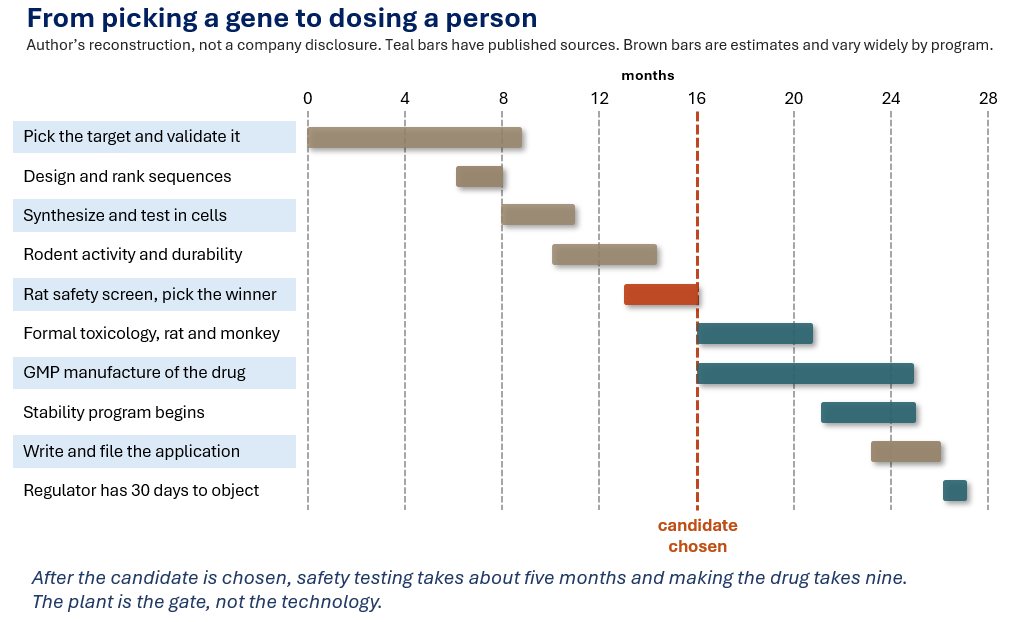
Figure 3. Author’s reconstruction, not a company disclosure. Teal bars have published sources. Brown bars are the author’s estimates. Any individual program can look quite different.
Two things jump out.
The first is that almost everything before the candidate is chosen runs in sequence. You cannot rank sequences before you have settled on the gene. You cannot test in cells until you have synthesized. You cannot run the rat screen until you have something worth screening. That whole stretch is a queue, one thing after another.
The second is what happens after. Formal toxicology and manufacturing start at the same moment and run alongside each other, because both need the same thing, which is a chosen molecule. The dosing and recovery periods are published at about three months, and call it five by the time the analysis is done. One large contract manufacturer advertises around nine months to deliver the first material made to clinical standard.
Which means the critical path between a finished candidate and a first patient can run through the manufacturing plant rather than the toxicology lab.
Treat that the way you would treat any conclusion built on estimates. It follows from the durations above, and if those are materially wrong, so is it.
That reframes a decision I have written about before. Arrowhead built its own plant in Wisconsin rather than renting capacity. Read as real estate that is a cost line. Read against this chart it is the company taking ownership of a potential bottleneck, on a platform designed to keep twenty things moving at once.
Arrowhead’s own chief medical officer handed me the limit on all of this, and I would rather quote him against my argument than tiptoe around it. Asked in September whether artificial intelligence would speed things up, James Hamilton said there is no substitute for running the clinical trial. Shaving a few months off discovery is fine, he said, but you still have to grind through every stage of development.
He is right, and it puts a fence around this entire paper. Everything described here compresses the path to the clinic. None of it compresses the path through one.
There is a harder version of that point, and it is the one I would put to myself. Eighteen candidates into the clinic is a count of entries, not of finishes. Some of those programs are no longer running. Getting to the starting line quickly and cheaply does not make a drug more likely to work once it is there, and on that question Arrowhead gets graded the same way everybody else does.
What the platform changes is how many times you get to take the test, and how early you can sit down for it. Those are worth a great deal. They are not the same as passing.
A Phase 3 cardiovascular outcomes trial takes the years it takes whether the molecule arrived in eighteen months or sixty. What the platform buys is more shots on goal and an earlier start on each. Development time cannot be recovered later, so that earlier start compounds across a pipeline.
11. Opening preparation
Chess has a version of this, and it is the closest analogy I have found to what is actually going on.
Two grandmasters sit down across from each other. Twenty moves in, one has burned four minutes on the clock and the other has burned an hour. Same board, same position, same rules. One of them prepared this line at home, knows the critical branches, and has been playing from memory. The other has been calculating.
The prepared player is not smarter and is not thinking faster. They did the work earlier, once, and are now collecting on it.
What preparation actually buys is not memorized moves. It is knowing which of the thirty legal options are worth thinking about. The unprepared player burns an hour eliminating possibilities their opponent eliminated last year.
Arrowhead is not designing drugs faster than anyone else. It is arriving at move twenty with most of the clock still on it.
Eighteen drugs in six years is what that looks like from the outside. From the inside it is a company that already answered the questions everybody else is still sitting with, and now spends its time on the handful that are genuinely new each time.
Every one of those eighteen ran the same race. Most of them started somewhere near the finish.

A Note on Supporting Independent Research
If this white paper has been valuable to you, whether it shaped your thinking, validated your conviction, or simply saved you the time of doing this work yourself, a voluntary contribution is genuinely appreciated and directly funds the next paper.
For individual investors and readers
Any amount you feel reflects the value you received is welcome and meaningful. A contribution in the range of what you might pay for a single premium research report is a thoughtful gesture that makes a real difference.
For family offices, investment funds, hedge funds, and research platforms
This paper is the caliber of work that institutional research desks bill significant retainers to produce. If your team referenced it, distributed it internally, or used it to inform a position, a suggested contribution of $1,500 reflects the professional value of the analysis, though any amount is meaningful. Your support makes it possible to continue publishing at this level without a paywall that limits the reach of the ideas. If your organization requires an invoice to process a payment, please reach out directly at bioboyscout@gmail.com and one will be provided promptly.
There is no obligation and no expectation. This is purely a thank you for work that meant something to you.
Zelle: (847) 227-7909
PayPal: paypal.me/bioboyscout
Thank you for reading, and for being part of a community that takes this thesis seriously.
— Robert Toczycki | BioBoyScout
Important Risks, Disclosures, & Disclaimers
The author, Robert Toczycki (aka BioBoyScout), certifies that:
all views expressed in this white paper accurately reflect his personal opinions about the topic discussed;
he was not compensated in any form for producing this white paper; and
he has not received and does not receive compensation from Arrowhead Pharmaceuticals.
This paper is provided for informational and analytical purposes only. It does not constitute investment advice, financial advice, legal advice, or a recommendation to buy, sell, or hold any security, and it is not a recommendation as to any corporate course of action. The author holds a long position in Arrowhead common stock. Past performance is not indicative of future results, and forward-looking analysis is inherently uncertain. The author and BioBoyScout are not registered investment advisors. The author assumes no obligation to update this paper.
Several of the load-bearing facts here come directly from Arrowhead and from its executives speaking publicly. The eighteen clinical candidates through 2023, the count of twenty-one to twenty-two candidates in clinical studies as of September 16, 2026, the cadence for opening a new cell type, the count of seven addressable cell types with clinical programs in five, the description of the company as an and rather than an or and the practice of building follow-on programs before the validating data arrives, the multi-year head start and its limits, the hundreds of thousands of RNAi molecules made to date, and James Hamilton’s point that nothing substitutes for running the clinical trial are all Arrowhead’s own statements, from a 2023 R&D day and from public appearances in September 2026.
The ARO-DIMER-PA results, the assessment of them, and the timing of the dimers behind it are from the company release of September 15, 2026 and from Chris Anzalone speaking the same week.
The sixth clinical tissue is the ocular program ARO-033, taken from its public registration on ClinicalTrials.gov under NCT07662096, which lists Arrowhead as sponsor and describes subcutaneous administration. The company has not announced it. Everything stated here about ARO-033 comes from that public registration.
Several phrases in the text are Chris Anzalone's own language from those appearances rather than mine, and their repetition here is deliberate: brute force is a hell of a thing, banging their heads against the RNAi wall, no substitute for history, in spades, an and rather than an or, and multi-year, not forever.
What is not Arrowhead’s. The sequence funnel numbers come from a published academic program against PCSK9 and illustrate the shape of the process rather than any one company’s. The attrition rate, the toxicology findings and the chemistry descriptions are drawn from the published literature, much of it Alnylam’s. The manufacturing duration is one contract manufacturer’s advertised figure. The grouping of which development steps recur is the author’s own, and so is the development timeline, including the sequence of stages, which run in parallel and how long each takes. Arrowhead has not published a stage-by-stage timeline. None of that chart should be read as company guidance, as a description of any specific Arrowhead program, or as a forecast of how long any future program will take.
About the Author
BioBoyScout is the publishing name for Robert Toczycki, an independent biotech investment research writer based in Chicago. The BioBoyScout series publishes institutional-grade analysis of structural dynamics in RNA-class therapeutics, with particular focus on Arrowhead Pharmaceuticals’ TRiM platform and the broader competitive landscape. Robert is a registered US Patent Attorney with a JD, an Executive MBA completed at the top of his class, and a BS in Mathematics and Computer Science from the University of Illinois at Urbana-Champaign. He has a deep passion for financial analysis, particularly identifying valuation discrepancies and demonstrating them through rigorous, data-driven research and solid analytics.
Comments or questions: bioboyscout@gmail.com.
Copyright © 2026, BioBoyScout. All Rights Reserved.