

Robert Toczycki, JD, MBA
bioboyscout.com
bioboyscout@gmail.com
847.227.7909
X: @BioBoyScout
1. What happened
Novartis announced this afternoon that its big Lp(a) trial failed. Across 8,323 patients with established cardiovascular disease and high Lp(a), pelacarsen failed to reduce the combined risk of cardiovascular death, heart attack, stroke and urgent coronary procedures versus placebo.
Read the next sentence of their release carefully, because it is the whole story. Lower Lp(a) levels were achieved with pelacarsen.
The drug did exactly what it was designed to do. It lowered the thing. Lowering the thing did not improve outcomes in the overall study population.
2. Why this is a hypothesis failure and not a modality failure
The distinction matters and it is going to get blurred in the coverage over the next few days.
Pelacarsen is an antisense drug, which is a different chemistry from Arrowhead’s RNAi but aimed at the same job of silencing a gene’s message. Ionis discovered it and licensed it to Novartis. Nothing here says either chemistry is broken. The molecule got to the liver, reduced production of apolipoprotein(a) and kept Lp(a) low in thousands of people for years.
What failed is narrower than the target itself. HORIZON refuted the proposition that the depth and duration of Lp(a) lowering pelacarsen achieved, in this treated secondary prevention population, produces a detectable cardiovascular benefit. That is a specific claim and it is now dead. Whether Lp(a) is a viable target at all is a wider question this trial does not fully settle.
Twenty years of genetic evidence said Lp(a) causes cardiovascular disease. That evidence appears to have been right about causation and wrong about reversibility, at least in this population and at this level of lowering.
Genetics measures what happens to somebody who carries elevated Lp(a) from birth. HORIZON asked something different. It asked whether lowering it late, after atherosclerosis is already built and while statins and blood pressure drugs are doing their work, undoes enough of that accumulated history to change what happens next.
Those are not the same experiment, and causation does not guarantee reversibility. The industry has spent a long time treating them as though it did.
3. What it costs Arrowhead directly
Olpasiran is Arrowhead’s own Lp(a) drug. Arrowhead built it and licensed it to Amgen back in 2016, and Amgen is now running OCEAN(a)-Outcomes, which tests the same idea with Arrowhead’s chemistry instead of Ionis’s.
The economics are less exposed than they look, because of a decision made four years ago.
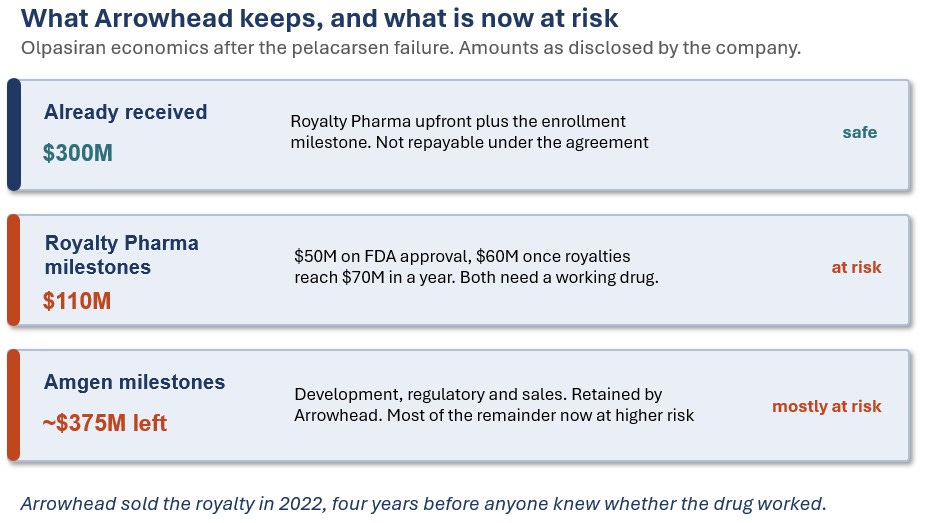
Figure 1. Amounts as disclosed in company filings and the November 2022 agreement.
In November 2022 Arrowhead sold its entire olpasiran royalty interest to Royalty Pharma for $250 million in cash, plus up to $160 million in milestones payable back to Arrowhead. The first of those, $50 million on completion of OCEAN Phase 3 enrollment, was collected in 2024.
That means $300 million has been received. The filings state plainly that Arrowhead is not obligated to repay it.
What is now in doubt is the remaining $110 million from Royalty Pharma, since both remaining triggers require an approved and selling drug, and much of the roughly $375 million in Amgen milestones still outstanding, particularly the regulatory and sales portions, which Arrowhead retained when it sold the royalty.
Arrowhead sold a royalty stream in 2022 for $250 million it never has to give back, four years before anybody knew whether the drug worked. Royalty Pharma bought the risk. This afternoon that looks like one of the better capital allocation decisions this management team has made.
I would not oversell it as foresight. Monetizing a partnered royalty to fund your own pipeline is a reasonable thing to do regardless of how the trial turns out. The trade was available to be made badly, though, and it was not made badly.
4. What happens to OCEAN(a)
Amgen almost certainly finishes. Enrollment closed in 2024, the trial runs to roughly seven thousand patients, it is event-driven, and the money is spent. Companies do not stop trials at this stage because a competitor missed.
The probability of success dropped hard this afternoon, though, and anyone telling you otherwise is selling something.
OCEAN(a) is not a carbon copy, and the differences deserve a fair hearing. It enrolled 7,297 patients at a higher Lp(a) threshold. Olpasiran produces substantially deeper suppression, above 95 percent at the higher doses in Phase 2 against roughly 80 percent for pelacarsen. Its primary composite is not identical to HORIZON. Novartis also wrote that the findings did not demonstrate reduced risk in the overall study population, which leaves the prespecified 90 mg/dL subgroup unaddressed.
Those differences are enough to keep the experiment worth running. They are not enough to pretend the prior probability has not moved. The surviving argument is that the effect needs sicker patients or deeper suppression than pelacarsen delivered, which is not absurd and is also what every program in this position says. I would want the subgroup data from the congress before giving it much weight.
5. The part that matters more than the money
Set the milestones aside. They are small against a twelve billion dollar company.
What happened this afternoon is the most expensive demonstration available that moving a biomarker is not the same as helping a patient.
Eight thousand three hundred and twenty-three people. Years of follow-up. A drug that unambiguously lowered the marker it was built to lower, in a target with two decades of human genetic evidence behind it, in a population where the marker is present in roughly one person in five. Then no demonstrated benefit.
Chess has a word for this. A refutation is a concrete demonstration that a line which looked perfectly sound actually loses. It does not mean the opening is bad or the pieces are wrong. It means that particular sequence has been worked out to the end and does not hold. Theory gets rewritten and everybody stops playing it.
This version of Lp(a) lowering was theory. Eight thousand patients was the refutation. The pieces are fine. That line is not.
6. What this should do to how you read September
Arrowhead reports first human data on ARO-MAPT at the end of this quarter or early next. The number everybody will trade on is tau reduction in cerebrospinal fluid.
That number tells you the drug got where it was going and reduced production of the protein it was built to target. That would demonstrate something RNAi has not previously established clinically, which is systemic delivery to the human central nervous system from a simple shot under the skin.
It is also exactly the kind of number pelacarsen produced.
I wrote earlier this week that a drug readout updates the probability of one drug while a platform readout updates the probability of drugs that do not exist yet. Both of those are still true. What this afternoon adds is the other half of the same idea. A biomarker readout establishes target engagement, not patient benefit, until somebody connects the two.
That connection is exactly what CELIA has begun to suggest for tau without yet establishing it. Diranersen lowered cerebrospinal tau by 50 to 65 percent and produced a clinical signal, and it missed its primary dose-response endpoint because higher doses did not produce greater benefit. For neurofilament in ALS, the FDA accepted a reduction as reasonably likely to predict clinical benefit, which is a regulatory judgment rather than a proven link. For Lp(a), Novartis has just spent eight thousand patients failing to establish that connection in the overall population.
If September delivers deep tau knockdown, that is a delivery result and it is worth a great deal to the platform. It is not, by itself, evidence that ARO-MAPT helps anybody with Alzheimer’s disease. Today is a reminder of how expensive it is to learn the difference.
7. Where that leaves things
For Arrowhead, a modest financial hit against milestones that were never in the base case, and a partnered program whose odds just got materially worse.
For Ionis, a harder afternoon. They lose the pelacarsen economics on top of already competing against plozasiran in severe hypertriglyceridemia.
For Novartis, worth watching. They face the largest patent expiry in their history and just lost a cardiovascular asset that was meant to help fill it. That does not reduce their need to buy something. It sharpens it.
For anybody holding this stock into a first-in-human CNS readout, a well-timed reminder that the number in the headline and the question that matters are not always the same number.

A Note on Supporting Independent Research
If this white paper has been valuable to you, whether it shaped your thinking, validated your conviction, or simply saved you the time of doing this work yourself, a voluntary contribution is genuinely appreciated and directly funds the next paper.
For individual investors and readers
Any amount you feel reflects the value you received is welcome and meaningful. A contribution in the range of what you might pay for a single premium research report is a thoughtful gesture that makes a real difference.
For family offices, investment funds, hedge funds, and research platforms
This paper is the caliber of work that institutional research desks bill significant retainers to produce. If your team referenced it, distributed it internally, or used it to inform a position, a suggested contribution of $1,500 reflects the professional value of the analysis, though any amount is meaningful. Your support makes it possible to continue publishing at this level without a paywall that limits the reach of the ideas. If your organization requires an invoice to process a payment, please reach out directly at bioboyscout@gmail.com and one will be provided promptly.
There is no obligation and no expectation. This is purely a thank you for work that meant something to you.
Zelle: (847) 227-7909
PayPal: paypal.me/bioboyscout
Thank you for reading, and for being part of a community that takes this thesis seriously.
— Robert Toczycki | BioBoyScout
Important Risks, Disclosures, & Disclaimers
The author, Robert Toczycki (aka BioBoyScout), certifies that:
all views expressed in this white paper accurately reflect his personal opinions about the topic discussed;
he was not compensated in any form for producing this white paper; and
he has not received and does not receive compensation from Arrowhead Pharmaceuticals.
This paper is provided for informational and analytical purposes only. It does not constitute investment advice, financial advice, legal advice, or a recommendation to buy, sell, or hold any security, and it is not a recommendation as to any corporate course of action. The author holds a long position in Arrowhead common stock. Past performance is not indicative of future results, and forward-looking analysis is inherently uncertain. The author and BioBoyScout are not registered investment advisors. The author assumes no obligation to update this paper. Lp(a)HORIZON details are from the Novartis release of September 4, 2026. Olpasiran deal terms are from the November 2022 Royalty Pharma agreement and Arrowhead's subsequent quarterly filings. Full Lp(a)HORIZON results have not been presented and the analysis here is based on topline disclosure only.
About the Author
BioBoyScout is the publishing name for Robert Toczycki, an independent biotech investment research writer based in Chicago. The BioBoyScout series publishes institutional-grade analysis of structural dynamics in RNA-class therapeutics, with particular focus on Arrowhead Pharmaceuticals’ TRiM platform and the broader competitive landscape. Robert is a registered US Patent Attorney with a JD, an Executive MBA completed at the top of his class, and a BS in Mathematics and Computer Science from the University of Illinois at Urbana-Champaign. He has a deep passion for financial analysis, particularly identifying valuation discrepancies and demonstrating them through rigorous, data-driven research and solid analytics.
Comments or questions: bioboyscout@gmail.com.
Copyright © 2026, BioBoyScout. All Rights Reserved.
Thank you for the great write up