

Robert Toczycki, JD, MBA
bioboyscout.com
bioboyscout@gmail.com
847.227.7909
X: @BioBoyScout
1. What was actually new
The headline numbers came out on July 22. Triglycerides down 79 and 81 percent in the two studies, pancreatitis events down 78 percent, both trials hitting every goal they had set. The market has had six weeks to think about that.
Sunday added what a press release cannot fit. Who the patients were. What happened to them month by month. Which side effects showed up and how often. The details behind the averages.
Buried in there is one chart that changes how you should read the whole program, and I have not seen anyone write about it yet.
2. The chart that matters
Patients got four injections, spaced three months apart, at Months 0, 3, 6 and 9. The trial then measured its main result at Month 12.
Sit with that timing for a moment. Month 12 is three months after the last shot. That is the point in the cycle when the drug has had the longest time to wear off, in the fourth cycle of the year, when any accumulating problem would have shown up.
It is, in other words, the point in the dosing cycle where you would expect the drug to look its weakest.
Every drug looks good right after you take it. The question that decides whether a once-every-three-months schedule actually works is what the patient looks like just before the next injection is due.
Here is the answer. At Month 10, triglycerides were down 84 percent in both studies. At Month 12, they were down 79 and 81 percent.
Roughly four points given back from Month 10 to Month 12, as patients reached the end of the three-month dosing interval in the fourth cycle of treatment. That is not meaningful wear-off. That is a remarkably flat curve through the end of the quarter.
That number does real work, because olezarsen is injected monthly. Twelve shots a year against four.
Before Sunday, the advantage of quarterly dosing was mostly a convenience argument, and a slightly hand-wavy one, since nobody had shown what happens at the end of the quarter. After Sunday, the durability needed to support that schedule is demonstrated. The drug holds at the exact point in the interval where meaningful waning should have been easiest to see.
3. Head to head with olezarsen
One fact has to sit underneath this entire comparison. Olezarsen was approved by the FDA for severe hypertriglyceridemia on June 24, six days ahead of its June 30 decision date. It is on the market for this condition right now, and any read of the SHASTA data that skips that is incomplete.
A caution goes with it. These two drugs have never been tested against each other. Everything below compares separate trials, run in somewhat different populations, and olezarsen measured its main result at six months where plozasiran measured at twelve. The gaps are large enough to be informative. They are not head-to-head evidence.
How do the two drugs actually stack up?
Triglyceride lowering: plozasiran, and it is the consistency that stands out. Olezarsen ran two pivotal trials as well. In the first, its two doses lowered triglycerides 63 and 72 percent more than placebo. In the second, the same two doses managed 49 and 55 percent. Plozasiran produced 79 and 81 percent across its two trials.
Look at what happened to olezarsen’s higher dose between studies: 72 percent, then 55 percent. That is a seventeen-point swing in the same drug at the same dose. Plozasiran moved two points. Whatever explains the difference, and trial populations and placebo performance can account for a good deal of it, the contrast is striking. Plozasiran’s replication across its two studies is unusually clean.
Getting patients to a safe number: plozasiran. Percentage reduction tells only part of the story. What a doctor actually wants to know is how many patients ended up below the danger line. At Month 12, 91 and 93 percent of plozasiran patients were under 500 mg/dL, the threshold that defines severe hypertriglyceridemia. Olezarsen reported 86 percent.
More striking is the normal range. Over half of plozasiran patients got below 150 mg/dL, which is a normal triglyceride level. In one of the two placebo groups, 2 patients out of 98 managed that. Two.
Pancreatitis: olezarsen looks slightly better on paper, and I would not make much of it. Both drugs cut pancreatitis attacks sharply. Olezarsen reduced them about 85 percent, plozasiran about 78 percent. The ranges around those two estimates overlap heavily, and olezarsen enrolled roughly 1,100 patients against Arrowhead’s 757, which buys you a tighter estimate regardless of how good the drug is. The honest read is that both drugs prevent pancreatitis and neither trial can tell you which does it better.
What plozasiran did produce is a striking number in the sickest patients. Among those who had already suffered a pancreatitis attack, close to 4 in 10 on placebo had another one within the year. On plozasiran it was roughly 1 in 25. That subgroup was small, 35 placebo patients against 60 treated, so the precise figure is soft. The direction is not.
There is one matched comparison worth having, in the sickest patients of all, those above 880 mg/dL with a prior attack. Ionis reported that four such patients would need treating for a year to prevent one attack. Arrowhead reported no events at all in that group. The caveat travels with it: the subgroup was small enough that the company did not publish the underlying numbers, so the direction is more informative than the figure.
Dosing: plozasiran, and Sunday is what turned it into an argument. Olezarsen is monthly. Plozasiran is quarterly, and the Month 10 to Month 12 data show the interval genuinely holds rather than merely being claimed. Four injections a year instead of twelve is a meaningful difference in a group of patients who are already managing a lot. Between 54 and 63 percent of the people in these trials were already diabetic, and roughly two thirds were taking two or more other cholesterol drugs before they enrolled. Every additional appointment is another chance to fall off treatment.
Liver enzymes: plozasiran. Olezarsen’s label lists liver enzyme elevations among its most common side effects. SHASTA showed no meaningful liver enzyme changes compared with placebo.
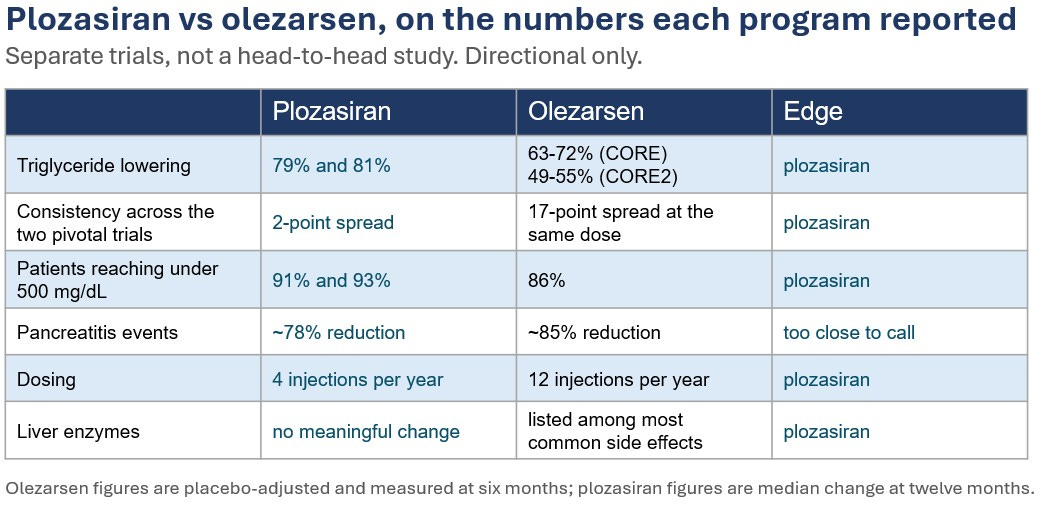
Figure 1. Every figure is as reported by each sponsor. The two programs were never compared directly.
4. Two places the data are thinner than they look
Two findings deserve more scrutiny than the coverage has given them. Both happen to sit exactly where Arrowhead would most want strength.
Liver fat. The press release says a planned MRI substudy found no meaningful increase in liver fat, with a p-value of 0.70. That reads as a clean result, and it has been repeated everywhere.
The substudy had 36 patients in it. Thirteen on placebo, 23 on plozasiran, at whichever trial sites happened to have the right scanner. Liver fat went up 1.0 percent on the drug and down 0.5 percent on placebo.
The p-value was 0.70, meaning the substudy did not detect a statistically significant difference between the groups. What that number cannot tell you is whether the study was large enough to confidently rule one out.
A p-value of 0.70 in 36 patients does not establish that there is no effect. It says the study did not find one, and with a sample that small, considerable uncertainty remains around the estimate.
This matters more than it might appear. Liver fat was supposed to be the clean differentiator against olezarsen, which showed increases of roughly 2 to 4 percent that grew with dose. Arrowhead’s own chief medical officer said in June that if plozasiran turned out to show something similar, both drugs would be in the same boat.
Sunday did not settle that question. It left it open, with a number that sounds like it settled it.
Blood sugar. Side effects related to worsening blood sugar control were reported in 14.3 percent of plozasiran patients against 8.7 percent on placebo. That is the first real imbalance this program has produced.
The defense is reasonable and it is in the data. Between 54 and 63 percent of enrolled patients were already diabetic, with average HbA1c, the standard measure of blood sugar control over the preceding months, between 6.4 and 6.6 percent. This is a population already at substantial risk of worsening blood sugar, which helps put the 8.7 percent placebo rate in context. When you look at the actual measured HbA1c rather than the reported side effects, it barely moved over twelve months in either group.
A side effect somebody wrote down and a lab value that actually changed are different things, and the lab values are reassuring. Even so, a 5.6-point imbalance in a population with this much baseline diabetes is conspicuous enough that regulators and clinicians are likely to ask about it.
One more figure belongs here, since this section exists to look at the uncomfortable parts. Three deaths occurred among plozasiran-treated patients, two cardiovascular and one from chronic myelomonocytic leukemia. Investigators attributed all three to pre-existing disease and judged them unrelated to treatment. Serious side effects overall were actually lower on drug than on placebo, 8.3 percent against 10 percent, and investigators found no treatment relationship for any of the three deaths. There is no evident mortality signal here, but the events are worth stating anyway.
5. What the call added
Management restated Sunday for most of the hour. The genuinely new material came from the independent discussant, and it did not point the way Arrowhead would have chosen.
Borge Nordestgaard presented unpublished registry data from Denmark covering 3.4 million people between 2008 and 2021, none of whom had cardiovascular disease at baseline. Within them he identified roughly 29,000 with severe hypertriglyceridemia. That group produced 400 cases of acute pancreatitis and 2,000 cardiovascular events. On an incidence basis, 2 per 1,000 patient-years against 18.
Five times as many cardiovascular events as pancreatitis attacks, and nine times the rate once you account for how long people were followed, in patients who had no cardiovascular disease when the clock started. His conclusion was not that the pancreatitis work is misdirected. It was that he would like to see studies going after both diseases, and that the long-term need in this population is cardiovascular.
Arrowhead put an independent expert on its own investor call, and he used the time to point out that these patients are roughly nine times more likely to suffer a cardiovascular event than the event the label is being built around.
That cuts in both directions. On the bearish side, if payers price plozasiran purely on pancreatitis prevention, the addressable market is narrower than headline patient counts suggest. Arrowhead’s own slide identifies roughly one million high-risk patients within the roughly three million Americans with the condition, and the initial commercial focus is that high-risk segment. Management nonetheless put a three to four billion dollar annual US opportunity on the same call.
On the bullish side, plozasiran reduced remnant cholesterol by 72 to 76 percent in these trials. If the drug ever runs a cardiovascular outcomes study and that reduction translates, the opportunity is a different order of magnitude than a pancreatitis label. That remains entirely hypothetical. SHASTA was not designed to demonstrate cardiovascular benefit and does not. Nordestgaard did not say otherwise. He simply pointed at where the events actually are.
What the glycemic number actually counted. An analyst asked what the imbalance actually consisted of, and Watts answered it. The 14.3 percent was not a single measurement. It pooled several loosely related endpoints, among them impaired glucose tolerance and the need to increase antidiabetic medication. On that basis he said it is difficult to make much of a five-point difference. He described the HbA1c change as very minor, not clinically significant, and something that resolves once treatment is intensified, adding that patients typically finish these studies with better control than they started with. Nordestgaard called the safety profile excellent against the risk these patients carry.
How the strongest numbers are constructed. The high-risk numbers arrive in three tiers, and the tiers matter. Across patients with triglycerides at or above 880, or above 500 with a prior attack, the number needed to treat is nine. Among those with a prior attack regardless of triglyceride level, it is three. In the narrowest group, above 880 with a prior attack, no events occurred at all. Watts called that last analysis exploratory and said plainly that the numbers are small. The direction is more reliable than any single figure until the publication lands.
The question management would not answer. The most useful exchange on the call came from Jefferies. Maury Raycroft said his back-calculation showed an imbalance among patients without a prior pancreatitis history, with three to four events in the plozasiran arm against none on placebo, and asked whether there was anything distinctive about those patients.
Management declined, citing the pending publication, and redirected to the point that the pooled endpoint was prespecified and hit statistical significance across the whole population. Both things are true. It is also true that a reader who wants to understand where the benefit concentrates, and where it does not, will have to wait for the manuscript.
A class effect, in his words. One more thing worth recording. Nordestgaard told the call that all five drugs in this class, across every study run so far, have produced roughly an 80 percent reduction in acute pancreatitis. His word was extremely consistent. That is the strongest available argument that neither company should be claiming an advantage on this endpoint, and it came from the independent discussant rather than from either sponsor.
The question nobody asked. Watts described the result as very reassuring, Arrowhead’s commercial lead described it as no liver fat elevation relative to placebo, and the size of the study went unmentioned by anyone on the call or in the questions that followed.
The switching question, answered by the wrong people. Bank of America asked the two physicians whether they saw any barrier to switching a patient from olezarsen to plozasiran. The answers were not the ones the switching argument wants.
Watts said switching happens in practice and that the quarterly interval is a patient preference matter, allowing that it leans in plozasiran’s favor. He also predicted the more likely response to inadequate control on olezarsen is a dose increase rather than a switch, while noting that the higher olezarsen dose carries its own problems.
Nordestgaard was blunter and less helpful to the thesis. Patients who get used to a drug and are having no trouble with it, he said, tend to stay on it, absent clearly more side effects or a real price difference. He then said what he had said twice already, which is that he would rather both companies spent their effort finding the enormous number of untreated patients than fighting over the ones already on therapy.
Management took the same line, framing severe hypertriglyceridemia as an untapped market with room for both drugs rather than a share contest. That is the diplomatic answer and it may also be the correct one. It is not, however, the answer that supports a thesis built on converting a competitor’s patients.
6. The longer route
Here is where this leaves things.
Arrowhead has the better drug on triglyceride lowering, on repeating that result across two trials, on getting patients into the safe range, on dosing schedule, and on liver enzymes. It has a comparable drug on preventing pancreatitis, which is the outcome that actually matters to a patient. It gives four injections a year where the competitor gives twelve.
What it does not have is permission to sell. Olezarsen has been approved for this condition since June. Arrowhead plans to file a supplemental application by the end of 2026, expanding the label on a drug the FDA has already approved rather than seeking a first approval. It will use a priority review voucher bought on August 4, which changes the FDA’s review goal from roughly ten months to six. Filing in December on that timeline points to a decision around the middle of 2027.
Call it a year of a competitor selling into a market before you can enter it. In a specialty field with a few thousand prescribing physicians, a year is enough time for habits to form.
That concentration cuts both ways, though, and the second edge is the one people forget. A small prescriber base lets Ionis establish habits quickly. It also means Arrowhead has a finite and identifiable audience to reach when it arrives, whether by converting patients already on therapy or, as management would prefer, by bringing untreated ones into it. This is not primary care, where changing behavior means reaching tens of thousands of physicians who have never heard of the disease.
Chess has a word for what happens next. A transposition is when two games reach the same position by different move orders. One player gets there down one path, the opponent down another, and once they both arrive, the order stops mattering. What is left on the board is the position.
The analogy is imperfect in a way worth naming. In chess both players arrive at the same moment. Here, Ionis got there a year early and has been using the time.
Pharmaceutical history offers plenty of reminders that arriving first is not the same as staying ahead. Lipitor was the fifth statin to market. Keytruda entered behind Opdivo. Neither case is proof of anything about this one, since market leadership turns on far more than which molecule performs better. What travels across all of them is that physicians can switch when the product difference is real. Nordestgaard’s answer on the call is a useful warning against assuming that dosing frequency alone will move a patient who is doing perfectly well. For a patient who is inadequately controlled, unhappy with monthly injections, or starting therapy for the first time, four injections a year instead of twelve gives Arrowhead an unusually simple conversation to have with a physician.
What Sunday did was hand Arrowhead the material for that conversation. What it could not do was change the order of arrival.
Ionis got there first. Arrowhead got there better. The position on the board is what settles it, and Arrowhead simply took the longer road to reach it.

A Note on Supporting Independent Research
If this note has been valuable to you, whether it shaped your thinking, validated your conviction, or simply saved you the time of doing this work yourself, a voluntary contribution is genuinely appreciated and directly funds the next paper.
For individual investors and readers
Any amount you feel reflects the value you received is welcome and meaningful. A contribution in the range of what you might pay for a single premium research report is a thoughtful gesture that makes a real difference.
For family offices, investment funds, hedge funds, and research platforms
This paper is the caliber of work that institutional research desks bill significant retainers to produce. If your team referenced it, distributed it internally, or used it to inform a position, a suggested contribution of $1,000 reflects the professional value of the analysis, though any amount is meaningful. Your support makes it possible to continue publishing at this level without a paywall that limits the reach of the ideas. If your organization requires an invoice to process a payment, please reach out directly at bioboyscout@gmail.com and one will be provided promptly.
There is no obligation and no expectation. This is purely a thank you for work that meant something to you.
Zelle: (847) 227-7909
PayPal: paypal.me/bioboyscout
Thank you for reading, and for being part of a community that takes this thesis seriously.
— Robert Toczycki | BioBoyScout
Important Risks, Disclosures, & Disclaimers
The author, Robert Toczycki (aka BioBoyScout), certifies that:
all views expressed in this note accurately reflect his personal opinions about the topic discussed;
he was not compensated in any form for producing this note; and
he has not received and does not receive compensation from Arrowhead Pharmaceuticals.
This note is published by BioBoyScout and is intended for informational and educational purposes only. It does not constitute investment advice, a solicitation to buy or sell securities, or a guarantee of future results. The author holds a long position in Arrowhead common stock. SHASTA-3 and SHASTA-4 figures come from Arrowhead's August 30, 2026 release and the slides presented at the ESC Congress Hot Line session the same day. Olezarsen figures come from the CORE and CORE2 results published in the New England Journal of Medicine and from sponsor disclosures. Comparisons across separate trials are directional only; the two programs measured their main results at different timepoints in somewhat different populations. Arrowhead Pharmaceuticals (ARWR) is a publicly traded company; investments in its shares involve material risks, including the risk of total loss. All financial projections, acquisition price estimates, and valuation analyses herein are hypothetical frameworks for analytical purposes and do not represent predictions of actual outcomes. Readers should conduct their own due diligence and consult a registered investment advisor before making investment decisions.
About the Author
Robert Toczycki is an independent analyst and registered US Patent Attorney with a JD, an Executive MBA completed at the top of his class, and a BS in Mathematics and Computer Science from the University of Illinois at Urbana-Champaign. He has a deep passion for financial analysis, particularly identifying valuation discrepancies and demonstrating them through rigorous, data-driven research and solid analytics.
Comments or questions: bioboyscout@gmail.com.
Copyright © 2026, BioBoyScout. All Rights Reserved.