

Robert Toczycki, JD, MBA
bioboyscout.com
bioboyscout@gmail.com
847.227.7909
X: @BioBoyScout
1. It moved
Three days ago I published a note arguing that the tau percentage arriving this morning would carry less information than people would read into it. The argument still holds, and I will come back to it. The first point to make, though, is the plain one.
ARO-MAPT reduced tau in the spinal fluid of healthy volunteers by a mean of 73 percent, with one individual reaching 85 percent. The drug was given as an injection under the skin. Arrowhead describes this as the first clinical validation of a platform delivering siRNA across the blood-brain barrier after a subcutaneous dose. Gene silencing has reached the human brain before, but by going in directly: antisense drugs injected into the spinal canal, and gene therapies infused into brain tissue through the skull.
Arrowhead did it with a shot.
Consider what that route makes possible. A spinal injection needs a procedure room, a trained hand, and a patient willing to come back for it. That constraint shapes what follows from it: who enrolls in the trial, how long the trial runs, which diseases are worth attempting, how many people ever get the drug. Remove it and the economics and practical reach of many brain programs could change.
It also changes what is worth trying. A disease that could never justify repeated spinal taps becomes approachable. Some patients for whom repeated spinal procedures are impractical become reachable. Treating people earlier, before the damage accumulates, stops being a logistical fantasy. None of that is proven this morning. All of it becomes possible to attempt.
The bishop moved. The long diagonal is open.
2. The number almost nobody will read
Everyone will quote the 73 percent. The number sitting underneath it is 105.
Day 105 is when the measurement was taken. The final dose in that cohort was given on Day 15. The reduction was therefore measured ninety days after the last drug entered the body, and it was still 73 percent. That is not a reading taken near the dosing period. Whatever the peak was, the release does not say.
Be clear about what that does and does not establish. One measurement at Day 105 shows suppression at Day 105. It does not show that the effect held at 73 percent the whole way, and it does not say how long it lasts beyond that point. The time course is missing.
What it does establish is durability at a point three months removed from the last dose, which is a credible basis for investigating dosing once a quarter. Against a procedure in a hospital, that is a different kind of medicine.
The headline is 73 percent. The number that matters is 105.
3. What I said to watch, and what arrived
On Sunday I listed six readings that would carry more information than the headline percentage. Here is the honest grading.
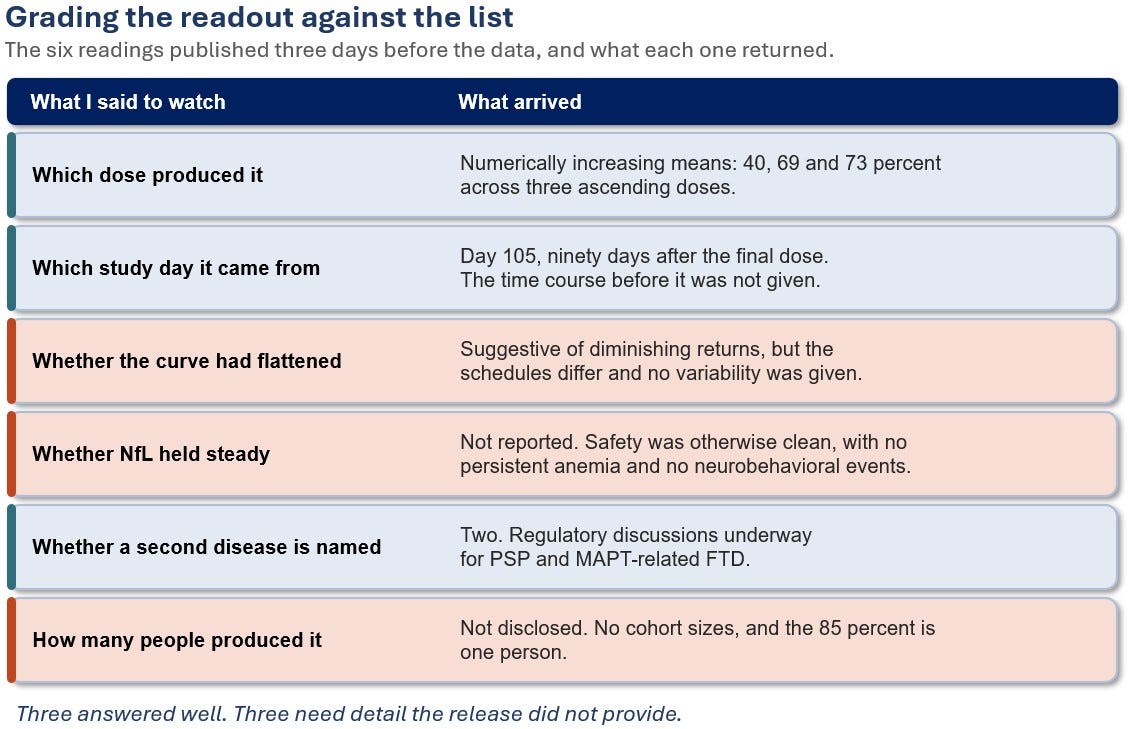
Figure 1. The six readings published October 11 and the results reported October 14. Source: Arrowhead’s announcement of October 14, 2026.
Three came back well. Three need detail the release did not provide, and all of them belong in the questions when Arrowhead hosts its webinar this afternoon. Neurofilament light, a marker of neuroaxonal injury, is not mentioned at all, in a safety section that otherwise reports no persistent anemia and no neurobehavioral events. No cohort sizes are given anywhere either, which means the 85 percent is one person and the means rest on groups of unstated size.
Neither omission is evidence of a problem, but both limit what the data can establish. It helps to separate two kinds of limit here. Some are built into the study: the volunteers were not selected for Alzheimer’s-related tau pathology or for decline, and neither pathology nor clinical benefit was assessed. No announcement can fix that. Others are simply absent from a short release and could be answered this afternoon. A reader should know which numbers are load bearing and which are not.
4. The ladder separated. Is it flattening?
The dose groups separated. At least numerically. That is where the interesting questions begin.
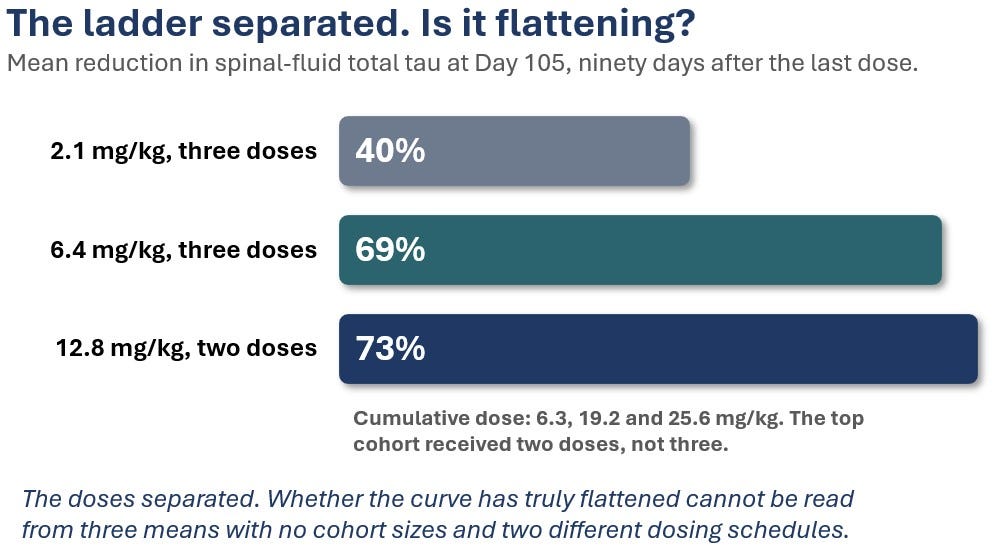
Figure 2. Mean reduction in spinal-fluid total tau at Day 105. Source: Arrowhead’s announcement of October 14, 2026.
The means are ordered in the right direction, and that is encouraging. Whether they describe a clean dose-response curve is another question.
Then do the math the release does not do for you. The top cohort received two doses. The two below it received three. The cumulative amount given was therefore 6.3, 19.2 and 25.6 milligrams per kilogram. The per-injection dose doubled from the middle group to the top, but the total drug administered rose by only a third.
That changes the reading. Tripling the total administered dose coincided with 29 additional percentage points of mean tau reduction. Raising it by another third coincided with four. The pattern still points toward diminishing returns, but it is a weaker claim than the headline doses suggest, and it is not a ceiling.
Administered dose is also not the same as exposure, which depends on uptake, distribution and clearance and cannot be read off a dosing schedule. To know whether the curve has genuinely flattened you would need cohort sizes, the spread of individual responses, and measured exposure rather than inferred. None of that is in the release. Anyone modeling 85 or 90 percent from the next cohort should want those numbers first, and so should anyone declaring a ceiling.
That cuts the other way too. The group with the fewest injections produced the deepest reduction at Day 105, which does not prove the shorter schedule was better, since the per-injection dose was also higher. It does make a question worth asking: how many loading doses does this drug actually need? Every injection removed from a regimen removes one more burden on the patient.
The top cohort got two doses. The ones below it got three. That is not a detail, it is the comparison.
5. How it compares
Biogen’s diranersen, the antisense drug that reduced tau on brain scans and showed signals of slower decline on secondary measures in early Alzheimer’s this year, reported spinal-fluid tau reductions of 50 to 65 percent across its doses. That drug is delivered into the spinal canal.
Arrowhead reported 73 percent through a shot under the skin.
That comparison does not establish superiority, and I would not use it that way. Different trials, different populations, different schedules, different measurement days. Healthy volunteers are not patients. Biogen also ran for eighteen months, and its best clinical result came from a dose given every six months, which is a less frequent schedule than the quarterly dosing Arrowhead is investigating.
There is a further asymmetry in what was measured, and it does not favor Arrowhead. Biogen’s tau reductions were accompanied by declining tau PET signal in patients with Alzheimer’s disease. Arrowhead has a spinal-fluid number in healthy volunteers.
The delivery distinction is real, though, and it is the part that does not depend on the numbers lining up. Biogen needed an injection into the spinal canal to reach substantial tau lowering. Arrowhead has now reached substantial tau lowering with a subcutaneous injection.
The comparison worth watching is not seventy-three against sixty-five. It is what a patient has to go through to get the drug.
6. Where the drug goes
There is a second difference between the two routes, and it may matter more than convenience does.
A drug injected into the spinal canal reaches the brain by diffusing inward from the fluid around it. That works well for structures near the surface and progressively worse the deeper you go. In primate studies spanning dozens of regions, accumulation in deep structures ran more than an order of magnitude below the cortex. Autopsy tissue from patients treated with an approved intrathecal drug showed the same gradient, with substantially higher concentrations in the lumbar spinal cord than in the brainstem, though measurable drug reached both.
Arrowhead ran the comparison itself and showed it at a conference in May. In monkeys given the drug into the spinal canal, relative concentrations were 21.6 in temporal cortex, 11.0 in thoracic spinal cord, and 1.0 in both caudate and putamen. That is a twenty-two fold spread from the best-served region to the worst. Under the skin the same four regions ran 3.6, 1.0, 2.0 and 3.3, a spread of under four fold. Confine it to the three brain regions and the subcutaneous spread falls under two fold, which is the comparison the company’s own slide draws.
Read that carefully, because it is a claim about evenness rather than depth. The company reported 70 to 80 percent knockdown across all twelve regions it measured, including the pons, the medulla, the thalamus and the basal ganglia, with up to 85 percent in some cortical areas. Staining showed the effect reaching neurons, astrocytes, microglia and oligodendrocytes in the brainstem. The argument is not that the shot silences harder. It is that in these monkeys it silenced across every region measured, including deep structures the spinal route reached less efficiently.
Twenty-two fold variation by spinal injection. Under four fold by a shot. The gap in evenness is the argument, not the gap in depth.
Four qualifications matter here. The two arms used different schedules, a single 15 milligram dose into the spinal canal against three weekly doses of 3 milligrams per kilogram under the skin, so this is a comparison of routes as each was run rather than of optimized regimens against each other. The concentrations were normalized within each route, so the absolute levels are not directly comparable. The work is also Arrowhead’s own, presented at a conference rather than peer reviewed, while the intrathecal literature it argues against is published.
The fourth is a detail in the timing. Both groups were sampled on Day 29, but that was twenty-eight days after the single spinal dose and only fourteen days after the last of the three subcutaneous ones. The two arms had different amounts of time to clear before anyone measured them. The separate knockdown comparison was run at a matched interval after the final dose in both groups, which makes the gene-silencing result the more informative of the two.
One more counterweight, and it is the strongest objection to this section. An independent primate study published in 2025, using an antisense drug against a different gene entirely, found measurable target engagement across neuronal cell types in deep brain regions even where intrathecal drug accumulation sat near the limit of detection. Its authors concluded that intrathecal drugs remain relevant to deep-brain diseases. Lower concentration is not the same as no activity, and a reader should not take the gradient to mean the other route cannot work down there. The claim worth defending is that uniformity may be better, not that only one route arrives.
Whether any of this holds in people is unanswered. Spinal-fluid tau is a bulk measure, and this morning’s release reports no regional detail at all.
Hold it next to what comes next, though. Progressive supranuclear palsy attacks deep structures, including the basal ganglia, the subthalamic nucleus and the brainstem, several of which sit far from the surfaces a spinal injection works from. That is unlikely to be a coincidence in the company’s plans.
7. Two diseases, named, with regulators already involved
In September I wrote a note called The Long Diagonal arguing that Arrowhead’s fastest road to approval in the brain might run through rarer diseases rather than through Alzheimer’s. The evidence was circumstantial: a talk title, a biomarker on a slide, two neurologists on a conference agenda.
This morning’s release says the company has initiated regulatory discussions in preparation for planned studies in MAPT-associated frontotemporal dementia and progressive supranuclear palsy.
Not considering. Not evaluating. Initiated discussions, in preparation for planned studies, in both diseases.
That is further along than I guessed, and it arrived just over two weeks later. Neither disease has an approved disease-modifying therapy. Both have small and biologically well-defined populations, and in neurofilament light a progression marker that Adam Boxer, the neurologist presenting for Arrowhead this morning, spent years establishing in exactly these diseases. None of that means approval is close, or that these routes are necessarily faster. It means the company is already building a development path that does not run only through Alzheimer’s.
I argued the fastest road ran through the rarer diseases. The company has already started the conversation.
8. What this actually proves
Three days ago I drew a distinction between three questions that get collapsed into one: did the drug reach its target, did it change the pathology, did it help the patient. This morning gives compelling evidence for the first, though the measurement is indirect, and leaves the other two exactly where they were.
Tau pathology and disease modification were not assessed in these volunteers, by design. There was no Alzheimer’s decline being measured, and no evidence that the study looked at reversing existing pathology. The release says so plainly, which is to the company’s credit. Patient enrollment continues, with further data updates expected in 2027.
No part of today tells you that lowering tau helps anyone with Alzheimer’s. That remains an open question, and the strongest evidence for it is still Biogen’s, not Arrowhead’s.
What today tells you is different, and it may be worth more. A company has demonstrated that a subcutaneous injection can produce substantial target suppression in the human central nervous system, still measurable three months after the final dose. The tau thesis could be wrong in every particular and that would still be true.
For an investor the practical consequence is that two different assets moved this morning, and from here they need not move together. One is ARO-MAPT, whose value still turns on patient data, years of safety, and regulatory outcomes in three diseases. The other is the delivery system, which is a reusable capability if it generalizes beyond this target, and that has not been shown yet.
There is a company commitment attached to this. On its spring earnings call Arrowhead said that if early ARO-MAPT data were encouraging, readers should expect a substantial expansion of its central nervous system pipeline beginning at the end of 2026. The data arrived this morning. Whether that expansion materializes, and which targets it names, is the first concrete test of whether the platform argument is real or a hopeful reading of one result.
Which one survives depends on how the drug fails, if it fails. If tau is adequately suppressed in the neurons that matter and Alzheimer’s progresses anyway, the delivery system did its job and the failure belongs to the therapeutic hypothesis. If the trouble is that the drug reached too few neurons, or reached them unevenly, or the chemistry carrying it causes harm, the platform is implicated directly. Those are different failures and they should produce different valuations.
There is a second level to this, and it decides how much the platform is worth. The regional evidence earlier covers one drug against one gene in monkeys. The harder question is whether the same chemistry carries a different gene, into a different cell type, in a different disease. Crossing the barrier is one achievement. Showing that the same delivery chemistry can reliably silence other targets, in the cell populations a given disease damages, is another. That validation is still ahead. The first has real support this morning. The second is where the platform’s value gets settled.
The drug could fail and the delivery system still succeed. Today was the delivery system.
9. What would make me wrong
This is not the disease. Older brains, damaged brains, brains with tangles in them may handle this drug differently. Every assumption in this note rests on a population that does not have the disease.
The measurement is indirect. Spinal-fluid tau is a proxy for what is happening in brain tissue. It is a good proxy and it is the one the field uses, but it is not a measurement of drug concentration in a neuron, and it is not a measurement of tangles.
The numbers come from unstated denominators. No cohort sizes were given. The 85 percent is one individual. The release also gives no placebo-adjusted effects and no confidence intervals. The percentage is clear. The precision around it is not. Small groups can produce impressive means, and the next sample can move those means in either direction. If cohort sizes and variance eventually show that the gap between 69 and 73 percent could readily be explained by sampling variability, the top of that ladder may be one step rather than two.
Safety is early, and good so far. The disclosed safety is encouraging: no serious treatment-emergent adverse events, no deaths, no treatment-emergent adverse events leading to discontinuation, most events mild, and no persistent anemia or neurobehavioral events reported. That is a good first look. It is also one interim look at small groups of healthy people over a few months, which cannot establish long-term tolerability in older patients with disease.
The ceiling may already be here. The curve appears to bend near the top of the reported range, though the differing schedules complicate that reading. If suppression is approaching saturation near 70 percent, more drug may buy progressively less. The present data cannot establish where any ceiling sits, or whether a different schedule would move it.
The drug does not distinguish normal tau from pathological tau. ARO-MAPT targets MAPT expression and is designed to reduce production of all six tau isoforms. It does not pick out the aggregated form, and pathological tau is not a separate isoform in any case, since any of the normal ones can misfold. Normal tau does work in healthy neurons, in microtubule regulation and axonal transport. Whether deep suppression can be sustained safely over years is an open question about the target itself, not only about the trial.
The delivery route has its own exposure. Arrowhead’s platform crosses the barrier using a ligand that binds transferrin receptor 1, and the company’s own structural work shows it binding at a site away from where the body’s own transferrin docks. That receptor sits on tissues outside the brain, including developing red blood cells. Other programs using this receptor have had to watch blood counts and iron handling, which is a concern carried over from their experience rather than a finding reported here. This morning’s release reports no persistent anemia, which is the right result. One interim look in healthy volunteers does not settle it.
The biggest one. Clinical benefit from lowering tau remains unconfirmed. Biogen showed slowing on several secondary measures and still missed its primary endpoint. The mechanism is unproven in the way that matters.
10. The line it opens
In chess the bishop is the piece beginners undervalue. It moves only on its own color, it cannot jump over an obstacle, and in a closed position it can sit behind its own pawns for twenty moves without doing useful work. Players learn to prefer the knight, which hops over whatever is in its way.
Then the position opens, and the bishop reaches across the whole board in one move.
Arrowhead has spent years extending its chemistry past the liver, into the lung, into fat, into muscle. The blood-brain barrier was the one position that stayed closed. This morning it opened.
What matters about a long diagonal is not the square the bishop lands on. It is every square that suddenly comes within reach. Tau is one target. The delivery system that carried it is the line.
A bishop is worth very little in a closed position. The whole game changes when the position opens.

A Note on Supporting Independent Research
If this note has been valuable to you, whether it shaped your thinking, validated your conviction, or simply saved you the time of doing this work yourself, a voluntary contribution is genuinely appreciated and directly funds the next paper.
For individual investors and readers
Any amount you feel reflects the value you received is welcome and meaningful. A contribution in the range of what you might pay for a single premium research report is a thoughtful gesture that makes a real difference.
For family offices, investment funds, hedge funds, and research platforms
This paper is the caliber of work that institutional research desks bill significant retainers to produce. If your team referenced it, distributed it internally, or used it to inform a position, a suggested contribution of $1,000 reflects the professional value of the analysis, though any amount is meaningful. Your support makes it possible to continue publishing at this level without a paywall that limits the reach of the ideas. If your organization requires an invoice to process a payment, please reach out directly at bioboyscout@gmail.com and one will be provided promptly.
There is no obligation and no expectation. This is purely a thank you for work that meant something to you.
Zelle: (847) 227-7909
Thank you for reading, and for being part of a community that takes this thesis seriously.
— Robert Toczycki | BioBoyScout
Important Risks, Disclosures, & Disclaimers
The author, Robert Toczycki (aka BioBoyScout), certifies that:
all views expressed in this note accurately reflect his personal opinions about the topic discussed;
he was not compensated in any form for producing this note; and
he has not received and does not receive compensation from Arrowhead Pharmaceuticals.
This note is published by BioBoyScout and is intended for informational and educational purposes only. It does not constitute investment advice, a solicitation to buy or sell securities, or a guarantee of future results. The author holds a long position in Arrowhead common stock. Arrowhead Pharmaceuticals (ARWR) is a publicly traded company; investments in its shares involve material risks, including the risk of total loss. All financial projections, acquisition price estimates, and valuation analyses herein are hypothetical frameworks for analytical purposes and do not represent predictions of actual outcomes. Readers should conduct their own due diligence and consult a registered investment advisor before making investment decisions.
All ARO-MAPT results, including the dose levels, the Day 105 measurements, the safety summary, and the statement regarding regulatory discussions in frontotemporal dementia and progressive supranuclear palsy, are from Arrowhead’s announcement of October 14, 2026. Trial design details are from the ClinicalTrials.gov registration, NCT07221344. The diranersen comparison figures are from Biogen’s announcement of May 14, 2026 and its presentation at the Alzheimer’s Association International Conference on July 14, 2026, and are drawn from a different trial in a different population. The six readings graded in Section 3 were published in Ninety-Eight Percent of Nothing on October 11, 2026. The argument regarding rarer tauopathies was published in The Long Diagonal on September 29, 2026. Cumulative dose figures in Section 4 are calculated from the per-injection doses and schedules in that announcement.
The intrathecal and subcutaneous primate comparison in Section 6, including the regional concentration figures, the twelve-region knockdown range, the cell-type staining and the transferrin receptor mechanism, is from Arrowhead’s TIDES USA 2026 presentation, Systemic RNAi Targeting MAPT, available in the investor section of the company’s site. The counterweight finding of deep-brain target engagement despite low intrathecal accumulation is from Frei and colleagues, Cell Type Distribution of Intrathecal Antisense Oligonucleotide Activity in Deep Brain Regions of Non-Human Primates, 2025. The intrathecal distribution gradient is also described in published primate pharmacology atlases and in autopsy analyses of patients treated with an approved intrathecal antisense drug. No regional distribution data for ARO-MAPT in humans has been reported. The statement regarding planned expansion of the central nervous system pipeline is from Arrowhead’s quarterly earnings call in the spring of 2026. The chess interpretation is the author’s own.
About the Author
BioBoyScout is the publishing name for Robert Toczycki, an independent biotech investment research writer based in Chicago. The BioBoyScout series publishes institutional-grade analysis of structural dynamics in RNA-class therapeutics, with particular focus on Arrowhead Pharmaceuticals’ TRiM platform and the broader competitive landscape. Robert is a registered US Patent Attorney with a JD, an Executive MBA completed at the top of his class, and a BS in Mathematics and Computer Science from the University of Illinois at Urbana-Champaign. He has a deep passion for financial analysis, particularly identifying valuation discrepancies and demonstrating them through rigorous, data-driven research and solid analytics.
Comments or questions: bioboyscout@gmail.com.
Copyright © 2026, BioBoyScout. All Rights Reserved.
Given the complete lack of treatment for the rare diseases you listed and the general consensus that PSP is a "cleaner" tauopathy than AD, it makes sense to focus on the that first. However, the challenge then becomes a commercial one as much as a scientific/clinical one; how would you ultimately reconcile rare disease pricing of the same drug for rare disease (six figures plus) with high-prevalence potential (in AD)?
Still that may be a high quality problem to own. Let's see what the presentation brings.