

Robert Toczycki, JD, MBA
bioboyscout.com
bioboyscout@gmail.com
847.227.7909
X: @BioBoyScout
Every argument for Arrowhead eventually rests on one claim: the platform works. That is an execution claim, and execution can be measured. This note measures it.
The headline, from Arrowhead’s own filings: 19 company-discovered drug candidates now in clinical trials, spanning Phase 1 through Phase 3, on a platform proven to deliver to 7 distinct cell types. The company spent $607 million on research and development in fiscal 2025 to run that engine. Alnylam spent roughly $1 billion. Ionis spent $916 million. Both are excellent companies, and by the estimates of their disclosed pipelines used here, neither reaches as many tissues.
In chess, development means bringing your pieces off the back rank into active play. The player who develops more pieces in fewer moves controls the board. It is the same word drug developers use, and it means very nearly the same thing.
1. Tissue breadth is the number that matters
Program counts flatter whoever runs the most trials. The harder measure is how many different tissues a company can actually deliver medicine to, because each new tissue is not one drug. It is permission to attempt every disease in that tissue.
Arrowhead’s disclosed clinical programs already span five tissues: liver, lung, muscle, adipose, and the central nervous system. The company has also disclosed that it is extending the platform into two more, ocular and cardiomyocyte, its sixth and seventh tissues, though it has not yet named targets in either. Most of the field, including the two larger peers, remains concentrated in the liver, which is the easiest destination in the body to reach and the one everyone solved first. Getting anywhere else is the hard part, and it is where Arrowhead has spent its moves. Cardiac tissue alone, once the cardiomyocyte work reaches patients, would open one of the largest untouched territories in medicine.
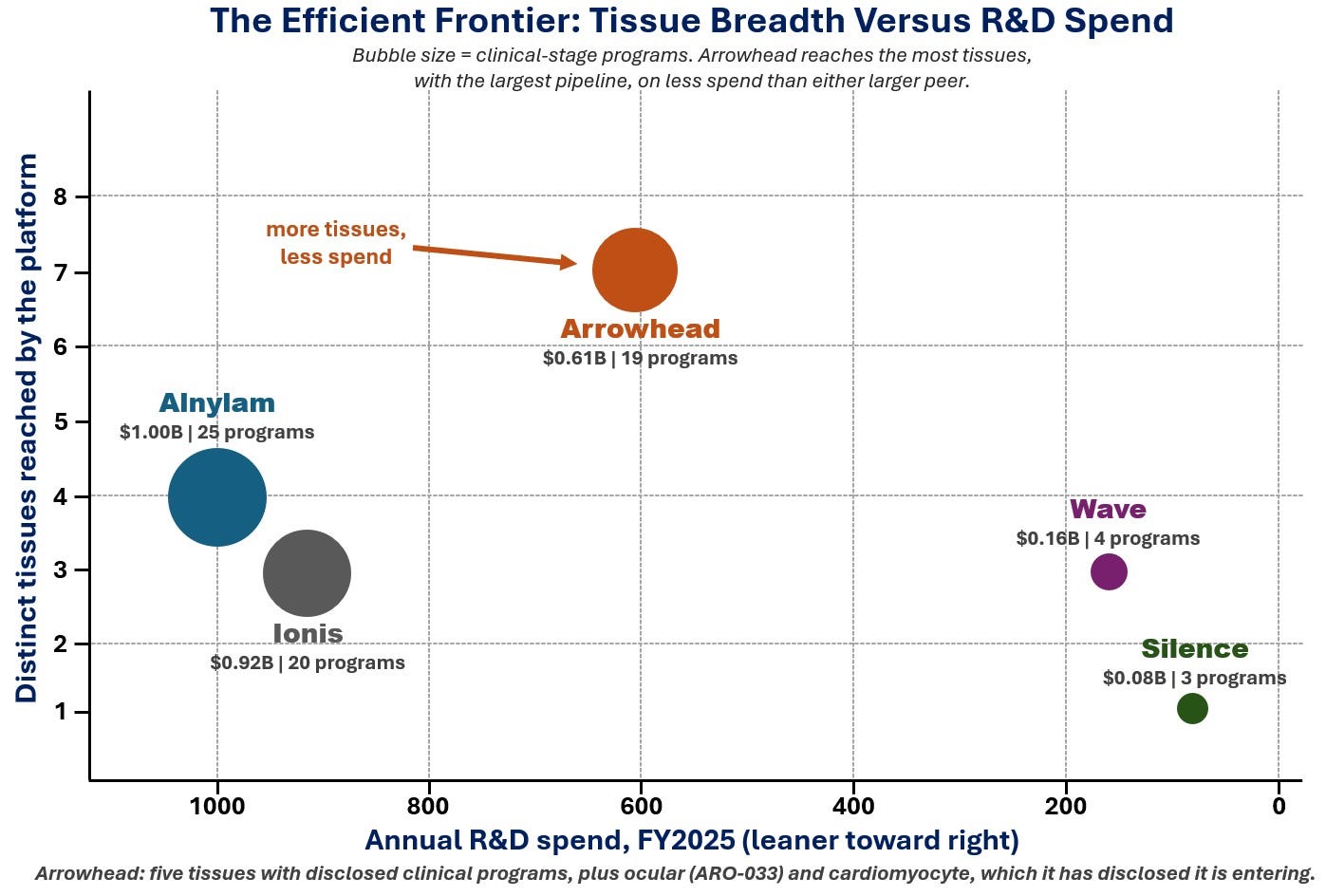
Figure 1. Tissue breadth against annual research spending. Bubble size is the number of clinical-stage programs. Arrowhead reaches more tissues, with a larger pipeline, on less money than either larger peer. Arrowhead is shown with 19 clinical-stage programs and seven tissues: the five in which it has disclosed clinical programs, plus ocular and cardiomyocyte, which it has disclosed it is entering. Targets in those two have not been named. Peer program and tissue counts are estimates drawn from company disclosures.
2. Tempo: the pace of getting to the clinic
Breadth is one half of the execution claim. Speed is the other, and it is the half the chess metaphor points at. In the opening, the player who develops pieces fastest dictates the game, forcing the opponent to react rather than build. Arrowhead develops quickly.
The company describes its discovery engine, in its own filings, as capable of generating multiple new clinical candidates every year, and the record bears that out: the clinical count has climbed from roughly 10 candidates a few years ago to 19 today. For context, the industry benchmark from hit identification to a nominated candidate averages 33 to 36 months, before the further stretch of studies required to reach human testing. An engine that adds multiple clinical candidates a year is running well inside the field’s typical cadence.
The most telling evidence is that a competitor pays Arrowhead for its speed. Under the Sarepta collaboration, Sarepta nominates targets and Arrowhead delivers investigational-ready constructs across six programs spanning muscle, cardiac, and central nervous system tissue. A sophisticated partner chose to outsource the distance from target to clinic to Arrowhead rather than cover it itself. That is the market pricing Arrowhead’s tempo directly, and it is the same tempo that produced ARO-033 in the registry before the market knew the program existed.
3. Why a tissue is worth more than a drug
The case for tissue expansion is usually made as a matter of ambition. It is better understood as a matter of structure. Four reasons make it the variable that decides this field.
The liver is commoditized. Every serious company in this modality cracked liver delivery years ago. That is precisely why the fight between plozasiran and olezarsen is being waged over percentage points on the same gene in the same organ: two good drugs, one destination, competing on margins. When everyone can reach a place, arriving there stops being an advantage. The only exit from that kind of competition is a tissue no one else has reached.
Most disease is outside the liver. A company that can only deliver to one organ has a ceiling on what it can ever treat, no matter how elegant its chemistry becomes. Each new tissue does not add a drug. It adds every lowerable disease in that tissue at once, which is why the list of targets Arrowhead could credibly pursue runs to hundreds rather than dozens.
Breadth is a hedge, and this is the reason most often missed. In a single-tissue company, every program shares one point of failure: if the delivery mechanism disappoints, the whole pipeline disappoints together. 7 validated tissues mean 7 substantially independent delivery problems already solved, so a setback in one does not travel to the others. That is a lower risk of ruin, not merely a wider set of chances, and it is why a broad platform deserves a different valuation framework than a deep one.
Each tissue makes the next one cheaper. Every conquest leaves behind reusable knowledge: ligand chemistry, molecules that tune how the drug moves through the body, safety experience with regulators, and a manufacturing plant whose cost is spread across everything that follows. Tissue expansion is not a series of equally expensive conquests. It gets easier as it goes. An engine that becomes more efficient the longer it runs does not converge with its competitors over time. It separates from them.
The honest objection is that focus has value too. Alnylam concentrated on the liver and has six approved products to Arrowhead’s one, which is a serious argument that depth converts to revenue sooner than breadth does. It is correct about the past decade. The question this paper raises is which approach owns the next one.
4. The cost picture, stated honestly
Divide research spending by clinical-stage programs and you get a rough cost per program: roughly $34 million at Arrowhead, and, using estimated peer program counts, on the order of $40 million at Alnylam and $46 million at Ionis. Arrowhead is leaner, though not dramatically so, and that distinction matters more than the direction of it.
The proxy is crude, and it deserves the caveats. Spending is lumpy. Programs sit at different stages, and a Phase 3 trial costs many times what a Phase 1 does. Partnered programs have some of their costs carried by Takeda, GSK, Sarepta, Amgen, Novartis, and Sanofi, which lowers Arrowhead's reported spending for reasons the counter-case takes up below. Smaller companies such as Silence and Wave spend far less in absolute terms, but they run a handful of programs across one to three tissues. Cheap alone is not the achievement.
What the numbers support is narrower and more durable than a claim of dramatic cost advantage. Arrowhead occupies the productive middle: more breadth and throughput than the small players, less spending than the large ones. It is the best combination of the two on the board.
5. Why it costs less, mechanically
Efficiency without an explanation is a coincidence. Arrowhead’s annual report supplies the mechanism. The design philosophy is to begin with a structurally simple molecule and add only the chemistry strictly necessary to achieve the required knockdown and duration. The company states plainly that its platform is built for simplified manufacturing and reduced costs. Simpler molecules take fewer synthesis steps, which makes each batch cheaper and faster to produce.
Two further structural advantages compound it. Arrowhead identifies potent RNA sequences rapidly using proprietary selection rules, which shortens the distance from target to candidate. It also manufactures in its own facility rather than queuing for slots at a contract manufacturer, which removes a bottleneck that routinely costs competitors months.
6. The proof that is audited rather than asserted
Any company can claim it executes well. Milestone payments are different, because the counterparty sets the bar, verifies the result, and pays in cash. In fiscal 2025, Arrowhead earned $300 million in milestones from Sarepta alone: $100 million when it hit the first enrollment target and won authorization to escalate dosing in the ARO-DM1 study, and $200 million when it cleared a safety committee review and reached the second enrollment target. Nobody pays $200 million for a good slide. They pay because the trial enrolled and the review cleared, on time.
Novartis then paid $200 million up front, with up to $2 billion in milestones, for a program that had not yet entered human trials. That is a sophisticated buyer pricing the engine rather than the asset.
There is a quieter piece of evidence as well. In June, a new Arrowhead candidate called ARO-033 appeared in the clinical trial registry, a placebo-controlled first-in-human study in roughly 42 healthy volunteers dosed subcutaneously. While Arrowhead has not yet officially disclosed the program’s target, research indicates it is an ocular program, most likely aimed at dry age-related macular degeneration. A candidate reached human testing before most of the market noticed it existed, which is what a running engine looks like from the outside.
On that basis the commercial logic is considerable. Dry age-related macular degeneration is a market generally sized at $3 to $5 billion, and it is underpenetrated because the approved therapies require an injection directly into the eye every one to two months. The mechanism is telling as well, since the complement proteins that drive the disease are made largely in the liver, which raises the possibility of treating an eye condition with a subcutaneous injection rather than a needle in the eye, and which fits the two complement programs Arrowhead already runs. The company has not formally confirmed the indication, so it should be held as a strong inference rather than a fact. What does not depend on it is the execution point: the engine put another candidate into humans before the market knew it existed.
7. The engine pays for itself
Here is the fact that separates Arrowhead from nearly every company running a pipeline this size. In fiscal 2025 it reported $829 million in revenue, $98 million in operating income, and $30 million in net income. It was profitable. Most companies running 19 clinical programs burn hundreds of millions and return to shareholders for more money. Arrowhead ran one of the broadest pipelines in the field, across more tissues than either larger peer, and finished the year in the black.
8. Quality, not just volume
Throughput proves the machine runs. It does not prove the output is good. For that, look at the cases where Arrowhead and a competitor pursued the identical target, which controls for the possibility that Arrowhead simply chose easier problems.
In alpha-1 antitrypsin deficiency, Arrowhead’s fazirsiran and Dicerna’s belcesiran went after the same gene. Fazirsiran published in the New England Journal of Medicine, showed a 94 percent reduction in the accumulated disease protein in the liver, produced fibrosis regression in a majority of biopsied patients, and advanced into Phase 3 with Takeda. It got further, faster. In severe hypertriglyceridemia, plozasiran and olezarsen target the same gene, and plozasiran has just delivered replicated 79 and 81 percent triglyceride reductions with a statistically significant reduction in acute pancreatitis, dosed four times a year against twelve.
One more marker of capability rather than volume: ARO-DIMER-PA is, by the company’s account, the first clinical candidate designed to silence two genes with a single molecule. The engine is not only fast. It does things the other engines have not done.
9. The honest counter-case
Four objections deserve a hearing, and one of them lands.
Alnylam has six approved products. Arrowhead has one. On cost per approval, which is the metric that ultimately matters, Arrowhead loses today and it is not close. The rebuttal is that approvals lag the engine that produces them, and Arrowhead only reached commercial stage in November of 2025. That is a real answer, but it is an answer about the future, and readers should weigh it as such.
The other three objections are weaker. Alnylam’s larger spending partly reflects a commercial organization supporting six marketed drugs, which is a different cost, not a worse one. Some of Arrowhead’s speed comes from RNAi biology in the liver rather than from management. Partnering also genuinely offloads late-stage costs, so the claim that Arrowhead would be cheaper standing alone remains unproven. That last point deserves a caveat of its own, though. Persuading Takeda, GSK, Sarepta, Amgen, and Novartis to fund your trials, pay you milestones for hitting them, and leave the wholly owned cardiometabolic, obesity, and brain programs untouched is not an accounting artifact. It is a deliberate strategy, and executing it is itself a form of efficiency.
10. What it means, and what to watch Tuesday
An acquirer buying Arrowhead is not buying 19 programs. Programs can be licensed one at a time. It is buying the machine that produced them, and machines of this kind have proven very hard to build from scratch. Novo Nordisk understood this in 2021 when it paid roughly $3.3 billion for Dicerna, acquiring an RNAi platform rather than any single approved drug, and notably paying that price for the platform even though the head-to-head program discussed above was lagging Arrowhead’s. Every large pharmaceutical company facing the patent expirations of the coming decade needs replacement revenue, and the fastest route is to buy an engine that is already running.
Arrowhead reports fiscal third quarter results on Tuesday, August 4. The quarter closed on June 30, before the SHASTA readout and before the first look at the brain program, so the financial statements are history. The engine is what to watch instead: the research spending line and what it bought, the pace of programs moving between phases, the launch of Redemplo, and above all the guidance on when the tau readout arrives. The numbers describe a quarter that has already ended. The commentary describes the machine that determines every quarter after it.
Arrowhead has developed more pieces, onto more squares, in fewer moves than anyone else on this board. Development is not the same thing as winning. It is what makes winning possible, and it is the part that cannot be improvised later.

A Note on Supporting Independent Research
If this note has been valuable to you, whether it shaped your thinking, validated your conviction, or simply saved you the time of doing this work yourself, a voluntary contribution is genuinely appreciated and directly funds the next paper.
For individual investors and readers
Any amount you feel reflects the value you received is welcome and meaningful. A contribution in the range of what you might pay for a single premium research report is a thoughtful gesture that makes a real difference.
For family offices, investment funds, hedge funds, and research platforms
This paper is the caliber of work that institutional research desks bill significant retainers to produce. If your team referenced it, distributed it internally, or used it to inform a position, a suggested contribution of $1,000 reflects the professional value of the analysis, though any amount is meaningful. Your support makes it possible to continue publishing at this level without a paywall that limits the reach of the ideas. If your organization requires an invoice to process a payment, please reach out directly at bioboyscout@gmail.com and one will be provided promptly.
There is no obligation and no expectation. This is purely a thank you for work that meant something to you.
Zelle: (847) 227-7909
PayPal: paypal.me/bioboyscout
Thank you for reading, and for being part of a community that takes this thesis seriously.
— Robert Toczycki | BioBoyScout
Important Risks, Disclosures, & Disclaimers
The author, Robert Toczycki (aka BioBoyScout), certifies that:
all views expressed in this note accurately reflect his personal opinions about the topic discussed;
he was not compensated in any form for producing this note; and
he has not received and does not receive compensation from Arrowhead Pharmaceuticals.
This note reflects the author’s personal opinions, is for informational purposes only. It does not constitute investment advice, a solicitation to buy or sell securities, or a guarantee of future results. Financial figures are drawn from audited annual filings. Peer program and tissue counts are estimates from public disclosures and are approximate. Cost per program is an indicative proxy, not a precise measure of development cost. The author holds a long position in Arrowhead common stock. Arrowhead Pharmaceuticals (ARWR) is a publicly traded company; investments in its shares involve material risks, including the risk of total loss.
About the Author
Robert Toczycki is an independent analyst and registered US Patent Attorney with a JD, an Executive MBA completed at the top of his class, and a BS in Mathematics and Computer Science from the University of Illinois at Urbana-Champaign. He has a deep passion for financial analysis, particularly identifying valuation discrepancies and demonstrating them through rigorous, data-driven research and solid analytics.
Comments or questions: bioboyscout@gmail.com.
Copyright © 2026, BioBoyScout. All Rights Reserved.
I haven’t checked the SEC documentation but, occasionally, companies disclose their actual R&D spend per asset (as opposed to aggregate expenditure). This makes for real granularity.