

Robert Toczycki, JD, MBA
bioboyscout.com
bioboyscout@gmail.com
847.227.7909
X: @BioBoyScout
The finding
In January and February of 2026, the United States Patent and Trademark Office granted Arrowhead Pharmaceuticals two patents covering the company’s central nervous system delivery platform. The first, US Patent 12,527,877 (Glebocka et al., granted January 20, 2026), claims a platform for delivering RNAi payloads across the blood-brain barrier and to skeletal muscle and heart tissues using antibody fragments that bind the transferrin receptor. The second, US 12,551,569 (Lazzara et al., granted February 17, 2026), claims a specific tau-targeting RNAi conjugate built on that platform, with named therapeutic indications including Alzheimer’s disease, frontotemporal lobar degeneration, progressive supranuclear palsy, and other tauopathies. Both patents are publicly available and run through 2045.
Read together with Arrowhead’s TIDES USA 2026 conference presentation on ARO-MAPT, the patent record reveals a feature of the TRiM SC architecture that public investor materials have not made explicit. The brain delivery platform Arrowhead has described publicly as a “chemistry-engineered targeting ligand” is fundamentally an antibody-fragment platform. The lead binder, identified in both patents as Fab0070, is a Fab fragment: the binding portion of an antibody, the piece that recognizes and attaches to a target on the surface of a cell. Antibody fragments are much smaller than full antibodies but retain the specificity that makes antibodies effective at homing in on particular targets. The transferrin receptor is a protein expressed on the surface of cells throughout the body and is the molecular doorway through which cells take up iron from the bloodstream. By engineering a Fab fragment that binds the transferrin receptor, Arrowhead has built a delivery system that uses that receptor’s natural transport machinery to ferry an RNAi payload into cells. ARO-MAPT, the company’s lead clinical-stage neurology program, is most likely the Fab0070-MAPT siRNA conjugate disclosed in the ‘569 patent claims.
This is a structural observation about the platform’s molecular architecture, not a discovery of hidden technology. The patents are public and the conference presentations have shown the structural imaging of the binder. What the public framing has not emphasized is that the binder is an antibody fragment. The “chemistry-engineered” language is technically accurate (Fab fragments are engineered molecules) but has not conveyed the antibody-fragment nature of the binding component to non-specialist readers.
The distinction matters. Fab-based architectures and small-molecule ligand architectures have different competitive moats, different manufacturing implications, different tissue distribution profiles, and different strategic value. The Fab choice itself is an engineering accomplishment worth understanding. Arrowhead’s scientists looked at how other companies had approached antibody-mediated brain delivery, recognized that the full-antibody approach forces intravenous administration, and engineered a Fab fragment instead. The remainder of this paper works through what the patent record reveals about that engineering choice, why it produces capabilities competing programs have not matched, and what the cross-tissue scope and pipeline breadth imply for Arrowhead’s strategic position.
What the patents and the TIDES presentation disclose
The ’877 platform patent claims an anti-transferrin receptor antibody fragment for delivering RNAi payloads to tissues that express the transferrin receptor. The patent specification describes a screening campaign in which Arrowhead generated and tested dozens of Fab candidates against the receptor, eventually selecting two lead clones called Fab0061 and Fab0070. A screening campaign like this is how antibody-based drugs are developed: a company generates a large library of candidate antibody fragments, tests each one for binding strength and specificity, and selects the best performers as the leads. The patent discloses the full amino acid sequences of both heavy and light chains for both Fabs, which is the level of detail at which the molecular identity of an antibody fragment is publicly established. The connection between the Fab and the siRNA payload is specified as a polyethylene glycol-based chemical tether, the chemistry that holds the antibody fragment and the RNAi payload together in a single drug molecule. The patent claims tissue coverage for the central nervous system, skeletal muscle, and heart muscle, with non-human primate data documenting subcutaneous knockdown across more than fifteen brain regions, both cardiac chambers and ventricles, and skeletal muscle including triceps and gastrocnemius.
The ’569 program patent claims the specific tau-targeting RNAi molecule and its conjugation to an anti-transferrin receptor Fab. The patent identifies the lead conjugate by molecular structure: Fab0070, the lead clone from the ’877 patent, joined through a defined linker chemistry to a specific MAPT-targeting siRNA sequence (MAPT is the gene that produces tau protein, which forms the toxic tangles inside neurons that drive Alzheimer’s disease and related tauopathies). The siRNA sequence is disclosed in the patent’s claims. The conjugation chemistry is the same as that disclosed in the ’877 patent. The therapeutic indications named in the claims include Alzheimer’s disease (Claim 26), frontotemporal lobar degeneration dementia, progressive supranuclear palsy, and other tauopathies (Claim 25). The patent specification frames the disclosure as addressing the historical failure of tau-targeting therapies due to blood-brain barrier penetration challenges, off-target effects, and limited efficacy.
The dual-patent structure (a platform patent and a program-specific patent for a clinical asset) is a meaningful escalation in Arrowhead’s intellectual property strategy. The company’s TRiM-liver franchise has historically relied on program-specific patents covering each clinical asset rather than on a platform-level patent claiming the underlying delivery chemistry. The foundational GalNAc-asialoglycoprotein receptor delivery technology used in the liver franchise is in the public domain and used across the RNAi industry, so platform-level patent protection was not available for that approach. The Fab-based brain delivery technology is different. Because no other company had built a subcutaneously-deliverable antibody-fragment-mediated RNAi delivery platform, Arrowhead was able to secure proprietary platform-level protection. The ’877 patent is the platform patent for the new technology; the ’569 patent is the program-specific patent for a tau program built on it. The ’569 patent provides direct documentary evidence that the antibody-fragment delivery architecture is not a research-stage exploration but a platform that has produced at least one specific clinical-stage molecule with named therapeutic indications, protected by granted intellectual property running through 2045.
The TIDES USA 2026 conference presentation, “Systemic RNAi Targeting MAPT: Advancing Tau Suppression Across the CNS with TRiM SC,” delivered by Kayal Madhivanan of Arrowhead, discloses the public scientific framing of ARO-MAPT. The presentation shows non-human primate data using a dosing regimen of three subcutaneous doses at 3 mg/kg administered weekly on Days 1, 8, and 15, with brain region knockdown of 70 to 80 percent measured at Day 29 across cortex, hippocampus, deep brain regions, and spinal cord, and up to 85 percent in some cortex regions. The durability data extends knockdown to Day 99 and shows tau protein suppression sustained out to Day 239 with a repeat dosing regimen of three weekly loading doses followed by four monthly maintenance doses. The presentation also shows a cryo-EM structure of the TRiM BBB ligand bound at the apical domain of the transferrin receptor (Cryo-EM is a structural imaging technique that uses cryogenic electron microscopy to produce three-dimensional images of biological molecules at near-atomic resolution). The cryo-EM image depicts the binder as a protein-sized molecule rather than as a small-molecule ligand.
The dosing regimen, brain region knockdown profile, durability data, and cryo-EM imaging in the TIDES presentation align with the ’877 and ’569 patent disclosures. The most consistent reading of the available primary-source evidence is that the TRiM BBB ligand publicly described in the TIDES presentation and the Fab0070 conjugate claimed in the ’569 patent are most likely the same molecule, and that ARO-MAPT is the Fab0070-MAPT siRNA conjugate disclosed in the ’569 patent claims.
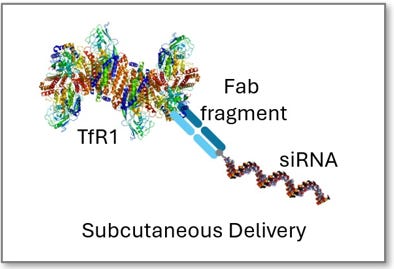
Figure 1. Schematic of the TRiM SC molecular architecture. The Fab fragment (shown in blue) is the binding component of the delivery system. One end of the Fab binds the transferrin receptor (TfR1) on the surface of cells across the blood-brain barrier and on cardiomyocytes and skeletal muscle. The other end is conjugated to the siRNA payload through a chemical linker. The Fab format is approximately one-third the molecular weight of a full antibody, which is what makes subcutaneous administration possible. Once the Fab binds TfR1, the complex is internalized into the target cell, where the siRNA is released to silence the target gene.
Why the Fab format matters: subcutaneous delivery
The Fab-based architecture is an engineering accomplishment worth pausing on. The competitive landscape for antibody-mediated brain delivery has been dominated by full-antibody approaches that require intravenous infusion. Denali, Roche, JCR, and Alector each took this route. Arrowhead’s scientists studied that landscape and chose differently. In chess terms, the Fab choice was a hypermodern move: a deliberate rejection of the classical approach in favor of an indirect route that proves stronger over time. By engineering a Fab fragment rather than a full antibody, they solved for subcutaneous delivery at the molecular level. The choice was not obvious and the engineering was not trivial. Selecting a Fab that binds the transferrin receptor with the right affinity, conjugating it to an siRNA payload through a stable linker, and demonstrating that the construct produces durable target engagement across the brain at primate scale from a subcutaneous injection is the kind of work that takes years of iteration and represents a meaningful step beyond what the broader field has produced.
The size choice matters more than it might first appear. Full antibodies are large, roughly 150,000 daltons in molecular weight, and at therapeutic doses they require intravenous infusion delivered in a clinical setting. Fab fragments are roughly 50,000 daltons, small enough to be administered as a subcutaneous injection, the same way insulin or a GLP-1 weight-loss drug is administered. The choice between a Fab fragment and a full antibody as the binding component of a brain delivery platform is therefore not just a chemistry decision, it is a commercial decision about how the eventual drug will be administered, where it can be administered, and which patient populations can practically receive it.
Every clinical-stage competitor pursuing antibody-mediated brain delivery has used full antibodies and administered them intravenously. Denali Therapeutics develops enzyme replacement therapies for lysosomal storage disorders such as Hunter syndrome and similar inherited diseases, with its lead clinical programs delivered intravenously. Roche’s Brainshuttle program develops modified antibodies for Alzheimer’s disease and other neurology indications, including trontinemab in the Alzheimer’s space, all delivered intravenously. JCR Pharmaceuticals develops enzyme replacement therapies including pabinafusp alfa for Hunter syndrome, delivered intravenously. Alector develops antibody therapies for neurodegenerative diseases including frontotemporal dementia, delivered intravenously. One preclinical competitor, Dyne Therapeutics, has pursued the same Fab-fragment architecture for muscle delivery and disclosed preclinical NHP MAPT data at the 2026 ASGCT meeting. Dyne’s NHP study used intravenous dosing, with subcutaneous-to-intravenous equivalence demonstrated in mice but not yet in primates. Dyne’s program is preclinical and the company has explicitly framed it as exploratory and capital-efficient rather than as a prioritized clinical development path. ARO-MAPT, by contrast, was demonstrated in primates by subcutaneous administration and has been dosing patients since December 2025. The platform-level engineering required to deliver subcutaneous antibody-fragment conjugates to the brain at clinical scale has been demonstrated only once at the primate-subcutaneous and clinical stages, and that demonstration is Arrowhead’s.
Arrowhead has designed its molecules to do exactly that, and the patent record documents primate subcutaneous knockdown data for both the androgen receptor and tau in Examples 12 and 13 of the ’877 patent. The Day 99 durability data documented in the ’569 patent’s Figure 2 extends the demonstration further, showing tau protein knockdown sustained at approximately three months after the final subcutaneous dose. The TIDES presentation extends this further still with the Day 239 durability data showing tau protein suppression maintained at 16 weeks after the final dose of a three-loading-dose-plus-four-monthly-maintenance regimen. The combination of the patent disclosures and the public TIDES disclosures establishes that Arrowhead’s Fab-based architecture not only enables subcutaneous administration in principle but produces durable target engagement in primates at doses and intervals consistent with quarterly clinical dosing.
The format choice is what makes the platform commercially differentiated. A Fab-based antibody conjugate that crosses the blood-brain barrier from a subcutaneous injection administered every three months is a fundamentally different commercial proposition than a full antibody that requires monthly or biweekly intravenous infusions in a clinical setting. The patient experience differs: a patient with Alzheimer’s disease can receive a subcutaneous injection at home or in a brief outpatient visit, while an IV infusion typically requires hours in an infusion center with skilled nursing. The reimbursement profile differs: payers price subcutaneous therapeutics differently than infused therapeutics, and the lower delivery cost flows through to net economics. The addressable patient population differs because subcutaneous injection at home expands access to patient populations that cannot reliably travel to infusion centers, including elderly patients and patients in rural areas where infusion infrastructure is limited. The cost-of-goods profile differs. The competitive moat against current clinical-stage competitors is substantial, and that moat exists because of an engineering choice (Fab fragment instead of full antibody) that none of the competitors has made.
Cross-tissue scope and pipeline breadth
The transferrin receptor is broadly expressed across the cell types that require iron for normal cellular function. Iron is essential for energy production in cells, and cells with high metabolic demand (the cells that work hardest) express more of the transferrin receptor in order to take up more iron. Beyond the cells of the blood-brain barrier, the receptor is expressed at high density on cardiomyocytes (heart muscle cells, which have particularly high metabolic demand) and on skeletal muscle cells. The Fab0070 conjugate that crosses the blood-brain barrier through transferrin receptor binding also reaches cardiomyocytes and skeletal muscle through the same receptor. The ’877 patent demonstrates this directly. In the same non-human primate study that documented brain knockdown of androgen receptor, the patent reports knockdown across all four heart chambers (77 to 87 percent across atria and ventricles) and across skeletal muscle (with gastrocnemius reaching 72 percent and triceps reaching 33 percent after two subcutaneous doses of 3 mg/kg, given seven days apart). The single Fab architecture, administered subcutaneously, produces deep target engagement in three distinct tissue types from one molecule.
The cardiac delivery data is worth singling out. The androgen receptor is not a therapeutic target in heart disease; the patent used it as a demonstration target to show where the platform reaches. The therapeutically meaningful implication is what this knockdown profile means for other cardiac genes. Several inherited cardiomyopathies are caused by mutations in specific genes that produce proteins inside heart muscle cells. LMNA mutations cause laminopathies, a group of inherited heart muscle diseases that often progress to heart failure and require transplantation. MYH7 mutations cause hypertrophic cardiomyopathy, the most common inherited heart disease, affecting roughly one in every 500 people. PLN mutations cause certain dilated cardiomyopathies. These targets are intracellular structural and regulatory proteins that have resisted small-molecule and antibody-based drug development for decades because conventional drugs cannot reach inside cells to affect them. Transthyretin (TTR) is the closest commercial precedent for cardiac RNAi: Alnylam’s vutrisiran is an approved RNAi drug for transthyretin amyloid cardiomyopathy, though it works through liver delivery to reduce circulating TTR rather than through direct cardiomyocyte targeting. Ion channel genes underlying inherited arrhythmias are another category. None of these therapeutic cardiac target genes is enumerated in the patent claims the way the CNS targets are. The patent claims heart muscle as a tissue the platform reaches but does not list specific cardiac target genes. That gap is notable, and it may indicate either that Arrowhead is reserving cardiac program disclosure for separate patent filings or that the cardiac applications sit at an earlier exploratory stage than the CNS and skeletal muscle programs.
For the CNS, the patent enumerates a substantial target list. More than thirty CNS target genes are claimed by name, including the targets of greatest current commercial interest in neurology. Tau (MAPT) is the target of multiple Alzheimer’s disease and tauopathy programs across the industry. Alpha-synuclein is the target of Parkinson’s disease programs. LRRK2 is another Parkinson’s disease target. Huntingtin is the cause of Huntington’s disease. The ataxin proteins (ATXN1, ATXN2, ATXN3, and others) are associated with various forms of spinocerebellar ataxia, a group of inherited neurodegenerative diseases. SOD1 and FUS are both targets in amyotrophic lateral sclerosis (ALS), also known as Lou Gehrig’s disease. Each of these names a clinical-stage or near-clinical-stage program at one or more major neuroscience companies. The breadth of the disclosed target list, combined with the ’569 patent’s confirmation that program-specific patents follow as individual molecules advance, signals that the antibody-fragment delivery platform is intended to support a broad neurology pipeline rather than to serve a single program.
The intellectual property architecture confirms this reading. The ‘877 platform patent protects the delivery technology at the platform level: anti-transferrin receptor Fab conjugates with siRNA payloads for subcutaneous delivery across the blood-brain barrier and to muscle and heart tissues. The ‘569 program patent then protects the specific MAPT-targeting molecule at the asset level. This is a meaningful escalation in Arrowhead’s intellectual property strategy. Arrowhead’s TRiM-liver franchise has historically relied on program-specific patents covering each clinical asset (ARO-AAT for alpha-1 antitrypsin deficiency, plozasiran for severe hypertriglyceridemia and now approved as Redemplo, ARO-ANG3 for cardiometabolic disease, ARO-PNPLA3 for nonalcoholic steatohepatitis, and others). The foundational GalNAc-asialoglycoprotein receptor delivery chemistry is in the public domain and used across the industry, including by Alnylam and Ionis, so broad platform-level patent protection was not available for that approach. The Fab-based brain delivery technology is different. Because no other company had built a subcutaneously-deliverable antibody-fragment-mediated RNAi delivery platform, Arrowhead was able to secure proprietary platform-level protection. The ’877 patent secures proprietary platform-level intellectual property for the antibody-fragment brain delivery technology, the kind of foundational protection that did not exist for the publicly available GalNAc-liver delivery chemistry. Additional program-specific patents would be expected as additional CNS targets advance toward clinical development. The granted intellectual property is the kind that supports a commercial pipeline rather than a research project, and the platform layer means competitors cannot replicate the approach without licensing or working around the ’877 patent.
The scope is therefore broader than the disclosed clinical pipeline reflects. ARO-MAPT is the lead clinical-stage asset. The patent’s thirty-plus CNS targets and the demonstrated extrahepatic reach suggest a multi-program pipeline that current investor materials have not articulated at the level of detail the patents now disclose.
Strategic and valuation implications
The Fab-based architecture has different manufacturing requirements than a small-molecule chemistry-engineered platform would have. Small-molecule drugs are produced through chemical synthesis. Antibody fragments are produced through biological manufacturing, where engineered cells (typically mammalian cells, such as Chinese hamster ovary cells) are grown in large bioreactors and instructed to produce the desired antibody fragment. The cells then secrete the antibody fragment into the surrounding fluid, from which it is purified and conjugated to the siRNA payload. This is a fundamentally different manufacturing process with different capital requirements, different operational expertise, different quality control systems, and different regulatory pathways. The Fab-based architecture means Arrowhead’s manufacturing footprint includes biologics-capable production capacity, either in-house or through contract manufacturing partners, which carries different cost and operational implications than the small-molecule chemistry that the GalNAc-liver programs require.
The cross-tissue scope expands the addressable disease space beyond what current investor materials emphasize. The CNS franchise spans Alzheimer’s, Parkinson’s, Huntington’s, ALS, and the spinocerebellar ataxias. The skeletal muscle extension opens muscular dystrophies. The cardiac extension opens inherited cardiomyopathies and inherited arrhythmias. The platform’s reach across three tissue types from a single subcutaneous injection means an acquirer is buying a multi-tissue intracellular delivery system rather than a brain delivery technology.
The intellectual property protection running through 2045 anchors the long-term strategic value. The ’877 platform patent and the ’569 program patent are granted, defensible, and would require an acquirer to either license or work around if a competitor tried to enter the same space. The platform-plus-program patent architecture also signals that additional program-specific patents will follow as additional clinical assets advance, creating layered intellectual property protection that compounds over time. A platform of this kind, with multi-tissue scope, durable patent protection, and primate-validated subcutaneous delivery, is the kind of asset that justifies acquisition premium above what current sell-side comparable-transaction methodology produces. The Acquisition of the Decade argued that the eventual acquirer of Arrowhead will own the most strategically important platform in biotech this decade. The patent-record evidence developed in this paper strengthens that case. The platform is more sophisticated, broader in scope, and more durably protected than public framing has emphasized. Whichever pharma is currently modeling Arrowhead as an acquisition target needs to model these features as part of the asset they are bidding on.
What this means for the existing thesis
The Acquisition of the Decade argued that Arrowhead is the most strategically important acquisition target in biotech this decade, on the basis of what the company had already publicly disclosed. The patents reviewed in this paper add documentary depth to that case. The brain delivery platform that public materials describe as a “chemistry-engineered targeting ligand” is fundamentally an antibody-fragment platform built around Fab0070. The platform reaches the brain, skeletal muscle, and cardiomyocytes from a single subcutaneous injection. The patent claims protect the architecture and the lead clinical asset through 2045. The platform-plus-program patent structure is stronger than the program-only intellectual property that has historically protected Arrowhead’s TRiM-liver franchise, signaling that the platform is positioned to support a full pipeline of clinical assets behind proprietary platform-level protection.
None of this changes the conclusion of The Acquisition of the Decade. This paper sharpens the supporting evidence. The platform is more sophisticated than public framing has emphasized, broader in tissue scope, and more deeply protected in the patent record. Each of these features strengthens the case that an acquirer of Arrowhead is acquiring a complete operational franchise rather than a single drug or a pipeline of small-molecule conjugates. The strategic value of that franchise is what the prior paper described as the most consequential acquisition available in biotech this decade. The patent-record evidence developed here makes the strategic value more concrete and more difficult for a sophisticated acquirer to ignore.
The public framing told one story. The patent record tells the full one. The Fab-based architecture documented in the patents is a real engineering accomplishment, the kind of work that takes years of iteration. The hypermodern move was the choice. The years of execution between choice and clinic are what turn a choice into a moat. The Fab choice is also a data point in a pattern. The same scientific team that delivered GalNAc-mediated liver RNAi, then extended the platform to skeletal muscle, to inhaled lung delivery, to adipose tissue, and now to subcutaneous brain delivery, has built a track record of solving the delivery problems that define what RNAi drugs can do. Each extension required its own engineering work. The team has not yet failed to find a path. When the next hard delivery problem arrives, the same team will be working on it. Arrowhead made the move, did the work, and arrived at the clinic alone.
The Fab choice was the hypermodern move. The years of execution were the moat. The position is now Arrowhead’s alone.

A Note on Supporting Independent Research
If this note has been valuable to you, whether it shaped your thinking, validated your conviction, or simply saved you the time of doing this work yourself, a voluntary contribution is genuinely appreciated and directly funds the next paper.
For individual investors and readers
Any amount you feel reflects the value you received is welcome and meaningful. A contribution in the range of what you might pay for a single premium research report is a thoughtful gesture that makes a real difference.
For family offices, investment funds, hedge funds, and research platforms
This paper is the caliber of work that institutional research desks bill significant retainers to produce. If your team referenced it, distributed it internally, or used it to inform a position, a suggested contribution of $1,000 reflects the professional value of the analysis, though any amount is meaningful. Your support makes it possible to continue publishing at this level without a paywall that limits the reach of the ideas. If your organization requires an invoice to process a payment, please reach out directly at bioboyscout@gmail.com and one will be provided promptly.
There is no obligation and no expectation. This is purely a thank you for work that meant something to you.
Zelle: (847) 227-7909
PayPal: paypal.me/bioboyscout
Thank you for reading, and for being part of a community that takes this thesis seriously.
— Robert Toczycki | BioBoyScout
Important Risks, Disclosures, & Disclaimers
The author, Robert Toczycki (aka BioBoyScout), certifies that:
all views expressed in this note accurately reflect his personal opinions about the topic discussed;
he was not compensated in any form for producing this note; and
he has not received and does not receive compensation from Arrowhead Pharmaceuticals.
This note is published by BioBoyScout and is intended for informational and educational purposes only. It does not constitute investment advice, a solicitation to buy or sell securities, or a guarantee of future results. The author holds a long position in Arrowhead common stock. Arrowhead Pharmaceuticals (ARWR) is a publicly traded company; investments in its shares involve material risks, including the risk of total loss. All financial projections, acquisition price estimates, and valuation analyses herein are hypothetical frameworks for analytical purposes and do not represent predictions of actual outcomes. Readers should conduct their own due diligence and consult a registered investment advisor before making investment decisions. All data cited herein were sourced from publicly available company disclosures, SEC filings, press releases, and peer-reviewed literature as of May 2026. Factual claims about the patent record are sourced from US Patent 12,527,877 (Glebocka et al.) and US Patent 12,551,569 (Lazzara et al.) as published by the United States Patent and Trademark Office. Factual claims about ARO-MAPT scientific data are sourced from the publicly available TIDES USA 2026 conference presentation by Kayal Madhivanan of Arrowhead Pharmaceuticals. The architectural identification of TRiM-CNS as a Fab-based antibody-fragment platform is an analytical inference from the most consistent reading of the available primary-source evidence rather than a direct statement from Arrowhead.
About the Author
Robert Toczycki is an independent analyst and registered US Patent Attorney with a JD, an Executive MBA completed at the top of his class, and a BS in Mathematics and Computer Science from the University of Illinois at Urbana-Champaign. He has a deep passion for financial analysis, particularly identifying valuation discrepancies and demonstrating them through rigorous, data-driven research and solid analytics.
Comments or questions: bioboyscout@gmail.com.
Copyright © 2026, BioBoyScout. All Rights Reserved.
The prospective commercial strategy will be interesting-prioritising AD over a “purer” Tauopathy such as PSP seems quite high risk to me (if I read the company’s intentions correctly). I’m not sure how you can reconcile six digit pricing for a rare disease such as PSP with the inevitably lower price in AD (if it comes to that).