

Robert Toczycki, JD, MBA
bioboyscout.com
bioboyscout@gmail.com
847.227.7909
X: @BioBoyScout
1. A week before the brain data
On October 7, Arrowhead announced that the FDA had granted plozasiran entry into a program called STAR, for its coming filing in severe hypertriglyceridemia. Entry means the filing qualifies for a six-month priority review instead of a ten-month standard one. The agency also says it will generally aim to act at least a month earlier than that, though it calls this a target rather than a promise. The filing is on track for the end of this year.
Most readers will file this under good housekeeping and move on to October 14. I want to spend a few pages on it, because three facts sit underneath it that the headline leaves out.
The first is that almost nobody uses this program. The second is that Arrowhead had already paid for the speed it just received for free. The third is that the skill on display here is the same skill the company is about to need for a far harder ask.
One clarification before the pull quote, because the easy version of this story is wrong. Plozasiran already held breakthrough designation in this indication, which points toward a six-month review on its own. The company bought a voucher over the summer to be certain it had that option. STAR then delivered the same six-month clock without spending the voucher, and added two advantages the designation does not: a review that starts on an incomplete package, and a stated aim of acting a month inside the priority date. The two hundred and fifteen million dollars is the unspent voucher. The months are a smaller and separate gain, and Section 8 argues about how small.
The company paid two hundred and fifteen million dollars for a six-month review. Nine weeks later it qualified for one anyway.
2. What STAR actually is
The name is Split Real Time Application Review. The FDA created it in October 2022 under the funding agreement that governs how the agency reviews drugs, and it runs through September 2027.
The mechanics are the interesting part. Normally a company assembles its entire application and sends it in, and the review clock starts when the package is complete. Under STAR, the company sends the application in two pieces. Part one contains the whole application except the final clinical study reports and the integrated summaries. Part two, with those documents, follows roughly two months later. The agency starts reading while the company is still finishing.
The idea is borrowed from a program the cancer division has used for years. Read the parts as they arrive rather than waiting for the whole.
One eligibility rule deserves its own sentence, because almost nobody will notice it. To enter, a sponsor must attest that no foreign manufacturing site is involved in the supplement, and the agency verifies that attestation when part one arrives. If a foreign site turns up, the application loses its place. The reason is practical: a foreign inspection takes time the split review was meant to save.
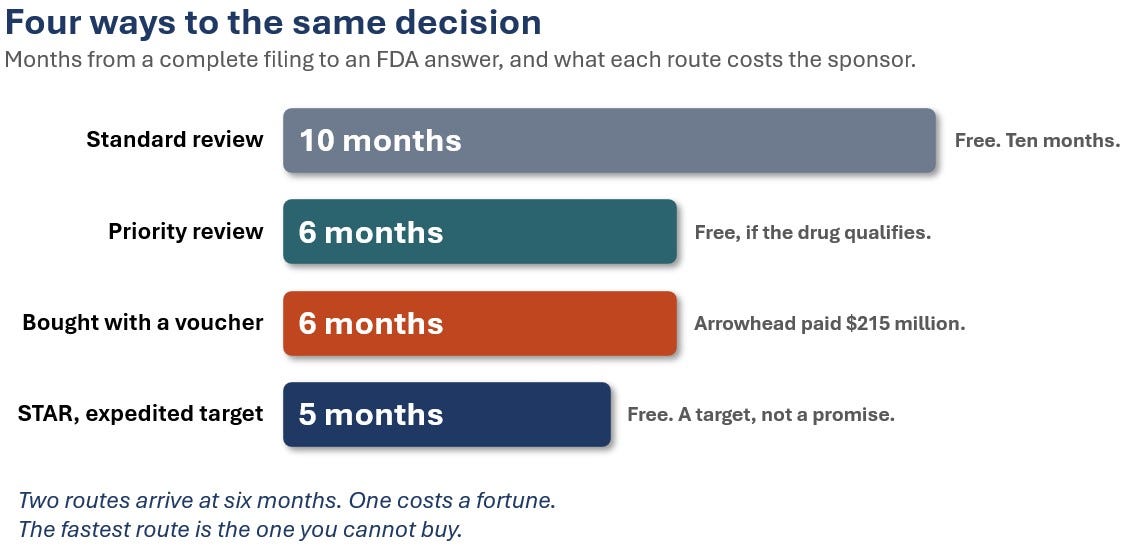
Figure 1. Review times from the FDA's program description and Arrowhead's announcement. The five-month bar is a target rather than a commitment.
3. The lane nobody drove in
Here is where the story stops being routine. The FDA published an assessment of its own pilot earlier this year, and the language is unusually blunt for a regulator describing its own work.
Here are the numbers, published by the agency in January. Across the first three years, through September 2025, the FDA received six requests to enter the program. All six went to the drug center. None went to the biologics center. One sponsor withdrew. The other five were denied. Zero were accepted.
The agency’s own summary of that record: it received no applications in the pilot program as of the end of the 2025 fiscal year. It had committed to holding a public workshop on the program by March 2026, and it cancelled the workshop, on the grounds that it had no experience to discuss. It also ran a separate experiment inviting original applications to use the same split approach, and received no formal requests at all.
Read that again. The agency built a faster lane, kept it open for three years, advertised it in webinars and at industry conferences, and had to cancel the meeting it had promised to hold about the lane, because nobody had driven in it.
Arrowhead’s grant came a year after that assessment window closed, so I cannot call it the first entry ever. The agency has not published a tally for the year since. What I can say is that the pilot spent its first three years at zero, and that this is the only public entry I can find since.
The reasons for the five denials are listed too, and the third one matters for what follows. Applications were turned away for failing the substantial improvement bar, for not addressing a serious unmet need, or because some part of the proposed application would have required a longer review anyway, which would have defeated the purpose of splitting it.
4. Why an empty fast lane stays empty
The obvious question is why a company would decline free speed. The answer is in the mechanics, and it is the most useful idea in this note.
To file in two parts, a company has to finish the whole application except the final study reports two to three months earlier than it otherwise would. The data have to be clean. The manufacturing section has to be done. The proposed label has to be written. The safety summaries have to be nearly complete. All of it has to be good enough to put in front of a reviewer who will start forming opinions immediately, before the company has had a chance to polish the final narrative.
Most organizations cannot do that, and the ones that can often do not want to. A filing is usually a scramble that ends the night before submission. A program that demands the scramble finish a quarter early is not free at all. It is paid for in organizational discipline, months in advance, by a team that has to work differently from how most teams work.
The foreign site rule belongs in the same column, and it screens on a constraint a company cannot fix in a quarter. A great deal of the world’s drug substance is made outside the United States. A sponsor in that position cannot opt in at all, however good the trial was.
Arrowhead built a drug substance plant in Verona, Wisconsin, announced at two hundred to two hundred and fifty million dollars, years before this program mattered to anybody. The rule does not require that plant. It requires that the supplement involve no foreign site, which any domestic manufacturer would satisfy. I have not confirmed which site supplies this filing, so I will not claim the factory bought the entry. What I will say is that a company making drug substance in the United States has one fewer problem to solve here.
The agency’s third reason for denial says the rest of it. A package that would have needed a longer review anyway could not be rescued by splitting it.
The price of admission is not the FDA’s goodwill. It is being finished early.
There is a second implication, and it is worth more than the four months. To hand a regulator the whole application minus the final study reports, a company has to have the trial finished, the database locked and the results settled well before the filing date. The readiness is not a claim about the schedule. It is evidence about it. A company nowhere near a year-end filing would not have been in a position to ask.
The toll on the fast lane is paid in preparation, which is why the lane is empty.
5. The increment
Chess clocks used to be simple. Each player got a fixed allowance, and when it ran out, the game was over regardless of the position on the board.
Modern clocks add an increment. After every move, a few seconds are added back to your clock. Play promptly and you can finish a long game with more time than you started. Dither, and the increment never catches up with what you are burning. The increment does not care how much money you have. It only responds to how you play.
That is the right way to read this announcement. Arrowhead did not buy the time it gained. It was handed time back for having the application far enough along that the agency could start reading it in pieces. Section 8 argues about how many months that is really worth. The mechanism is the same either way.
Preparation is the only currency the clock recognizes.
6. The voucher it no longer needs
At the end of July, Arrowhead agreed to buy a priority review voucher for $215 million, and announced it on August 4. These are transferable tickets that let a company move one application to the front of the queue. The government hands them out as a reward for developing drugs in neglected areas, and they can be sold on.
The company said at the time exactly what the voucher was for: the plozasiran filing in severe hypertriglyceridemia, expected before the end of the year. Nine weeks later, plozasiran qualified through STAR for the same six-month path, and the voucher was no longer needed for the application it had been bought to accelerate. Chris Anzalone said as much in this week’s announcement, noting that the company can now redeploy it or sell it.
That is not a rounding error. Voucher prices have roughly doubled in a few years, and 2026 sales have run between about 180 and 210 million dollars. On the same day as the Arrowhead announcement, Ultragenyx agreed to sell one for 210 million.
The asset is therefore worth roughly what Arrowhead paid for it in July, give or take the spread on a market that prints every other month. The $215 million is not sunk. It is parked.
A voucher can be spent once, and only on a marketing application. The brain program is years away from one, so nobody should read this as a voucher being saved for ARO-MAPT. What Arrowhead holds is simpler: an asset it can turn into cash at any time, or keep for a filing that has not been written yet.
The choice between those two looks different after the fourteenth than it does today. If the company has just shown it can reach the human brain, it has more use for optionality. If it has not, it may prefer the money.
7. The sentence in the criteria
There is one more line worth reading closely. To grant entry, the FDA must determine that clinical evidence from adequate and well-controlled studies indicates the drug may demonstrate substantial improvement on a clinically relevant endpoint over available therapies.
Available therapies in severe hypertriglyceridemia include fibrates, prescription fish oils, and now Ionis’s olezarsen, which reached the indication first. Arrowhead arrived second.
I want to be careful about how much weight that carries. It is a threshold for entering a program, not a finding of superiority. The FDA also states plainly that acceptance guarantees neither the expedited action nor an approval. What entry does secure is the six-month clock. The agency has also said that real-world evidence cannot be used to clear this bar, so what persuaded it came from the controlled trials.
Still, a regulator looked at the plozasiran data and concluded it may substantially improve on what is already available. In the indication where this company got there second, that is the most interesting sentence in the release.
The wording is worth one more beat. The same phrase, substantial improvement over available therapies, is the standard behind breakthrough designation, which plozasiran already holds in this indication. The agency used it once before olezarsen was approved for severe hypertriglyceridemia, and has now used it again, for entry, with that drug on the market. The bar is a criterion for entry and not a ranking. It was applied the second time with a rival APOC-III drug already carrying the label.
The bar was applied a second time, with the competitor already approved.
8. Why this is worth less than it looks
Three reasons, and they belong before the bullish part rather than after it.
A buyer will not pay for a regulatory team. Regulatory affairs is the one capability the large drugmakers have in abundance. Lilly, Roche and Novartis employ hundreds of specialists who do only this work and have dealt with the agency for decades. In an acquisition, a regulatory department is among the most redundant assets on the books. Nobody pays a premium for one. Note the scope of that objection, though. It applies only if the company is sold. If Arrowhead stays independent, the capability is not redundant to anybody, and the next section is about what it is worth in that case.
The criterion judges the data. A superb regulatory group cannot get a mediocre drug into STAR. The criterion is about what the trials showed. Most of this signal is about plozasiran, not about the people who filed the paperwork.
The gain may be smaller than ten minus six. A published study of supplemental approvals found the median review already ran about six months. Plozasiran also already held breakthrough designation in this indication, which points toward priority review on its own. The step from ten months to six may overstate what STAR adds on top of what this drug would likely have received anyway. The genuinely incremental piece is the expedited action target and the earlier start.
9. Why it is worth more than it looks
The tempting conclusion is that Arrowhead has a good relationship with the FDA. That is the lazy version of this argument, and I do not think it is the right one. Agencies do not grant clocks out of affection.
The valuable asset is not a relationship. It is a position, and the difference matters because one of them survives a transaction and the other may not.
A regulatory team can leave, be reorganized, or be made redundant. A regulatory position attaches to the drug. Designations, agreed endpoints, an agency that has already read and accepted a package, a clock that is already shorter: those travel with the asset through any deal, and they convert directly into earlier revenue. Four or five months of a launch is a number that goes in a model.
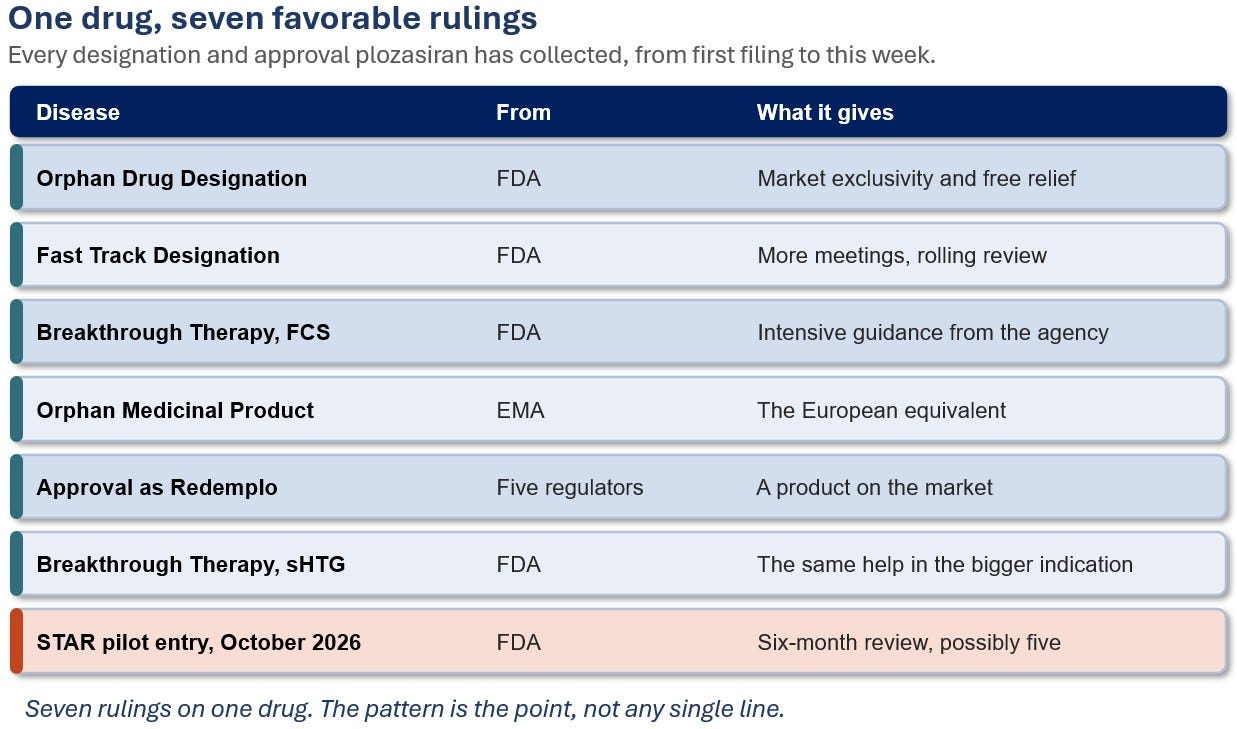
Figure 2. Compiled from Arrowhead’s announcements.
For a platform company the pattern compounds, and that is the part the market has no good way to price. Each successful interaction leaves behind pieces that get used again: manufacturing experience, validated assays, an agency that already understands how this chemistry behaves, and a working sense of what the reviewers will ask next. Scientific precedent in one tissue does not transfer to another, and nobody should pretend it does. The organizational learning does transfer. A company that intends to file drugs in the liver, the lung, fat, muscle and the brain gets that benefit on every one of those filings, not once.
Count what plozasiran has collected. On the designation side: American orphan status, fast track, breakthrough designation in familial chylomicronemia syndrome, European orphan status, and breakthrough designation again in severe hypertriglyceridemia. On the approval side: the United States, the European Union, China, Australia and Canada. STAR is the newest entry on that list rather than the final item in a tidy series. The number is less interesting than the run. None of these came from a single good quarter.
What if nobody buys the company? All of which assumes a sale. Suppose there is not one, which is what the company says it expects. Then the capability stops being redundant to anyone and starts belonging entirely to Arrowhead’s own shareholders, which is a better outcome, not a worse one.
Start with the competitor, and be honest about the size of the gap. Ionis won the severe hypertriglyceridemia label on June 24 of this year and had the drug available in July. Arrowhead files at year end. Even on a six-month clock, an answer lands around the middle of next year. The lead is roughly a year, and most of it is already banked before Arrowhead’s file reaches the agency. Four or five months off the review does not close that. It shortens the tail of it.
Shortening the tail still counts. In a market where an incumbent builds prescriber habit month by month, every month the follower is absent is a month of habit it has to break later. Time to the label is not a soft benefit. It can become share, at the margin, which is where share in these markets is usually won.
Then consider the pipeline. Arrowhead owns key programs outright, including in obesity and liver disease, and its wider pipeline spans the liver, the lung, fat, muscle and the brain. Each of those filings gets the benefit of whatever this team has learned, and none of it is shared with a partner. An acquirer would absorb the capability into a department that already has one. Independence keeps it concentrated in a company where it is scarce.
The clock survives a sale. The team only survives if there is not one.
10. The harder ask
Here is why I think this matters more than a routine press release should, and triglycerides have no part in it.
In a note two weeks ago I argued that Arrowhead’s brain drug may find its fastest path through rare tauopathies rather than Alzheimer’s, and that the route runs through a blood marker of nerve damage called NfL. That argument requires a difficult concession. It needs the FDA to accept a biomarker it has never accepted for a tau disease, in a tiny population, as evidence that a drug is reasonably likely to help.
That is not a filing. That is a negotiation, conducted over years, with a review division weighing an argument no regulator has accepted before. Evidentiary standards do not bend for favored sponsors, and nobody should suggest they do. A company whose last several submissions were clean, early and accurate does walk into that conversation with regulatory credibility already established.
A STAR entry proves no part of that. It is one small piece of evidence that this is the kind of sponsor that shows up with the work done. Seven days before a readout that could make the hard question live, I find that worth noticing.
Finishing a package early and persuading a division to accept a new biomarker are different muscles. This week tested the first one.
11. What would make me wrong
The filing could slip. A filing is on schedule until it is not. Every argument here assumes the sNDA goes in by year end.
Entry is not approval. The FDA says in its own materials that entry guarantees neither an expedited review nor an approval. The clock can be shortened and the answer can still be no.
The lane may be less empty than it looks. If several other companies turn out to have entered quietly, the scarcity argument weakens considerably, and this becomes a competent filing rather than an unusual one.
Good paperwork is not good science. Regulatory fluency and scientific judgment are separate skills. A company can be excellent at filings and still be wrong about which drugs to file.
A faster label is not a faster launch. None of this changes the commercial ramp. Chris called the expansion a slow burn, and a shorter review moves the starting line without changing the slope of what follows.
Time to label may not convert to share. Prescribers switch patients when a drug is better, not only when it is first, and Ionis has most of its lead banked already.
The expedited action may not happen. The earlier action is a target the agency aims at, not a goal date it owes. If the review simply lands on the six-month date, the part STAR uniquely added is the earlier start of reading, not a shorter clock, and the whole gain is smaller than this note implies.
12. Seconds, not dollars
An increment cannot be purchased. You can buy a better computer, a bigger team, a stronger opening repertoire. You cannot buy the seconds that come back after a good move. Those are earned by playing well, one move at a time, and they accumulate quietly until someone looks at the clock late in the game and notices that one player has more time than the other.
Notice also when the work gets done. Nobody at Arrowhead knew in the spring that the FDA would grant this. The application was being finished early anyway, by people who had no way of knowing it would pay. That is the uncomfortable part of an increment. You cannot decide to be ready once the opportunity shows up. The seconds you collect were bought months earlier, in rooms where nobody was watching.
Arrowhead bought a voucher over the summer to be sure of a six-month review. In October it qualified for one anyway, after the drug cleared the bar and the work was far enough along to be read in pieces. The voucher never got used, and the earlier start came on top.
The data arrives on October 14. Whatever the number says, Arrowhead walks into that position with months off one regulatory clock and two hundred and fifteen million dollars of unspent acceleration sitting in a drawer.
You cannot buy an increment. You pay for it in advance, with work nobody watches, and collect it on a clock nobody checks.

A Note on Supporting Independent Research
If this note has been valuable to you, whether it shaped your thinking, validated your conviction, or simply saved you the time of doing this work yourself, a voluntary contribution is genuinely appreciated and directly funds the next paper.
For individual investors and readers
Any amount you feel reflects the value you received is welcome and meaningful. A contribution in the range of what you might pay for a single premium research report is a thoughtful gesture that makes a real difference.
For family offices, investment funds, hedge funds, and research platforms
This paper is the caliber of work that institutional research desks bill significant retainers to produce. If your team referenced it, distributed it internally, or used it to inform a position, a suggested contribution of $1,000 reflects the professional value of the analysis, though any amount is meaningful. Your support makes it possible to continue publishing at this level without a paywall that limits the reach of the ideas. If your organization requires an invoice to process a payment, please reach out directly at bioboyscout@gmail.com and one will be provided promptly.
There is no obligation and no expectation. This is purely a thank you for work that meant something to you.
Zelle: (847) 227-7909
Thank you for reading, and for being part of a community that takes this thesis seriously.
— Robert Toczycki | BioBoyScout
Important Risks, Disclosures, & Disclaimers
The author, Robert Toczycki (aka BioBoyScout), certifies that:
all views expressed in this note accurately reflect his personal opinions about the topic discussed;
he was not compensated in any form for producing this note; and
he has not received and does not receive compensation from Arrowhead Pharmaceuticals.
This note is published by BioBoyScout and is intended for informational and educational purposes only. It does not constitute investment advice, a solicitation to buy or sell securities, or a guarantee of future results. The author holds a long position in Arrowhead common stock. Arrowhead Pharmaceuticals (ARWR) is a publicly traded company; investments in its shares involve material risks, including the risk of total loss. All financial projections, acquisition price estimates, and valuation analyses herein are hypothetical frameworks for analytical purposes and do not represent predictions of actual outcomes. Readers should conduct their own due diligence and consult a registered investment advisor before making investment decisions.
The STAR entry, review timelines, filing schedule, voucher status and Chris Anzalone’s quotation are from Arrowhead’s press release of October 7, 2026. The program’s launch date, two-part submission mechanics, entry criteria, exclusion of real-world evidence, and the statement that acceptance guarantees neither expedited review nor approval are from the FDA’s STAR program materials and from Regulatory Focus reporting of the FDA’s program description.
The entry request counts, the denial reasons, the cancelled public workshop, the separate pilot for original applications and the agency’s inability to assess the program are from the FDA’s published STAR Pilot Program Assessment, covering October 2022 through September 30, 2025 and posted in January 2026. The eligibility criterion barring foreign manufacturing sites, and the attestation verified at the part one submission, are from the FDA’s STAR program webpage. The Verona facility figures are from Arrowhead’s own announcements and from state economic development reporting at the time of construction.
The olezarsen approval date and United States availability are from Ionis’s announcement of June 24, 2026. The voucher purchase price of $215 million, the July 31, 2026 agreement date and the stated intention to use it for the severe hypertriglyceridemia filing are from Arrowhead’s announcement of August 4, 2026 and the subsequent events note to its quarterly report for the period ended June 30, 2026. Other voucher prices are from 2026 transaction announcements, including Ultragenyx’s agreement announced October 7, 2026, and from Endpoints News reporting on the voucher market. The median review time for supplemental approvals is from a 2023 analysis published in JAMA Network Open. The designations and approvals listed are from Arrowhead’s announcements. The chess analogy and the interpretation throughout are the author’s own.
About the Author
BioBoyScout is the publishing name for Robert Toczycki, an independent biotech investment research writer based in Chicago. The BioBoyScout series publishes institutional-grade analysis of structural dynamics in RNA-class therapeutics, with particular focus on Arrowhead Pharmaceuticals’ TRiM platform and the broader competitive landscape. Robert is a registered US Patent Attorney with a JD, an Executive MBA completed at the top of his class, and a BS in Mathematics and Computer Science from the University of Illinois at Urbana-Champaign. He has a deep passion for financial analysis, particularly identifying valuation discrepancies and demonstrating them through rigorous, data-driven research and solid analytics.
Comments or questions: bioboyscout@gmail.com.
Copyright © 2026, BioBoyScout. All Rights Reserved.