

Robert Toczycki, JD, MBA
bioboyscout.com
bioboyscout@gmail.com
847.227.7909
X: @BioBoyScout
1. The presentation nobody went to
Nine in the morning on Monday, in a session called Beyond statins, a physician from Peking Union Medical College Hospital in Beijing presented the first Phase 3 results anywhere in the world for zodasiran.
It appeared in the program under Visirna’s development code, VSA003, rather than zodasiran or ARO-ANG3, the name most Arrowhead investors know it by. Arrowhead mentioned it in one sentence on its investor call an hour later. As far as I can tell, almost nobody wrote about it.
The disease is homozygous familial hypercholesterolemia (HoFH). About as rare as diseases get, somewhere between one in 170,000 and one in 300,000 people.
Here is what these patients are dealing with. Your liver clears cholesterol out of your blood using a receptor on the surface of its cells. These patients inherit defects that leave that receptor pathway severely impaired, in some cases close to nonfunctional. Statins work largely by making the liver produce more of those receptors, so in this disease there is much less receptor function to work with. Untreated, patients develop heart disease as children.
The trial enrolled 46 people in China, 30 on drug and 16 on placebo. Average starting LDL cholesterol was around 390 milligrams per deciliter. A normal number is under 100.
2. The number, and who to measure it against
LDL cholesterol dropped 44.8 percent from where patients started, and 43.9 percentage points more than placebo, at six months. ANGPTL3, the protein the drug is designed to suppress, fell 89.4 percent from baseline, which is 86.2 points more than placebo.
Two comparisons make that number mean something, and neither is obvious from the press coverage.
The first is Arrowhead’s own earlier study. A Phase 2 called GATEWAY, run in a similar population, produced a 35.7 percent LDL reduction at this same dose. The China Phase 3 beat it by about nine points.
That should get your attention. It would have been reasonable to expect some fade in a larger, properly blinded Phase 3, particularly coming off an open-label Phase 2 where everybody knew who was getting the drug. GATEWAY was open-label. This one was blinded. The effect got bigger anyway.
The second is the drug this would compete with. Evinacumab is an approved antibody for this disease, it hits the same target, and in its pivotal trial it lowered LDL by 47.1 percent from baseline. It is given by intravenous infusion, once every four weeks.
Zodasiran came in at 44.8 percent on the same measure. Roughly two points apart. It is a shot under the skin, once every three months.
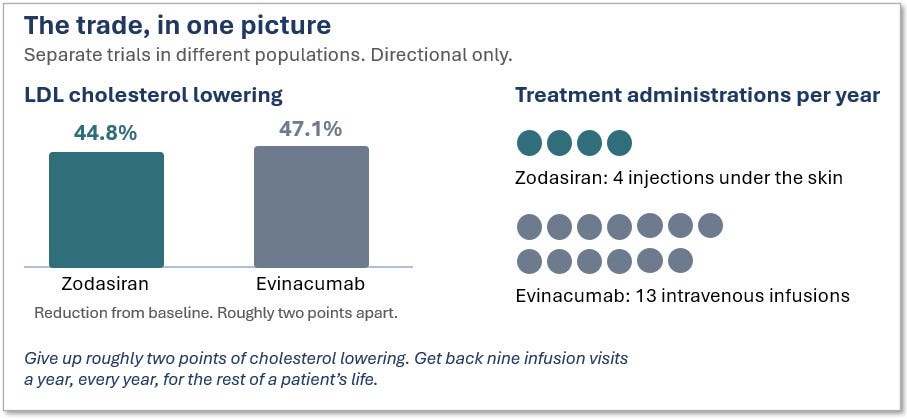
Figure 1. Both figures are reduction from baseline. They come from separate trials in different populations and are not directly comparable.
3. Why those two points are worth giving up
Thirteen infusions a year against four injections. That sounds like a convenience argument until you think about who is receiving them.
This disease gets diagnosed in childhood. Treatment never stops. Plenty of these patients are also on apheresis, which is a procedure that filters cholesterol out of the blood mechanically, and it means hours hooked to a machine every week or two on top of everything else. The average patient in this trial was in their thirties. Four of them were teenagers.
An evinacumab infusion needs a clinic, an appointment, a nurse, an IV line and most of a morning, every four weeks. A quarterly injection is a fundamentally smaller procedure. Even if every zodasiran dose were given in a clinic rather than at home, that is four brief visits a year instead of thirteen infusions. Spread across forty or fifty years of treatment, that stops being about convenience.
Chess has a name for this kind of trade. Giving up the exchange means handing your opponent a rook, the more valuable piece, in return for a bishop or a knight and a better position. On the scoresheet you have lost material. Tigran Petrosian built a world championship partly on these, and for years both computers and commentators undervalued them, because material is easy to count and position is not.
Zodasiran gives up roughly two points of cholesterol lowering. It gets back nine infusion visits a year, every year, for the rest of somebody’s life. Anyone scoring this on the efficacy number alone is counting material and ignoring the position.
Worth adding: two thirds of the patients in this trial were already on a PCSK9 inhibitor, and the drug worked on top of it.
4. What the slides left out
Two things are missing from the presentation, and I think both are informative rather than sinister.
The responder rate stops at 30 percent. The trial design slide says they planned to report the share of patients who cut LDL by at least 30 percent and by at least 50 percent. The results give you the 30 percent number, which was 83.3 percent of treated patients. The 50 percent number never appears. In a deck built to show a drug at its best, the omission suggests that number was not the headline.
Goal attainment is missing too. The presentation does not report how many patients reached a specific LDL target, and a group average cannot answer that question, because patients did not all start in the same place or respond by the same amount. What the average does tell you is how brutal this disease is. The treated group started around 383 milligrams per deciliter, and even a 45 percent cut leaves the average patient well above what guidelines want for an adult with this condition. Some individuals may well have reached goal. The slides do not say how many.
This should eventually get a real answer. The global Phase 3, called YOSEMITE, lists the proportion of patients getting below 100 milligrams per deciliter as a secondary objective. It is fully enrolled at 70 patients with completion expected around the middle of 2027.
5. The liver signal
Start with the context. Overall side-effect rates were essentially identical, 76.7 percent on drug against 75.0 percent on placebo, and there were no drug-related serious adverse events at all. Against that backdrop, one thing stands out.
Three patients on drug had liver-related adverse events flagged. None on placebo did.
Two were mild elevations in a liver enzyme called AST, three to five times the normal ceiling. One was moderate, above five times, and the investigator judged it probably unrelated to the drug. All three cleared up within six weeks. Total bilirubin stayed below twice the normal ceiling in every case, and that matters: a substantial bilirubin rise alongside those enzyme elevations would raise considerably more concern for clinically significant drug-induced liver injury.
The slide separately notes two moderate drug-related events in patients whose liver enzymes were already abnormal before they started. Both were still unresolved when the database closed.
Three events in thirty patients is a small number and a real one. I would watch it rather than worry about it, and I would want the imaging. An earlier zodasiran study measured liver fat directly by MRI and found it moved in the favorable direction. This trial did no imaging at all, and that is a gap I would want closed somewhere in the broader zodasiran safety package.
One detail says somebody was paying attention. Worsening blood sugar in diabetic patients was written into the protocol in advance as something to watch for specifically. Zero events, both arms.
There was one death, sudden cardiac death in a 61-year-old woman with several risk factors, judged unrelated to treatment. In a population carrying extreme lifetime cardiovascular risk, a sudden cardiac death is unfortunately not unexpected. Somebody will still quote it without the context.
6. The number worth watching
Lipoprotein(a) came in 28.9 percentage points lower than placebo, with a p-value of 0.0016. Lp(a) is set by your genes, barely responds to anything, and independently drives cardiovascular risk. A reduction that size from a drug not designed to touch it would be genuinely interesting.
I would hold it loosely. The placebo group started with much higher Lp(a) than the treatment group, 148.8 against 116.5, which is a real imbalance in a 46-person trial. The spread around the estimate is wide. The pivotal antibody data against this same target did not show anything close to this magnitude of Lp(a) lowering.
Worth watching in the global study. Not worth building anything on yet.
7. The pattern, which is the actual story
This is the second time in two days that Arrowhead presented a Phase 3 result resting on the same foundation.
Sunday: plozasiran matched or beat an approved competitor on triglyceride lowering and offered four injections a year against that competitor’s twelve.
Monday: zodasiran came within roughly two points of an approved competitor on LDL lowering and offered four injections a year against that competitor’s thirteen intravenous infusions.
Different disease, different target, different competitor, different continent. One sentence describes both. Comparable efficacy, radically better delivery.
That is what a platform looks like when it is working. Raw potency is not the common denominator here. Efficient delivery and durability are. Arrowhead is getting a molecule where it needs to go and producing gene silencing durable enough to dose on a schedule a patient can actually live with, which is the thing that has always been hardest in this field.
8. What it is actually worth
Very little directly. Quite a lot indirectly.
The direct commercial opportunity is not the point. China has roughly 5,000 patients with this condition, and only about four percent of them are on any cholesterol-lowering therapy at all. Greater China rights are licensed to Visirna, which is Arrowhead’s majority-owned regional vehicle rather than an unrelated partner, so the economics are not entirely someone else’s. Even so, nobody should be modeling meaningful revenue off a few thousand Chinese patients.
What it buys is a positive, blinded Phase 3, run separately by Visirna in China, on the same molecule in the same indication as the global YOSEMITE program. Zodasiran has had a complicated history, and in this disease specifically, until Monday it was an asset with encouraging open-label Phase 2 data and an open question about the liver. It is now an asset with a blinded Phase 3 that beat its own Phase 2.
That does not make zodasiran approved in Arrowhead’s major commercial markets. It changes what it is reasonable to assume about the trial that would.
9. The chair
Strip out the endpoints and it comes down to something simple.
Somebody with this disease will spend their life in treatment. The question Monday answered was not whether a new drug lowers cholesterol, because the approved antibody already does that, and slightly better. The question was how much of that life has to be spent sitting in a clinic.
Arrowhead did not present a better cholesterol drug on Monday. It presented one that is nearly as good and asks for a fraction of the patient’s life. That has been the argument all week.

A Note on Supporting Independent Research
If this note has been valuable to you, whether it shaped your thinking, validated your conviction, or simply saved you the time of doing this work yourself, a voluntary contribution is genuinely appreciated and directly funds the next paper.
For individual investors and readers
Any amount you feel reflects the value you received is welcome and meaningful. A contribution in the range of what you might pay for a single premium research report is a thoughtful gesture that makes a real difference.
For family offices, investment funds, hedge funds, and research platforms
This paper is the caliber of work that institutional research desks bill significant retainers to produce. If your team referenced it, distributed it internally, or used it to inform a position, a suggested contribution of $1,000 reflects the professional value of the analysis, though any amount is meaningful. Your support makes it possible to continue publishing at this level without a paywall that limits the reach of the ideas. If your organization requires an invoice to process a payment, please reach out directly at bioboyscout@gmail.com and one will be provided promptly.
There is no obligation and no expectation. This is purely a thank you for work that meant something to you.
Zelle: (847) 227-7909
PayPal: paypal.me/bioboyscout
Thank you for reading, and for being part of a community that takes this thesis seriously.
— Robert Toczycki | BioBoyScout
Important Risks, Disclosures, & Disclaimers
The author, Robert Toczycki (aka BioBoyScout), certifies that:
all views expressed in this note accurately reflect his personal opinions about the topic discussed;
he was not compensated in any form for producing this note; and
he has not received and does not receive compensation from Arrowhead Pharmaceuticals.
This note is published by BioBoyScout and is intended for informational and educational purposes only. It does not constitute investment advice, a solicitation to buy or sell securities, or a guarantee of future results. The author holds a long position in Arrowhead common stock. Trial figures come from the presentation delivered at the ESC Congress on August 31, 2026. Comparisons to GATEWAY and to evinacumab are across separate trials in different populations and are directional only. Zodasiran is investigational and has not been approved by any regulatory authority for this indication. Arrowhead Pharmaceuticals (ARWR) is a publicly traded company; investments in its shares involve material risks, including the risk of total loss. All financial projections, acquisition price estimates, and valuation analyses herein are hypothetical frameworks for analytical purposes and do not represent predictions of actual outcomes. Readers should conduct their own due diligence and consult a registered investment advisor before making investment decisions.
About the Author
Robert Toczycki is an independent analyst and registered US Patent Attorney with a JD, an Executive MBA completed at the top of his class, and a BS in Mathematics and Computer Science from the University of Illinois at Urbana-Champaign. He has a deep passion for financial analysis, particularly identifying valuation discrepancies and demonstrating them through rigorous, data-driven research and solid analytics.
Comments or questions: bioboyscout@gmail.com.
Copyright © 2026, BioBoyScout. All Rights Reserved.