

Robert Toczycki, JD, MBA
bioboyscout.com
bioboyscout@gmail.com
847.227.7909
X: @BioBoyScout
JPMorgan’s sum-of-the-parts model for Arrowhead assigns $1 per share to the company’s brain program. Not 1 billion. $1.
That number is not an insult. It is an accounting convention. Analysts price what has been proven and hold a placeholder for what has not, because a model that pays in advance for unproven platforms has stopped being a model. The placeholder is honest.
The question, then, is not whether the Street has overlooked the central nervous system platform. It has not. It has explicitly chosen not to value it yet, and that choice is internally consistent: there is no human evidence to price, so a placeholder is the disciplined answer. The argument of this note is not that the choice is wrong today. It is that the choice is about to be overtaken by the exact evidence it has been waiting for.
It is also the most important number in the model, because the thing it is holding a place for is not one drug.
1. What the market is actually pricing
When the SHASTA readout landed, the market rerated Arrowhead in a hurry. The stock rose roughly 19 percent in a single session, its best day in nearly eight months, to a fresh 52-week high. Analysts moved with it: Morgan Stanley lifted its target to $120, Piper Sandler to $126, Chardan to $115, with others following. The cardiometabolic data was real, and the Street repriced it enthusiastically and fast.
That is exactly what makes the next observation so striking. Look at what those same, freshly raised targets still assign to Arrowhead’s brain program. In JPMorgan’s sum-of-the-parts model, it is $1. The analysts who had just moved their targets $15 to $40 higher on the cardiometabolic franchise did not move the platform, because there was nothing new to move it on.
That is the structure worth holding in mind. The market prices Arrowhead’s drugs readily, and repriced them the moment SHASTA gave it something to model. What it will not price is Arrowhead’s platform, and it declines for a defensible reason: the platform’s central claim has never been proven in a human brain. This September, the first data that could prove it arrive. The drugs already have their catalyst. The platform is still waiting for its.
2. A keystone, not a brick
An arch is not built like a wall. Every stone leans on the others, and none of them carries load until the last stone, the keystone, is set at the top. Before it goes in, the structure is scaffolding and intention. After it goes in, every stone locks into place and the arch carries weight it could not carry a moment earlier.
ARO-MAPT is the keystone of this thesis. It has been dosing subjects since December 2025, and management has now guided topline data from the healthy-volunteer cohort to September, so the readout is an imminent result from a trial already underway, not a distant event. Beyond that timing, it is not testing one proposition. It is testing four, at the same time, in the same patients.
The drug question. Does lowering tau in the human brain accomplish anything? Tau is the protein whose tangles track most closely with cognitive decline in Alzheimer’s disease. One tau-lowering drug, Biogen’s diranersen, has produced a suggestive clinical signal, but it missed its primary endpoint and did not reach statistical significance, so whether removing tau changes the course of the illness remains unproven.
The delivery question. Can an injection under the skin silence a gene inside the brain? This is the one that matters most, because nobody has done it. Every genetic medicine for the brain in the clinic today is delivered by lumbar puncture, a needle placed into the spinal canal.
The pipeline question. Arrowhead has guided a substantial expansion of its central nervous system pipeline at the end of 2026, contingent on encouraging data, and on the earnings call management tied that expansion directly to a successful MAPT readout, noting it would validate the platform for numerous additional CNS programs including partnered ones. Today that expansion is a promise. A good readout converts it into a plan.
The platform question. Does the engine that reached liver, lung, muscle, adipose tissue, and now the brain keep converting delivery capability into clinical programs at the pace it has managed so far?
Four propositions. One readout.
3. Why a good result would compound rather than add
Here is the part that models handle badly, and it is worth walking through slowly because it is the analytical core of this note.
When several uncertain propositions must all be true, their probabilities multiply rather than add. Give each of the four above an even chance and the joint probability is not one half. It is one sixteenth. That is roughly how a platform ends up valued at $1: not because anyone believes it is worth $1, but because a chain of individually reasonable discounts produces a number near zero at the end of the chain.
Now run it in the other direction. A readout that provides the first human validation of the delivery platform does not remove one term from that chain. It removes the condition every other term was hanging from. The drug question, the pipeline question, and the platform question were all discounted for the same underlying doubt, which is whether Arrowhead can put a silencing molecule where it needs to go. Answer that doubt once, and three other discounts collapse alongside it.
This is why the repricing would be nonlinear. The model does not move from $1 to $2. The model changes category, from a pipeline of separately discounted drugs to a validated platform, and platforms are valued on an entirely different basis. One clarification keeps this honest: a good readout would be the first human proof of concept for the delivery architecture, not a guarantee that every future central nervous system program built on it will succeed. What it validates is the route. Each program still has to earn its own approval. That is enough to move the platform off a placeholder, because the market is not pricing certainty on every program; it is pricing whether the architecture works at all.
4. The precedent nobody is citing
There is a temptation to treat all of this as theory. It is not. The most important part of the argument has already been tested in the market, in the same organ, against the same modality, delivered by the same route.
In 2016, Biogen launched Spinraza, an antisense oligonucleotide for spinal muscular atrophy delivered by lumbar puncture. It was the first treatment ever approved for the disease, and it became the standard of care.
In 2020, Roche launched Evrysdi. It works on the same underlying biology, the splicing of the SMN2 gene, toward the same therapeutic goal. The meaningful difference is that patients drink it.
By 2024, Evrysdi was the global market leader in spinal muscular atrophy, with more than 16,000 patients treated and revenue growing 18 percent. Spinraza’s revenue fell roughly 10 percent to $1.57 billion. Roche’s own explanation for the gain was that Evrysdi is the only noninvasive treatment for the disease. Trade coverage put it less delicately: the oral drug removes the need for painful lumbar injections.
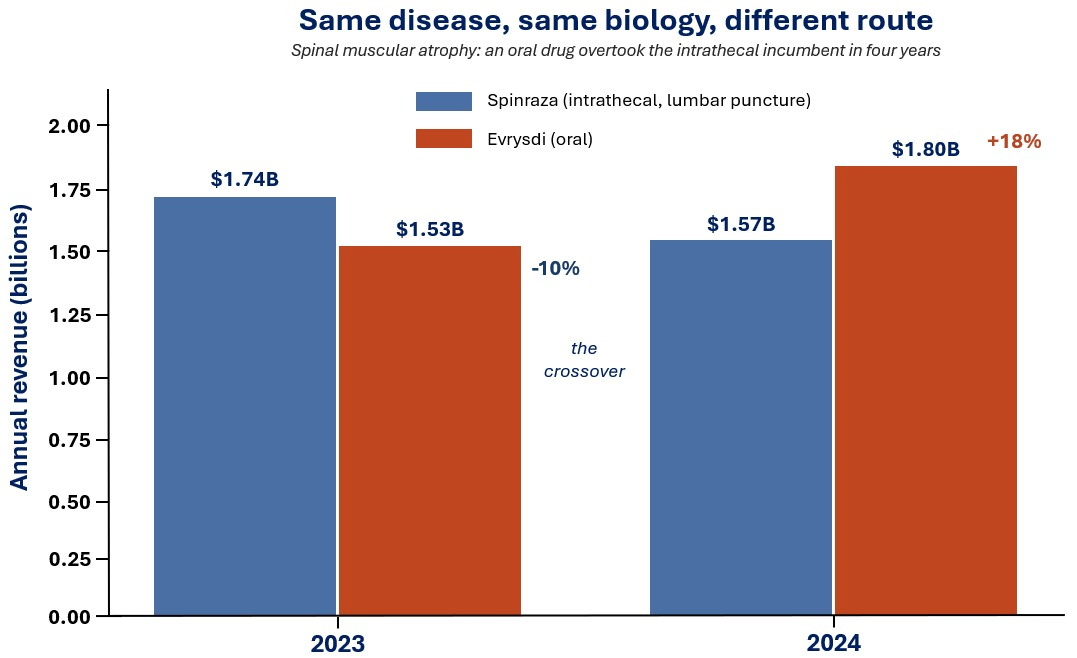
Figure 1. Reported annual revenues. Evrysdi converted from Swiss francs; 2023 figures derived from reported year-over-year changes. The incumbent was first, effective, entrenched, and backed by a large company. It lost its lead in roughly four years, and it lost on route of administration.
Read that sequence carefully, because it is this entire thesis in miniature. Nothing about Spinraza stopped working. What changed is that patients were offered the same biology without the needle in the spine, and they took it. That is what a delivery shift looks like when it arrives. It is neither gradual nor polite.
5. What the precedent implies for the incumbents
Every genetic medicine for the brain in clinical development today is delivered into the spinal canal.
Ionis, the pioneer of the field, describes a neurology franchise that addresses all major brain regions, with 13 investigational medicines in clinical development. Spinraza for spinal muscular atrophy and Qalsody for SOD1-ALS are on the market. ION582 for Angelman syndrome is in Phase 3 with Breakthrough Therapy designation. ION717 targets prion disease, zilganersen has cleared its pivotal study in Alexander disease, and further programs address Huntington’s disease, multiple system atrophy, Parkinson’s, and Alzheimer’s. Diranersen, the tau program partnered with Biogen, belongs to the same family. Every one of them is administered by lumbar puncture.
Those are real medicines, and several of them are genuinely important advances for patients who had nothing. Spinraza alone still generates over $1.5 billion a year, and the broader intrathecal neurology franchise across these companies runs to billions more in current and projected revenue, all of it delivered by lumbar puncture. The argument here is not that they stop working. The argument is that their long-term value quietly assumes the route survives, and a validated subcutaneous alternative would not compete with them one drug at a time. It would date the route they all share.
Two honest limits belong on that claim. Antisense chemistry reaches targets and cell types that RNA interference may not, so the two approaches are not perfectly substitutable, and not every brain target will yield to a silencing molecule delivered under the skin. A first-in-human readout also proves biology rather than commercial displacement, which takes years to play out.
There is a further wrinkle that makes the route question sharper than mere convenience. Diranersen’s own trial produced an inverse dose response, in which the lowest dose performed best, alongside a confusional state that climbed from 5 percent on placebo to 28 percent at the highest dose. The chief executives of both Voyager and Denali publicly attributed that pattern to delivery rather than to tau biology. The same trial appears twice in this note, once as evidence that tau-lowering is not yet proven and here as evidence that the route may be the problem, and both readings can hold at once: the drug missed, and the delivery is a plausible reason it did. If that reading is right, the intrathecal route is not simply inconvenient. It may be the constraint on the dose.
6. Value does not appear, it moves
Markets reprice shifts of this kind abruptly, and the mechanism is worth understanding. In the clinic, a transition from one delivery route to another takes years. In a model it takes an afternoon, because an analyst does not gradually shade down an incumbent’s terminal growth rate. The analyst changes the assumption.
A validated subcutaneous route into the brain would therefore do two things simultaneously. It would create a platform premium where a placeholder used to sit, and it would begin subtracting terminal value from franchises built on the older route. The total value of treating brain disease would not change much on the day of the readout. The ownership of that value would start to.
That is the difference between a good clinical result and a repricing event.
7. How large a repricing, and why the number is conservative
The natural question is how large. This note will not answer it with a single price target, because a point estimate on an unproven readout is false precision. What it will do is build the number from the model already on the Street, state every assumption, and then show that the result is conservative against what buyers have actually paid. A skeptical analyst should be able to rebuild it and land in the same range.
Begin with the model itself, since the argument requires no new one. JPMorgan's sum-of-the-parts is a discounted-cash-flow build on roughly 134 million shares. In the breakdown published with its $95 target, the components were approximately $48 a share for Redemplo in severe hypertriglyceridemia, $5 for Redemplo in familial chylomicronemia, $5 for zodasiran, $10 for the obesity programs, $12 for partner milestones, and the balance in cash and tax assets. The brain platform, meaning ARO-MAPT plus the entire central nervous system pipeline plus the delivery technology, was carried at $1. JPMorgan raised the target to $100 the day after the third-quarter print. That raise followed a quarter dominated by cardiometabolic and commercial progress, the priority review voucher, the SHASTA strength, the accelerated sHTG path, rather than any human brain data, so there is no reason to think the extra value reflects a new credit for the platform. Absent a fresh readout, the platform remains the placeholder this section reprices. That single dollar is the line the argument turns on. Everything else is left as JPMorgan has it.
The four components of a repriced platform
A good readout does not lift the platform line by a few dollars. It forces an analyst to build a line item that does not currently exist, out of four distinct value pools. Each is estimated separately below, deliberately, so that a reader can dispute any one without collapsing the rest.
One: ARO-MAPT itself. Value the lead asset the way an analyst values any de-risked clinical program, with a risk-adjusted net present value. Assume a peak-sales estimate for a subcutaneous tau therapy in early Alzheimer’s that is deliberately modest by the standards of the indication, on the order of $4 to $6 billion, reflecting a large patient population against meaningful competition and pricing pressure. Assume an unadjusted program value of roughly 1.5 to 2 times peak, standard for a durable therapy with a decade of exclusivity. Then apply a probability of success that a positive biomarker readout would support but not inflate, in the range of 15 to 20 percent, which respects Alzheimer’s long history of late-stage failure. The product lands near $12 to $18 a share. Note the discipline in that figure: it already assumes most versions of this drug fail.
Two: the wholly-owned central nervous system pipeline. Arrowhead has guided a substantial expansion of its own central nervous system programs contingent on encouraging data, a linkage management restated on the earnings call. A positive readout converts that guidance into credible, separately valuable programs beyond tau. Ascribe only a few risk-adjusted dollars to each of a small number of them and the pool is worth roughly $10 to $15 a share. This is distinct from the value of ARO-MAPT and distinct from the platform’s licensing value below, and it is priced as option value, not as certainty.
Three: the delivery platform as a business asset. Separate from any drug Arrowhead develops itself is the value of a proven subcutaneous route to the brain that other companies will pay to use. This is not speculative. Novartis has already paid $200 million up front and committed up to $2 billion for one program and a few targets built on this platform, before any human brain data. That is the observed price of a single slice. Assigning the entire platform’s licensing potential $12 to $20 a share, roughly $1.5 to $2.5 billion, values the whole at less than what Novartis committed for a fraction. A conservative anchor by construction.
Four: validation of the existing partner licenses. JPMorgan already carries $12 a share for partner milestones. A positive readout raises the probability of the central nervous system portion of those milestones, the Novartis synuclein program and the Sarepta ataxia and Huntington’s programs, all of which ride the same architecture. Marking up only that portion adds roughly $5 to $10 a share. This is an increase to an existing line, not a new invention, which makes it the least disputable of the four.
Summed, the four pools rebuild the platform line from $1 to roughly $40 to $55 a share. Since that line entered JPMorgan’s target at $1, replacing it means adding roughly $39 to $54 of platform value on top of the rest of the model. Set against JPMorgan’s current $100 target, that points to a base case in the rough vicinity of $140 to $155. The precise figure depends on JPMorgan’s latest component split, which is not the point. The point is the shape of the move: a repricing of $40 to $55 a share, or something over 40 percent, off a target that still prices the platform at nothing.
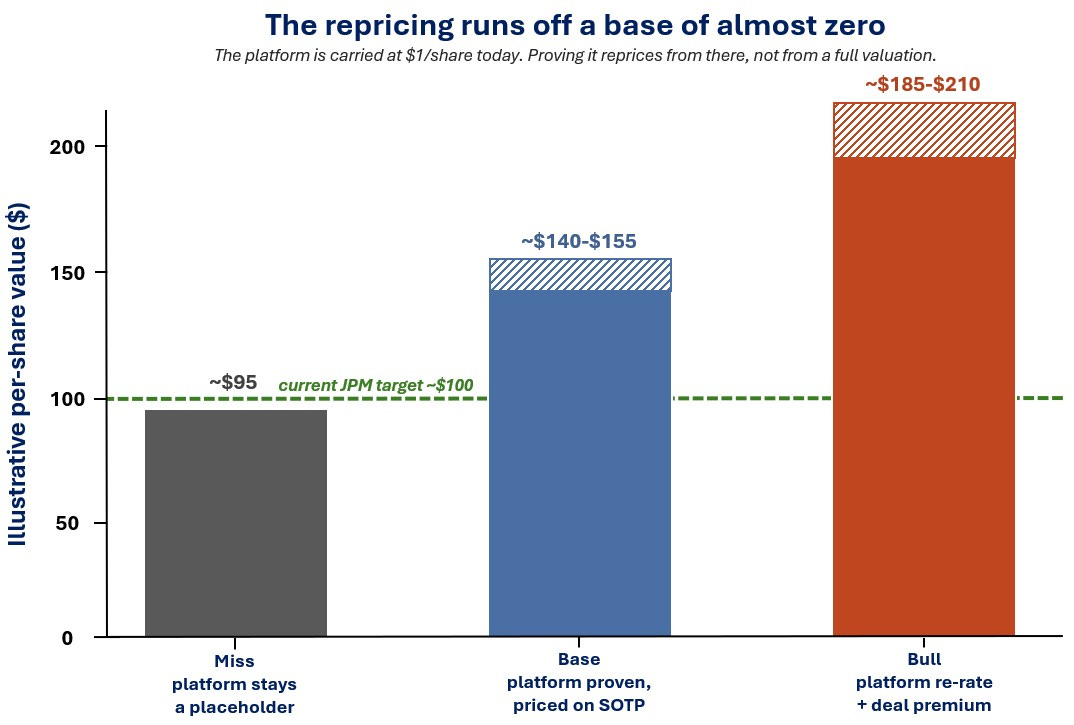
Figure 2. Illustrative, not a forecast. The scenarios reprice only JPMorgan’s $1 platform line; every other component of JPMorgan’s target is held fixed. Figures illustrate magnitude and are not price targets.
Why this is the conservative case, not the bullish one
The test of any target is what informed buyers pay for comparable assets, and here the comparison is unusually direct. In October 2025 Novartis agreed to acquire Avidity Biosciences for approximately $12 billion, an $11 billion enterprise value, for a platform that delivers RNA to one tissue, muscle, with three late-stage assets. Novartis described the capability as one competitors had struggled to replicate and paid a 46 percent premium for it. The comparison is not exact, since Avidity also carried three late-stage clinical assets that Arrowhead’s early brain program does not yet match, but it remains informative on one point the debate turns on: what a proven single-tissue delivery platform commands in a real transaction. Alnylam, whose platform remains concentrated in the liver, carries a market capitalization in the tens of billions and is itself now pushing RNAi into Alzheimer’s, which tells you where the field believes the value is going.
Set the base case against those marks. It implies a platform worth roughly $45 a share, about $6 billion. Novartis paid twice that for a single-tissue platform. The base case therefore values Arrowhead’s entire multi-tissue platform, liver, lung, muscle, adipose, and a validated route to the brain, at half of what one tissue fetched in a real transaction months ago. Either the base case is too low, or Novartis materially overpaid for Avidity. Both cannot be true, and a buyer paying an $11 billion enterprise value in cash is the harder number to dismiss.
The right way to read the base case, then, is as a floor rather than a midpoint. It is built from deliberately conservative inputs at every step, a modest peak-sales figure, a low probability of success, a licensing value set below what a partner has already paid for a fraction of the platform, and it still lands beneath the price a real buyer paid for a narrower asset months ago. A base case that sits below the observable market-clearing price is doing its job as a floor. The honest implication is that the expected value most likely sits above the stated base range, not at its center, and the numbers are kept low on purpose so that the case does not depend on the optimistic end of any single assumption.
One source of upside sits entirely outside these figures and is worth naming precisely because it is not in them. The four pools value Arrowhead as a standalone platform. They contain no control premium. A positive readout would raise the market’s implied probability of an acquisition, and an acquirer would pay above the standalone value, that is what a control premium is. That premium is real and it skews the entire distribution to the upside, but it is left out of the modeled numbers on purpose, because quantifying it would mean stacking a guessed probability of a deal on top of a guessed premium, and a case that needs a takeover to work is a weaker case than one that does not. The repricing above stands on fundamentals alone. The acquisition premium is additional upside on top of it, directional rather than modeled, and it widens the right tail well beyond the bull case.
The magnitude is not an aggressive assumption laid on top of the model. It is what the model produces once the zero is filled in, and it still values a proven multi-tissue platform below what a single tissue sold for this year.
The bull case, and what it requires
The bull case, roughly $185 to $210, is not a larger version of the same arithmetic. It requires the category switch described earlier to actually occur: the market stops valuing Arrowhead as a pipeline of risk-adjusted drugs and starts valuing it as a platform company, on the higher multiple those command. That is where the pipeline expansion, the partnered licenses, and a live acquisition premium all begin to carry value at once, and it is the softest of the three scenarios because it depends on a change in how the market frames the company, not only on the data. It is included for completeness and flagged as the least certain.
The objections a careful reader will raise
Three are worth answering directly.
That Alzheimer’s always fails: conceded, which is why the probability of success above sits at 15 to 20 percent rather than higher, and why the platform’s value does not depend on ARO-MAPT’s clinical success alone, since the delivery proof validates the route regardless of the drug’s eventual outcome in dementia.
That a biomarker is not clinical benefit: also conceded, and it is why the readout is a repricing trigger rather than a settlement, with full value accruing over years as later data matures.
That the drug value and the platform value double-count: they do not, and the four pools above are defined to be mutually exclusive, one drug, other drugs, licensing to third parties, and an uplift to an existing milestone line. On share count, the analysis uses JPMorgan’s own 134 million throughout, so a larger diluted figure would lower every per-share number proportionally while leaving the percentage move, which is the quantity that matters, unchanged.
8. Why proof, not price, has been the obstacle to a deal
The most common objection to the acquisition thesis is that Arrowhead has become expensive. That has the logic backwards.
A large acquirer cannot justify paying platform multiples for a platform that has not been proven. That is a governance problem before it is a financial one, since the board that approves the premium has to defend the evidence behind it. The obstacle was never the price of the asset. It was the absence of the evidence that would make the price defensible in a boardroom.
Proof removes that obstacle, and it removes it in the direction of urgency. A de-risked delivery platform that reaches the brain would be the scarcest asset in an industry facing the largest patent expiration cycle in two decades, and there would be exactly one of them. It would also carry a defensive motive that does not exist today, because whoever owns the successor route owns an option on every franchise built on the route it replaces.
Novartis has already partially voted. In 2025 it paid $200 million up front, with up to $2 billion in milestones, for a preclinical Arrowhead brain program and access to the platform, before any human brain data existed at all. That is what a sophisticated buyer pays for an unproven platform. Novartis is not the only buyer paying, either: within the most recent quarter Madrigal licensed a clinical-stage Arrowhead liver program for $25 million up front and up to $975 million in milestones, one more sophisticated buyer paying to rent the engine rather than build one. The interesting question is what a buyer pays for a proven platform, and what a rival pays to keep it from happening.
Novartis is not the only one exposed to the readout. The same subcutaneous delivery platform ARO-MAPT is about to report on in humans is the one that carries a row of already-licensed brain programs. Novartis holds the rights to ARO-SNCA for Parkinson's disease, described in the deal itself as subcutaneous delivery to the central nervous system, plus options on further targets. Sarepta has licensed a set of central nervous system programs run on the same architecture, covering ataxias and Huntington's disease, with the right to add more.
Every one of those licenses was written on the belief that a subcutaneous injection can silence a gene in the brain. ARO-MAPT is the first clinical test of that belief, now dosing patients with topline data guided to September. A positive readout does not just validate Arrowhead's own programs; it validates every partner's license at once, and confirms that the companies which paid for early access were paying for something real.
None of this makes a transaction certain. It makes the specific thing that has been preventing one go away, which changes both the probability and the timeline.
9. The honest asymmetry
Everything above is conditional, and the condition may not be met.
If ARO-MAPT disappoints, the sequence runs in reverse. The platform premium does not appear. The pipeline expansion guided for the end of 2026 reverts to a hypothesis. The intrathecal incumbents receive a reprieve, because the route everyone criticizes remains the only route that works. The delivery question, the keystone, stays unanswered, and the discount stays applied.
What does not change is the floor. SHASTA-3 and SHASTA-4 have already read out, plozasiran is approved and launching in five geographies, the cardiometabolic franchise is real revenue rather than a projection, and the balance sheet holds roughly $1.57 billion in cash and investments even after the company committed $215 million to a priority review voucher to pull the sHTG approval forward. Management has put the peak sales of that broader approval in the $3 to $4 billion a year range. A disappointing brain readout does not touch any of that.
Underneath that floor, the company is compressing the approval timeline on two separate fronts, and the distinction between them is worth getting right. The priority review voucher shortens the review clock itself, taking the FDA standard review from ten months down to six once the clock starts. Per JPMorgan, management has already told the FDA of its intent to use the voucher, a step required ninety days before filing, and separately intends to request the agency’s Split Real-Time Application Review, or STAR. STAR does not obviously shorten the six-month clock further. It works on a different segment of the timeline, letting a sponsor split the submission into two parts filed roughly two months apart so the agency can begin reviewing the first part before the complete package arrives, with the formal clock starting on the second.
The benefit is front-loading rather than a shorter clock, so the honest way to hold it is as a second, smaller accelerator on the submission-to-clock-start window, not as further compression of the six months the voucher already buys. Two caveats keep it grounded: STAR is a limited pilot with a small number of slots, and it carries eligibility conditions, including a disqualifier tied to foreign manufacturing sites, so an intent to request is not the same as an acceptance. The signal that matters is directional. A company does not pursue two independent acceleration mechanisms at once for an approval it is unsure it wants to reach quickly.
It is worth naming the pattern in these moves, because it is the same quality the platform thesis depends on. Management treated time as a quantified asset and acted on it. It paid for the voucher in cash rather than issuing stock, it timed the regulatory communication to the ninety-day requirement rather than improvising, it layered a second acceleration request on top, and the chief financial officer put the company’s own arithmetic on the decision, describing the four-month pull-forward as worth more than three times the price of the voucher on present value alone, before any competitive benefit from reaching the market ahead of a rival. Read together, these are the actions of a team that knows precisely what its time is worth and spends to protect it. That disposition is not incidental to this note. The value in the sections above depends on execution, on a company that converts capability into approved, launched, partnered programs at a consistent pace, and the way management handled this approval is one more piece of evidence that the execution is real.
The asymmetry is the actual investment observation in this note, and it is more useful than any target price. The downside is bounded by a commercial franchise that already exists. The upside is not a higher number in the same model. It is a different model.
One caution belongs here on what would count as success. A first-in-human readout of this kind is a biomarker and safety event. It shows whether the drug reaches the brain, how much tau it removes, how long the effect persists, and whether patients tolerate it. It does not show that patients get better, which requires years and far larger trials. Reading a strong biomarker result as proof of clinical benefit would be the same error as pricing the platform at $1, made in the opposite direction.
10. What to watch when the data arrives
Five things will separate a good headline from a result that confirms the thesis.
Depth of knockdown. In primates, Arrowhead reported roughly 70 to 80 percent reduction of tau messenger RNA across brain regions, and 50 to 60 percent reduction of tau protein in cerebrospinal fluid sustained for months. The two figures measure different things, and the distinction matters for reading the human data. Messenger RNA knockdown cannot be measured directly in a living human brain, so the number a first-in-human study reports is the cerebrospinal fluid tau protein reduction.
Management has now named its target explicitly, guiding to a 50 to 60 percent knockdown and anchoring that level to the degree of tau lowering associated with clinical improvement in the reference literature. That is the benchmark to hold the September data against, and it lines up with the primate cerebrospinal fluid figure rather than the higher messenger RNA number. A reader who remembers the 70 to 80 percent primate mRNA figure and expects it in humans is measuring against the wrong yardstick, the gap between species is where optimism usually goes to die, and the honest comparison is the cerebrospinal fluid number the company has itself put forward.
Regional distribution. This is the most important item on the list and the least discussed. A drug delivered into spinal fluid diffuses inward from the surface, so it reaches superficial cortex more readily than the deep structures beneath, and those deep structures carry much of what patients and families actually care about. Cerebrospinal fluid tau cannot show this; only imaging can, which is why the exploratory tau-PET readout, if the company reports it, matters more than the headline knockdown number. Whether Arrowhead shows the drug reaching deep structures, rather than an aggregate figure alone, is the difference between reaching the brain and reaching the part of the brain that matters. A leading tau imaging researcher raised exactly this question about the Biogen data, and Biogen did not answer it.
Durability. Duration of effect per dose determines dosing frequency, and dosing frequency is where a subcutaneous route turns a scientific advantage into a commercial one.
Safety, specifically its absence. The signature that follows oligonucleotides in spinal fluid includes inflammation of the cerebrospinal fluid, rising neurofilament light as a marker of neuronal injury, and ventricular enlargement. A clean profile on those measures would not merely reassure. It would be the affirmative case that changing the route solves the problem rather than trading one problem for another.
What the company chooses to disclose. A company confident in its regional data shows regional data. The shape of the disclosure will say almost as much as the numbers inside it.
11. The position, and the move
Chess players recognize positions like this one. Every piece is developed, the center is prepared, and the entire game reduces to a single break in the middle of the board. Until that break is played, the position is only potential, and the stronger player is usually the one who understood several moves earlier that everything had already been arranged.
Arrowhead has spent more than a decade arranging this position: seven tissues, 19 clinical programs, its own manufacturing plant, an approved and launching medicine, partners who pay it for hitting deadlines, and a balance sheet that lets it refuse a low offer.
The readout in September does not create that position. It reveals whether the position was real.

A Note on Supporting Independent Research
If this white paper has been valuable to you, whether it shaped your thinking, validated your conviction, or simply saved you the time of doing this work yourself, a voluntary contribution is genuinely appreciated and directly funds the next paper.
For individual investors and readers
Any amount you feel reflects the value you received is welcome and meaningful. A contribution in the range of what you might pay for a single premium research report is a thoughtful gesture that makes a real difference.
For family offices, investment funds, hedge funds, and research platforms
This paper is the caliber of work that institutional research desks bill significant retainers to produce. If your team referenced it, distributed it internally, or used it to inform a position, a suggested contribution of $1,500 reflects the professional value of the analysis, though any amount is meaningful. Your support makes it possible to continue publishing at this level without a paywall that limits the reach of the ideas. If your organization requires an invoice to process a payment, please reach out directly at bioboyscout@gmail.com and one will be provided promptly.
There is no obligation and no expectation. This is purely a thank you for work that meant something to you.
Zelle: (847) 227-7909
Thank you for reading, and for being part of a community that takes this thesis seriously.
— Robert Toczycki | BioBoyScout
Important Risks, Disclosures, & Disclaimers
The author, Robert Toczycki (aka BioBoyScout), certifies that:
all views expressed in this white paper accurately reflect his personal opinions about the topic discussed;
he was not compensated in any form for producing this white paper; and
he has not received and does not receive compensation from Arrowhead Pharmaceuticals.
This paper is provided for informational and analytical purposes only. Forward-looking analysis of an unannounced readout. Nothing here is a prediction of clinical results. Revenue and franchise figures are drawn from company reports and public disclosures. It does not constitute investment advice, financial advice, legal advice, or a recommendation to buy, sell, or hold any security, and it is not a recommendation as to any corporate course of action. The author holds a long position in Arrowhead common stock. Past performance is not indicative of future results, and forward-looking analysis is inherently uncertain. The author and BioBoyScout are not registered investment advisors. The author assumes no obligation to update this paper.
About the Author
BioBoyScout is the publishing name for Robert Toczycki, an independent biotech investment research writer based in Chicago. The BioBoyScout series publishes institutional-grade analysis of structural dynamics in RNA-class therapeutics, with particular focus on Arrowhead Pharmaceuticals’ TRiM platform and the broader competitive landscape. Robert is a registered US Patent Attorney with a JD, an Executive MBA completed at the top of his class, and a BS in Mathematics and Computer Science from the University of Illinois at Urbana-Champaign. He has a deep passion for financial analysis, particularly identifying valuation discrepancies and demonstrating them through rigorous, data-driven research and solid analytics.
Comments or questions: bioboyscout@gmail.com.
Copyright © 2026, BioBoyScout. All Rights Reserved.
Thanks very much for sharing — interesting read.
Do you know of anything that supports the likelihood of a successful ARO-MAPT readout in the coming month, given that no clinical data are yet available to the company or anyone else. Is there any evidence suggesting that the strong NHP and other preclinical results are likely to translate into positive Phase 1 data, beyond just the company’s track record with other drugs in their pipeline?
Secondly, Any idea why Vangaard and Blackrock are decreasing their holdings?