

Robert Toczycki, JD, MBA
bioboyscout.com
bioboyscout@gmail.com
847.227.7909
X: @BioBoyScout
1. The claim I am going to try to prove
Arrowhead rose 24 cents on Wednesday, four tenths of one percent, on the day it reported the first clinical evidence that a shot under the skin can silence a gene in the human central nervous system.
One point has to be made immediately, because leaving it out would be dishonest. Wednesday was the worst day for American stocks since July. A hot inflation print sent the ten-year Treasury above 5 percent, the S&P 500 fell 1.11 percent, and the Nasdaq fell 1.88. Against those, a gain of 0.41 percent looks respectable.
Biotechnology told a different story. The sector index finished the day essentially flat. Measured against its own industry rather than against technology stocks having a bad afternoon, Arrowhead’s outperformance was under half a percentage point.
One more detail from Wednesday belongs here. Arrowhead traded as high as 60.53 that session, more than four percent above the previous close. By the bell almost all of it was gone. The question is not whether investors noticed. It is why so little of what they did survived the afternoon.
The next day gave everyone more time. The webinar had run at 2:30 that afternoon, so Thursday was the first full session with the presentation, the dose curve and the scientific explanation all public. Biotechnology rallied more than two percent. Arrowhead added thirteen cents.
Across the two sessions the sector gained about two percent and Arrowhead gained less than one. The gap widened after the explanation rather than closing.
Hold that number. Under half a point on the day, and further behind by Thursday. The rest of this note is about what the same market has paid for comparable evidence on other days.
A lot of people found that insulting. Rather than simply agree, here is a falsifiable version of the complaint. The market has repriced companies violently on exactly this kind of evidence before. Twice in the last five years it moved roughly forty percent in a single session on an interim Phase 1 readout with single-digit patient numbers and no clinical outcome at all.
Both times, the organ was the liver.
2. Four firsts, four tapes
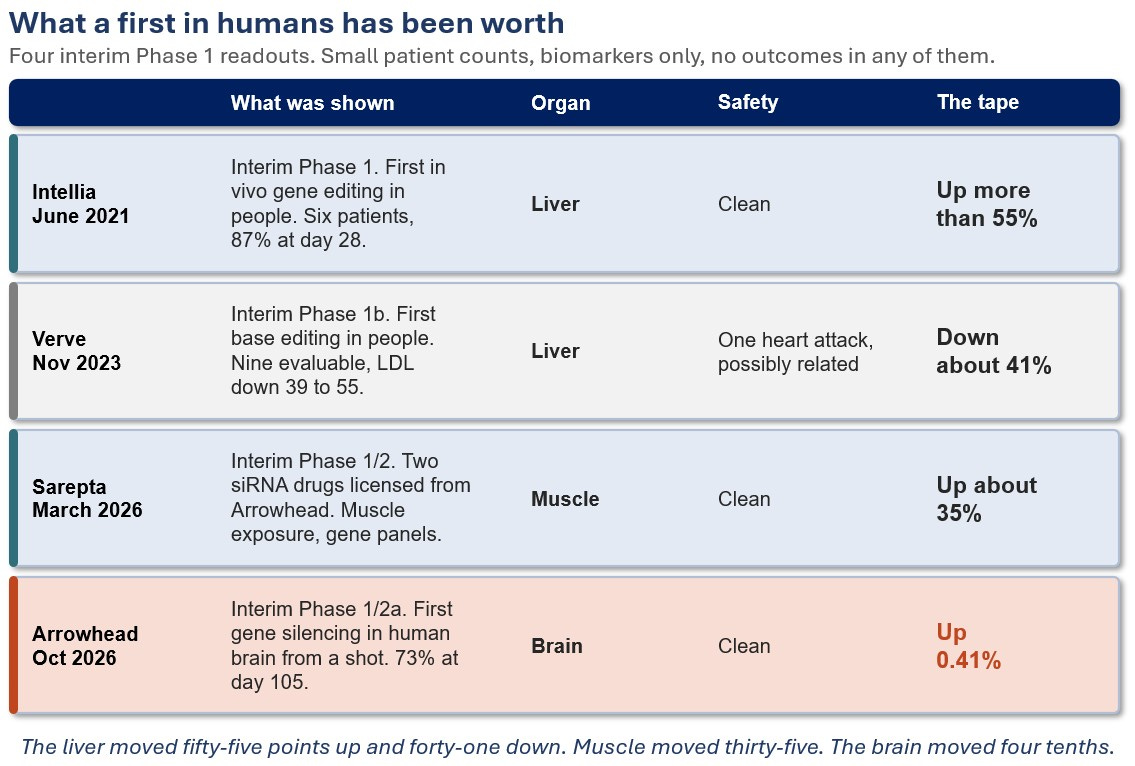
Figure 1. Compiled from company announcements, press coverage at the time, and the trading record for each date.
Intellia. In June 2021 Intellia reported that six patients had received a gene-editing drug through an intravenous infusion, and that the protein it targets had fallen by a mean of 87 percent at day 28. No clinical benefit was measured. The company called it proof of concept for its delivery platform. The shares closed up more than 55 percent. The forty in this note’s title is the figure the wires carried that morning, and the conservative one.
Verve. In November 2023 Verve reported the first base editing performed inside a human body. Nine patients evaluable, cholesterol down between 39 and 55 percent at the higher doses. One participant had a heart attack the investigators judged possibly related to treatment. The shares closed down about 41 percent.
Sarepta. In March of this year Sarepta reported the first clinical data on two siRNA drugs for muscle disease: drug concentrations in muscle tissue, suppression of a panel of genes downstream of the target in one program, a placebo-adjusted reduction of the target gene in the other, and favorable tolerability. The shares closed up about 35 percent.
Arrowhead. On Wednesday Arrowhead reported that six treated volunteers had a mean 73 percent reduction in spinal-fluid tau, measured ninety days after the last injection. That is pharmacodynamic evidence of silencing in the central nervous system rather than a measurement of gene expression in brain tissue, and the distinction is worth keeping. No serious treatment-emergent events, no discontinuations attributed to them, no persistent anemia. The shares rose 24 cents.
The market is not indifferent to this category of news. It priced three of these in double digits and the fourth at four tenths of one percent.
3. The March case is Arrowhead’s own technology
Start with Sarepta, because it is the most useful of the four comparisons.
SRP-1001 and SRP-1003 are Arrowhead drugs. Arrowhead’s own proxy statement lists them under partnered programs and gives their former names: ARO-DUX4 and ARO-DM1. The delivery chemistry that carries them into muscle is Arrowhead’s. Sarepta licensed the platform. The trade press covering the readout said so in the headlines, calling them Arrowhead’s siRNA assets and RNAi drugs from Arrowhead.
What Sarepta reported on March 25 was early, and it was not trivial. Drug concentrations in muscle well above a competitor’s, a dose-dependent rise, suppression of the gene panel downstream of DUX4 of roughly 90 percent against placebo in the FSHD program, and a 50 percent placebo-adjusted reduction of the target gene in the myotonic dystrophy program, which the company itself called limited given the numbers involved. No clinical outcomes in either.
Sarepta closed up about 35 percent.
In March the market added about a third to a company’s value for results built on Arrowhead’s technology.
Arrowhead moved too. It rose eight percent that same day. Biotechnology was strong, up about 3.7 percent, so call it four points of sector-relative gain. Not all of it belongs to Sarepta’s news and I cannot separate out what does. The point is simpler than attribution.
Investors had no difficulty repricing Arrowhead in March on evidence about its licensed delivery chemistry working in muscle. Seven months later, on evidence about its own delivery chemistry working in the brain, the sector-relative gain was under half a point. The same stock, the same engineering group, roughly a tenth of the response.
That needs one qualification. Sarepta holds the development and commercial rights, so most of the direct economics of those two programs belong to it, with Arrowhead retaining milestones and royalties. The market had a rational reason to reward Sarepta. What is harder to see is how much it assigned to the layer underneath, which was evidence that a targeted delivery chemistry works in people, and that chemistry is Arrowhead’s.
This is the hardest of the comparisons for a skeptic to wave off. It was this year, in this market, in this sector. The data was in patients rather than healthy volunteers, and it was thinner than Arrowhead’s. It was also not tau, so whatever the market thinks of that target cannot explain it.
4. The Verve case closes the other door
If the only comparison were Intellia, somebody would reasonably say that 2021 was a different market, that money was free and gene editing was a story stock, and that none of it carries over.
Verve answers that. November 2023 was not a bull market in biotech. The move was also violent in the other direction, which is the point. The market read an interim Phase 1 biomarker readout in nine patients, found one safety signal in it, and took forty percent off the company inside a session.
A market that can do that has not lost the ability to price early platform data. It was paying close attention in 2023. It paid close attention in 2021. On Wednesday its reaction was barely visible.
5. Eight examples are not a distribution. They are a rebuttal
A reasonable reader at this point says I have picked three days out of five years and arranged them to suit myself. That is fair, and these eight cannot establish how the market normally prices Phase 1 data. No such claim is being made. What they establish is narrower: investors have repeatedly assigned large changes in company value to early genetic-medicine evidence, sometimes with no clinical outcome, sometimes without the company reporting a result of its own. Whether the market knows how to react is not in dispute.
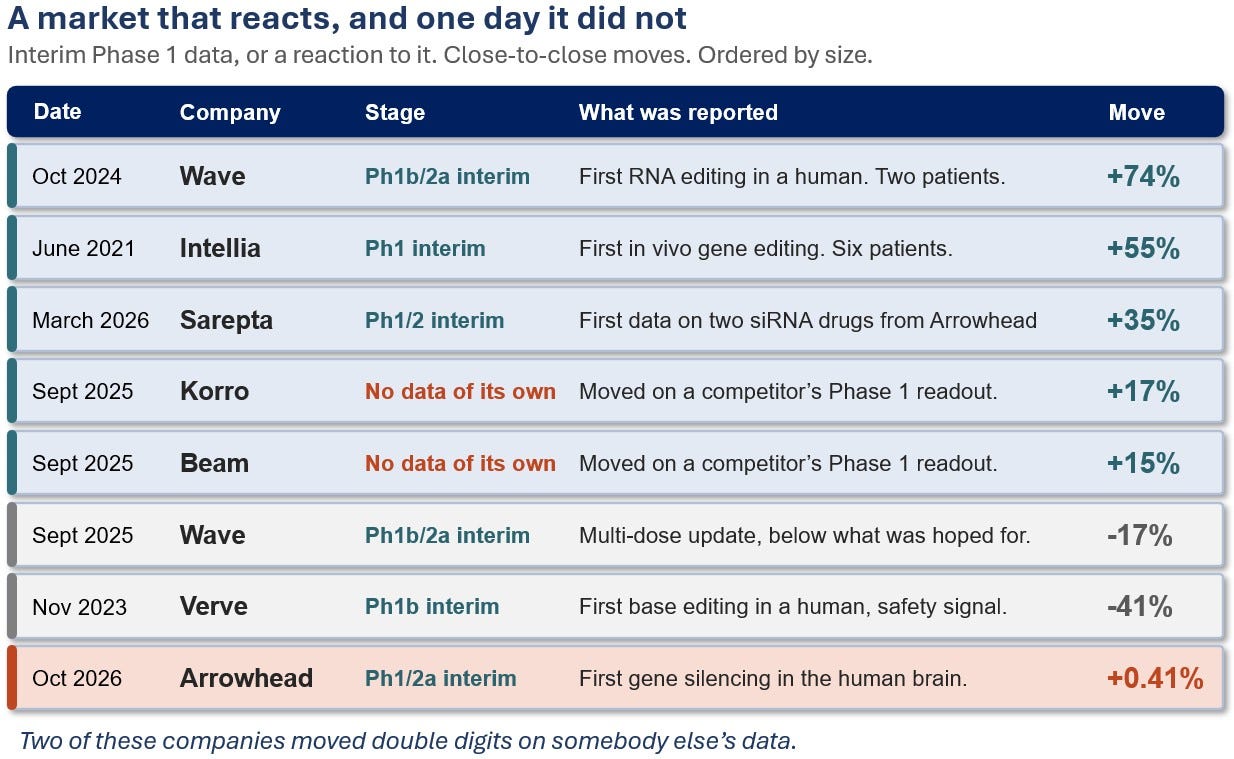
Figure 2. Single-session share moves following interim Phase 1 data releases in genetic medicine. Compiled from company announcements and press coverage at the time.
Wave is the extreme case. In October 2024 it reported the first therapeutic RNA editing ever performed in a human being, in two patients, on a single dose. The stock closed up about 74 percent. Eleven months later it reported more data from the same Phase 1b/2a study, the result came in below what investors wanted, and the stock fell about 17 percent.
One detail about that October makes it the closest parallel to Arrowhead of any case here. WVE-006 was already licensed to GSK, which held the global rights, with Wave keeping milestones and royalties. The market repriced the originating company by three quarters anyway. The clinical questions were not equivalent, and the protein Wave restored has a better established link to its disease than tau reduction has to slowing dementia. The licensing structure is what makes the comparison useful. Investors were willing to pay the originating technology company even when a partner held the global rights.
The September 2025 readout is the one worth sitting with, though, because of what happened to everybody else that day. Beam rose 15 percent and Korro rose 17 percent. Neither company reported a result that day. They moved because a competitor’s result changed where the value in a shared approach might end up, which is not quite the same as validating the approach.
That is the market this note is about. It will reprice a company by double digits because a rival published. It repriced Arrowhead by four tenths of one percent for the first gene silencing ever achieved in a human brain.
6. Where Arrowhead’s data is stronger, and where it is weaker
Honesty here cuts both ways, so take the weaker side first.
Against Arrowhead. Intellia and Verve dosed people who had the disease. Arrowhead dosed healthy volunteers. That is a real difference and I will not argue it away. A biomarker in a sick person carries information about treating that person which the same biomarker in a healthy one does not.
The reason for the difference is worth knowing, though. Exposing a healthy person to a potentially permanent change in their genome, with no prospect of benefit to them, is a risk-benefit calculation that rarely survives review, so those companies had little choice but to study patients. Silencing is reversible and a shot under the skin is routine, which is how Arrowhead got 41 volunteers through a study in the time it takes to enroll a handful of patients. What makes the data look weaker is downstream of what makes the drug interesting.
There is a further point against my own concession. For validating delivery specifically, rather than efficacy, healthy volunteers may offer the more controlled test. Sick brains vary. Disease stage, atrophy, comorbidity and concomitant medication all add noise to a measurement whose whole purpose is to establish whether the drug arrived. A clean dose-response in people whose biology is not confounded tells you more about the vehicle than a messier signal in patients would.
Then a qualification to the qualification. Spinal-fluid tau is an indirect measure, and nobody biopsied a brain. A diseased brain may differ in barrier integrity, in tau biology and in how the drug distributes. The healthy-volunteer result makes the delivery case stronger. The patient cohorts will show how much of it survives contact with the disease.
For Arrowhead. Now the stronger side.
Intellia reported its headline number at day 28. Verve used a time-weighted average from day 28. Wave saw a signal by day 15 and carried it to day 57 on one dose. Arrowhead’s 73 percent was measured ninety days after the last injection.
Ninety days does not simply beat twenty-eight, and it would be sloppy to claim it does. Intellia was editing DNA, aiming at a permanent change, so its short observation window was never the point. Arrowhead is silencing RNA, which wears off. The significance of day 105 is not that the number is larger. It is that substantial suppression persisted a quarter after the last injection from a drug that makes no permanent change at all, which is what an infrequent dosing schedule would require. That is a potential commercial advantage, provided efficacy and repeat dosing hold up.
Arrowhead showed rising mean suppression across three dose levels, 40, 69 and 73 percent, though the top two are close together and the highest cohort received two injections where the others received three. Verve’s safety signal cost it forty-one percent. Arrowhead’s interim safety observations were encouraging, including on the specific risk that attaches to its delivery receptor.
Then the organ.
7. The liver is the cooperative one
The next paragraph is the argument.
Lipid nanoparticles, the delivery vehicle in both of those gene-editing programs, reach the liver with the biology helping rather than resisting. Put them in a vein and the liver takes them up through a receptor it already uses for cholesterol. Getting that to work took real engineering and years of it. The point is that the organ was cooperating.
The brain is the opposite. Plenty of small molecules cross its barrier, which is why anesthetics and antidepressants exist. What that barrier excludes is large charged molecules, and an siRNA construct is exactly that. Oligonucleotide drugs that reached the human brain before this week generally required direct administration, most often a needle between the vertebrae.
Two companies demonstrated they could reach the organ where the biology cooperates, and the market repriced them by tens of points each.
8. What actually changed
Not the market’s appetite for platform data, as Verve shows. Not the quality of the evidence, which is stronger on durability and safety and weaker on population. What may have changed is how the company gets valued.
Intellia in 2021 and Verve in 2023 were primarily platform companies. Each booked some collaboration revenue, and neither had an approved product generating commercial sales. The platform dominated the investment case. Validate it and every number in the model moves, because there was little else in the model to anchor them.
Arrowhead’s chief executive, Chris Anzalone, called this a therapeutic holy grail on the call, and had the sense to flag that the term is overused before he used it. He is not wrong about the difficulty. Delivering an oligonucleotide into the brain from a shot under the skin is a problem the field has failed at for thirty years.
The trouble is that difficulty is not an input. A model has fields for market size and launch year and none for how long a problem went unsolved.
Which produces an odd result. An easy problem gets solved on the way to a product, so its value lands inside somebody’s forecast. A genuinely hard one gets solved before the business that would use it exists, so no forecast has been built. The harder the problem, the less a spreadsheet has to say about having solved it.
Chess engines are useful here. They used to judge a position by adding up terms a programmer could name: material, king safety, pawn structure, mobility, each weighted in advance by somebody who decided what mattered. Then in 2017 a program called AlphaZero, which had been given the rules and left to teach itself by playing, began handing over material for positions the old arithmetic had no term for, and winning. The arithmetic was not wrong. It was counting pieces at a moment when the position had become about what the pieces could reach.
A discounted cash flow model is an evaluation function. Somebody decided in advance which terms it contains.
A blank field is not an estimate of zero. It is a decision not to estimate.
Put plainly for anyone who skipped the chess: this is a limit of the instrument, not a judgment rendered by it. Discounted cash flow can be extended to value uncertain platforms, and real-options methods exist precisely for this. The question is whether the published models reviewed here do any of that.
Arrowhead has an approved drug, a Phase 3 readout, and 1.6 billion dollars. It is priced on discounted cash flow now, anchored on a cardiovascular franchise. Five of the commercial assumptions such a model runs on are market size, penetration, price, probability of success and launch timing.
A healthy-volunteer biomarker, against a target no regulator has ever approved a drug for, supplies too little to populate those inputs with any confidence.
9. A drug, and a method for making drugs
A drug is a bet on one molecule, one disease, one market. A delivery platform is a bet on the ability to place more of those bets.
If ARO-MAPT fails in Alzheimer’s, one therapeutic hypothesis failed. It does not undo the evidence that this construct crosses into the brain and lowers its target there. If the same chemistry carries a different payload, the consequences are not confined to tau.
One experiment changed the odds on experiments nobody has run yet. That is what separates a platform from a drug.
Though it is not one key. The chemistry carrying siRNA into muscle for the Sarepta programs is an integrin-targeting ligand. The construct going into the brain uses an antibody fragment against a different receptor entirely. These are not the same key.
That does not weaken the argument. It changes what the argument is about. Arrowhead is not demonstrating that it found a universal delivery molecule. It is demonstrating that its approach to engineering tissue-specific delivery keeps producing solutions for tissues that did not have one.
A key that opens one door is useful. A method for cutting keys to doors nobody could open before is a different asset.
A platform also creates choices, not only programs. Arrowhead does not have to pursue every target it can now reach. It can select, abandon, partner or keep, and revise as the biology comes in. Maintaining the capability costs money every year, so flexibility is not free and does not by itself imply a positive number. That flexibility may carry economic value even so, and a forecast built around individual drugs has no place to put it.
Opening a file does not require the rook to move. It gives the rook moves it did not have before.
Liver, then lung, then muscle, then fat, now brain. None of these opened the same way. The lung program used an inhaled route. The fat program showed suppression directly in tissue. The brain program gives pharmacodynamic evidence after a subcutaneous shot, with nobody biopsying a brain. Different problems, different routes, different grades of evidence.
Which is the point rather than a weakness in it. The common achievement is not that every organ has fallen. It is that the same group keeps finding ways to make siRNA work in tissues that had no way. None of that guarantees the next door opens. The list of doors already opened is what is being priced here, or not priced.
A portfolio of unrelated drugs is a set of separate bets. A portfolio built on shared delivery engineering has a common layer beneath it. Every new target still carries its own biology, but none starts from zero on whether the drug can get there.
There are two levels to this and they behave differently. Within the brain, programs using related machinery share technical risk directly. Across organs, what is shared is broader and looser: the engineering capability that keeps producing tissue-specific solutions.
The correlation cuts both ways at each level. A problem with the brain receptor would damage several brain programs together, and would say little about muscle, which uses a different mechanism entirely. One platform does not mean one risk. It means related capabilities whose risks overlap in some places and not others.
Correlation is not a gift. It is a property.
It also means the cause of any future failure matters. If tau turns out to be the wrong target, the delivery evidence survives more or less intact. If the construct proves toxic over time, or distributes worse in sick brains than in healthy ones, the platform takes the damage with the drug.
This is not speculation about targets Arrowhead might one day find. On Wednesday’s call Chris Anzalone said the company already has one wholly owned and one partnered brain program in the clinic, expects another partnered candidate there in 2027, and intends to put at least three more wholly owned candidates into the clinic inside twelve months. He described the platform as feeling like a company’s worth of value on its own.
A reader can discount all of that. Transferability to other targets is unproven. The doses are high. Manufacturing, long-term receptor safety and real clinical convenience are all open. One target is not a platform. Each of those argues for a discount, possibly a brutal one, and together they may fully explain why an analyst declines to put a figure on it today. That is a different claim from the capability being worth zero, and the narrower one is the only claim this note makes.
In chess, opening a file changes what every piece that can use it is worth. Arrowhead may have opened one. The models are still counting pieces.
10. At least three analysts said it out loud
Three banks published on Arrowhead this week, and these are only the notes I could read. All three are positive on the stock. None of the three identifies a material contribution from the brain program to its published target.
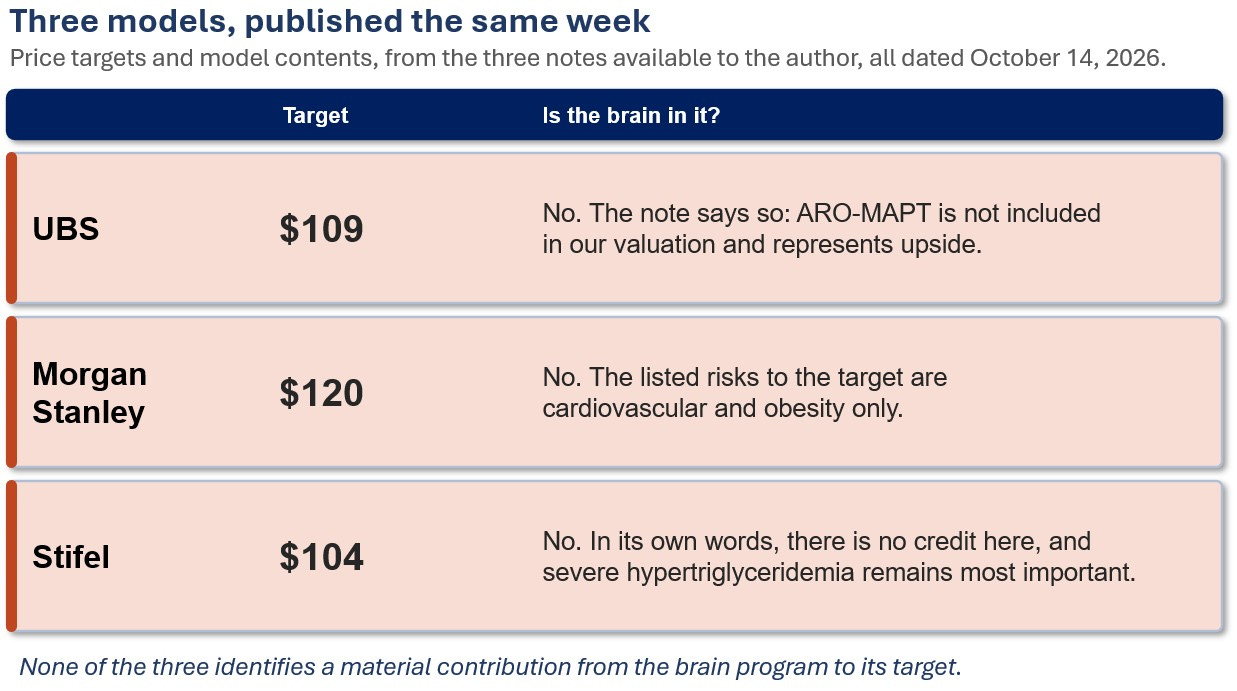
Figure 3. Compiled from the three published research notes available to the author, all dated October 14, 2026. Other banks cover Arrowhead and their models were not reviewed.
UBS is the most explicit, and the most useful, because it states the mechanism rather than hiding it. ARO-MAPT is not included in the valuation and represents upside. That is not a judgment that the program is worthless. It is a statement that the model has no field for it.
Stifel reaches the same place in plainer language, writing that there is no credit here and that severe hypertriglyceridemia remains what matters for the stock. Morgan Stanley’s risks to the target, up and down, are cardiovascular and obesity. The brain appears on neither list.
A caution about all of this. One limitation has to be stated plainly. Published analyst targets are not the market. They are evidence of how several influential participants are framing the problem, and no more than that. Private models, discretionary positioning and speculative premium could all carry CNS value that never appears in a price target, and the trading record cannot tell us how much of this was already discounted.
What the three notes do establish is narrower. Substantial new clinical evidence arrived, and explicit value for it is hard to locate in the models I could read.
11. What these numbers are actually made of
One more item from the UBS note, because it reveals what price targets are made of.
UBS raised its target from 63 dollars to 109, a jump of 73 percent, on assumption of coverage. A new analyst took the pen. The note is built on the cardiovascular franchise and explicitly excludes the brain, so whatever moved the number by three quarters, it was not the data that landed that morning.
That is not a criticism of the analyst, whose model is more thorough than most. It is a reminder of what a price target is: one person’s spreadsheet, which changes when the person does.
12. What would make me wrong
The populations differ. Intellia and Verve dosed patients. Arrowhead dosed healthy people. If the market simply weights that difference more heavily than I do, the whole comparison softens.
Perhaps the market expected it. Prices move on the distance between a result and what was already believed, not on how important the result is. Arrowhead had announced the readout in advance, booked a webinar, and discussed a benchmark of 50 to 60 percent beforehand. Seventy-three cleared it. Whether it cleared what investors had already priced is a different question, and management’s stated objective is not the same as the market’s expectation. I cannot rule this out, and it is the best argument against the whole of this note. It does raise a second question. If the market already expected systemic silencing in the brain to work, that expectation should be visible somewhere in what the brain is worth. In the three models I could read, it is not.
Not every biomarker is equal. Cholesterol is a validated treatment target with decades of outcome data behind it. Tau is biologically compelling and therapeutically unresolved. A 73 percent reduction in spinal-fluid tau establishes pharmacology, not a reduction in anybody’s risk of dementia, and a market discounting the commercial program on that basis is making a defensible judgment rather than an error.
Which leaves the question this note keeps circling. If tau turns out to be the wrong target, does the ability to deliver gene silencing into the human brain become worthless? Those are two risks, not one, and no rule requires them to be priced together.
Tau has a history. Biogen’s diranersen lowered tau substantially, reduced tau on brain scans, produced encouraging cognitive signals, and still missed its primary dose-response endpoint. An older Biogen antibody against extracellular tau failed outright. A market that has watched this target disappoint may be pricing target risk rather than ignoring delivery, in which case it is making a judgment rather than an omission.
The stock was already broken. Arrowhead traded above 95 dollars inside the last year and sits near 58 now. A stock already down by a third on commercial worries may be too preoccupied to listen, which would be a different failure from the one I am describing.
Size matters. These companies were smaller than Arrowhead is now, and a move of forty percent on an eight and a half billion dollar company is a different ask than on a two billion dollar one.
They may simply be right. The last one is the serious one. The models may be right. A Phase 1 biomarker in six people, against a target with no approval precedent, may genuinely deserve a zero until there is more. Analysts have declined to credit assets before and been correct to wait.
Here is how to tell which of these is right. Those are three different explanations and they imply three different tests. If the market is waiting for patients, the Alzheimer’s and tauopathy data in 2027 should move it. If it will not credit the platform until a second target works, the first non-tau brain readout is the one to watch. If the constraint is commercial visibility rather than science, the next informative event may not be a readout at all. It may be a transaction, because a licensing deal requires somebody other than Arrowhead to put a number on this. Upfront cash, the breadth of target access and where the milestones sit would say more than another biomarker. A single-asset license and broad platform rights are very different signals. The next eighteen months may begin to separate them.
13. Twenty-four cents
The liver is the organ where the biology cooperates. Two companies showed they could edit a gene in it, in a handful of patients, with a biomarker and no clinical outcome, and the market repriced them by forty points in one direction or the other. In March it paid a third company roughly a third of its value for reaching muscle, using chemistry Arrowhead invented and licensed out.
The brain is the organ that a hundred years of pharmacology has failed to reach without a needle in the spine. Arrowhead reached it with a shot, in six people, with a biomarker and no clinical outcome, and held the effect for three months.
Twenty-four cents.
The market did not decide the brain was worth less than the liver. It never got as far as deciding.

A Note on Supporting Independent Research
If this white paper has been valuable to you, whether it shaped your thinking, validated your conviction, or simply saved you the time of doing this work yourself, a voluntary contribution is genuinely appreciated and directly funds the next paper.
For individual investors and readers
Any amount you feel reflects the value you received is welcome and meaningful. A contribution in the range of what you might pay for a single premium research report is a thoughtful gesture that makes a real difference.
For family offices, investment funds, hedge funds, and research platforms
This paper is the caliber of work that institutional research desks bill significant retainers to produce. If your team referenced it, distributed it internally, or used it to inform a position, a suggested contribution of $1,500 reflects the professional value of the analysis, though any amount is meaningful. Your support makes it possible to continue publishing at this level without a paywall that limits the reach of the ideas. If your organization requires an invoice to process a payment, please reach out directly at bioboyscout@gmail.com and one will be provided promptly.
There is no obligation and no expectation. This is purely a thank you for work that meant something to you.
Zelle: (847) 227-7909
Thank you for reading, and for being part of a community that takes this thesis seriously.
— Robert Toczycki | BioBoyScout
Important Risks, Disclosures, & Disclaimers
The author, Robert Toczycki (aka BioBoyScout), certifies that:
all views expressed in this white paper accurately reflect his personal opinions about the topic discussed;
he was not compensated in any form for producing this white paper; and
he has not received and does not receive compensation from Arrowhead Pharmaceuticals.
This paper is provided for informational and analytical purposes only. It does not constitute investment advice, financial advice, legal advice, or a recommendation to buy, sell, or hold any security, and it is not a recommendation as to any corporate course of action. The author holds a long position in Arrowhead common stock. Past performance is not indicative of future results, and forward-looking analysis is inherently uncertain. The author and BioBoyScout are not registered investment advisors. The author assumes no obligation to update this paper. The characterization of what is and is not in the published literature, the probability judgments, and the chess analogy are the author’s own.
Intellia’s interim Phase 1 results for NTLA-2001 were announced on June 26, 2021, covering six patients across two dose cohorts, with an 87 percent mean reduction in serum transthyretin at the higher dose by day 28, and were published in the New England Journal of Medicine. The share move is as reported at the time. Verve’s interim results for VERVE-101 were presented at the American Heart Association Scientific Sessions on November 12, 2023, covering ten dosed and nine evaluable patients, with time-averaged LDL-C reductions of 39 and 48 percent in the two patients at 0.45 milligrams per kilogram, and a serious cardiac event in one participant judged possibly treatment-related. The share move is as reported contemporaneously. Sarepta’s first clinical results for SRP-1001 and SRP-1003 were announced on March 25, 2026.
Arrowhead’s proxy statement lists both as partnered programs under their former designations, ARO-DUX4 and ARO-DM1, and Sarepta’s siRNA platform is licensed from Arrowhead. That share move is also as reported at the time. Sector-relative comparisons use XBI, the SPDR S&P Biotech ETF, as the benchmark, on closing prices. The additional moves shown in Section 5 are drawn from company announcements and press coverage at the time of each release: Wave’s first-in-human RNA editing result of October 2024, from the ongoing Phase 1b/2a RestorAATion-2 study, and its multi-dose update from the same study on September 3, 2025, together with the same-day moves in Beam Therapeutics and Korro Bio, neither of which reported results that day.
ARO-MAPT results are from Arrowhead’s announcement and investor webinar of October 14, 2026. Price targets, model contents and the change in the UBS target on assumption of coverage are from research notes published by UBS, Morgan Stanley and Stifel dated October 14, 2026. Arrowhead’s cash and securities position is from its quarterly filing for the period ended June 30, 2026.
About the Author
BioBoyScout is the publishing name for Robert Toczycki, an independent biotech investment research writer based in Chicago. The BioBoyScout series publishes institutional-grade analysis of structural dynamics in RNA-class therapeutics, with particular focus on Arrowhead Pharmaceuticals’ TRiM platform and the broader competitive landscape. Robert is a registered US Patent Attorney with a JD, an Executive MBA completed at the top of his class, and a BS in Mathematics and Computer Science from the University of Illinois at Urbana-Champaign. He has a deep passion for financial analysis, particularly identifying valuation discrepancies and demonstrating them through rigorous, data-driven research and solid analytics.
Comments or questions: bioboyscout@gmail.com.
Copyright © 2026, BioBoyScout. All Rights Reserved.
Am a bit surprised the analyst assigned no value to the asset; with no treatment for PSP, there is a route to approval in this rare disease (and we can add CBD too). This should add a few $ to the valuation (given the low POS in the first instance).
AD is more complex and I think combination therapy as articulated by Adam Boxer could be very complex in the real world.
Also the CEO mentioned other potential assets in the CNS space now that POC has been demonstrated. I’m guessing that one of these is against alpha-synuclein for PD.