

Robert Toczycki, JD, MBA
bioboyscout.com
bioboyscout@gmail.com
847.227.7909
X: @BioBoyScout
1. What the agenda gave away
On September 29, Arrowhead set a date. On October 14 it will show the first human data for ARO-MAPT, its drug designed to lower tau in the brain from a simple subcutaneous shot under the skin. Almost everyone will be watching one number: how far tau falls in the spinal fluid.
I want to point at something else in the announcement, because it is easy to miss. The guest speaker is Adam Boxer of the University of California, San Francisco. He directs the university’s clinical trial programs for Alzheimer’s disease and for frontotemporal dementia, and he is one of the best-known investigators in a small family of diseases most investors have never heard of. His talk is titled Silencing MAPT in Alzheimer’s Disease and other Tauopathies. The press release describes the drug the same way.
That is the third signal in a matter of days. Arrowhead’s slides at an RNA conference on September 25 described the program as aimed at Alzheimer’s and related tauopathies. They also listed NfL, a marker of nerve damage measured in blood and spinal fluid, among the things the trial tracks. The first full scientific presentation of the data comes at a major Alzheimer’s meeting on November 19. Its listed first author is Catherine Mummery of University College London, who was also first author of the published Phase 1b trial of the leading rival tau drug.
Everyone will be watching how far tau falls. I would also watch where Arrowhead says the drug goes next.
2. The tau family
A tauopathy is any disease driven by a buildup of the protein tau inside brain cells. Alzheimer’s is the biggest one, but it is not the purest. In Alzheimer’s, tau shares the stage with amyloid, the sticky protein that the approved antibody drugs remove. That makes it hard to know how much of the disease a tau drug can fix on its own.
The rarer tauopathies are cleaner tests. Progressive supranuclear palsy, or PSP, affects roughly six people in every hundred thousand. It takes away balance, movement and control of the eyes, it moves relentlessly, and there is no approved treatment that slows it. Corticobasal degeneration, or CBD, is a close cousin. A substantial share of frontotemporal dementia, which usually strikes people between their mid-forties and mid-sixties, involves tau too, and a much smaller group is caused directly by inherited mutations in the MAPT gene. That is the same gene ARO-MAPT silences.
Starting small has another advantage, and it is about getting a clear answer. Alzheimer’s asks whether lowering tau can matter inside a disease that also involves amyloid, inflammation, damaged blood vessels and enormous differences from one patient to the next. Inherited MAPT disease asks a cleaner question. If the mutation drives the disease and the drug silences the gene, biology has fewer places to hide. Read purely from the biology, one logical order of attack runs from the clearest cause to the biggest market: inherited MAPT disease, then PSP and CBD, then Alzheimer’s.
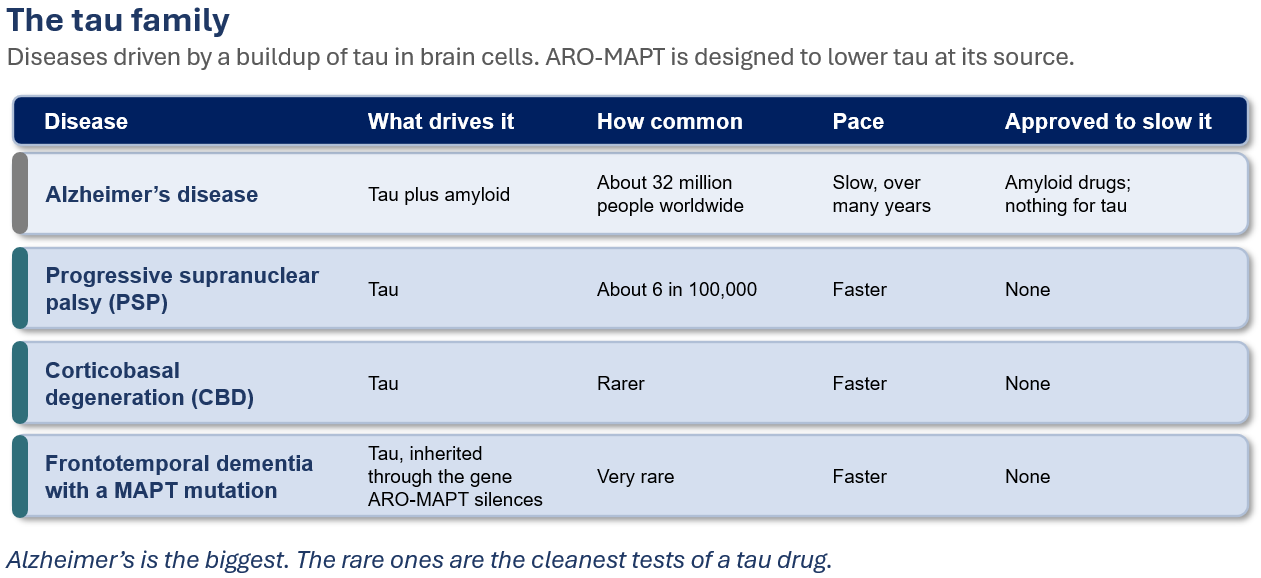
Figure 1. Author’s summary. Prevalence for PSP from published reviews; the Alzheimer’s figure is from Arrowhead’s September 29 release.
3. Why PSP fits this particular drug
One detail in the PSP research jumped out at me. In PSP, much of the tau damage sits deep in the brain, in the basal ganglia, the brainstem and part of the cerebellum, with parts of the cortex affected as well. Those deep structures can be particularly hard to reach evenly with drugs delivered into the spinal fluid. They are also the regions Arrowhead keeps pointing to when it says its delivery reached deep brain structures consistently in animal studies.
If that delivery claim holds up in people, PSP may be the disease where it matters most.
A drug that reaches the deep brain is worth the most in the disease that lives there.
4. A door that has been opened before
There is also a regulatory reason to look at the small diseases first. In 2023 the FDA granted accelerated approval to tofersen, a gene-silencing drug for an inherited form of ALS, based on a drop in blood NfL. It did so even though the drug’s main trial did not show a significant clinical benefit. The agency’s outside advisers voted unanimously that lowering NfL was reasonably likely to predict benefit in that disease.
NfL has a history in PSP too. A 2016 study found that blood NfL is elevated in PSP and that patients with higher levels declined faster and lost more brain volume over a year. The senior author of that study was Adam Boxer.
Put those pieces side by side and a path appears. A rare, fast, untreated tauopathy. A drug designed to lower the protein at its source. A blood marker with a regulatory precedent and a track record in this exact disease. The inherited MAPT form of frontotemporal dementia is the closest parallel to tofersen of all: a small group of patients defined by a mutation in the very gene the drug turns down.
The side door into neurology has been opened once before. It was opened with NfL.
5. What would make me wrong
The number disappoints. Everything here depends on October 14. If tau does not fall far enough in healthy volunteers, none of the rest matters.
Tau drugs have failed in PSP before. Two antibodies aimed at tau, Biogen’s gosuranemab and AbbVie’s tilavonemab, failed large trials in PSP. Both grabbed tau floating outside cells. ARO-MAPT is designed to cut production of tau inside them, which is a different bet. The history is still a warning, and Boxer knows it firsthand, since he was an author on the gosuranemab trial. Tilavonemab showed it was hitting its target in the spinal fluid and did not help patients. Moving a biomarker is not the same as helping people.
No regulator has accepted NfL for a tauopathy. Tofersen was one disease, one mutation and one decision. The FDA could insist on clinical endpoints in PSP, and it would be within its rights to do so. That would slow the path, not close it. None of this requires the FDA to accept NfL as a stand-in for benefit. A fast-moving, biologically cleaner tauopathy could still give a much quicker test of whether deep tau silencing changes the disease.
Arrowhead may not go there. A talk title is not a trial. The company has not announced a PSP or frontotemporal dementia study, and it may choose to put everything into Alzheimer’s.
6. What to watch on October 14
Beyond the headline number, four things. The first three test the idea in this note. Whether management names another tauopathy as a next step. Whether NfL results appear, even as a safety check in healthy volunteers. Whether Boxer speaks about PSP or inherited frontotemporal dementia in any detail. Any one of those would make the tauopathy path harder to dismiss as coincidence.
The fourth is bigger than this note. The webinar opens with an overview of Arrowhead’s brain pipeline, and Chris Anzalone has already said that encouraging early ARO-MAPT data would bring a substantial expansion of that pipeline starting at the end of 2026. Watch whether management names new brain targets or puts specifics behind that promise. If the route into the brain works, tau is the first drug through the door, not the last.
7. The long diagonal
In chess, a fianchetto puts a bishop near the edge of the board, tucked in beside the king. Beginners think it looks passive. Stronger players know better. The bishop sits on the longest diagonal on the board and bears down on the center from the side, often with more force than a piece planted in the middle.
Alzheimer’s is the center of the board, the prize everyone wants. Arrowhead does not have to approach it head on. PSP and inherited frontotemporal dementia sit on the edge: small, overlooked and untreated. A drug that proves itself on tau there bears down on the biggest prize in neurology without walking straight into it. The diagonal runs from the cleanest biology to the largest market, not the other way around.
The fastest road to the center of the board is not always straight up the middle.
October 14 will tell us whether the bishop can move at all. The agenda already hints at which diagonal Arrowhead has in mind.

A Note on Supporting Independent Research
If this note has been valuable to you, whether it shaped your thinking, validated your conviction, or simply saved you the time of doing this work yourself, a voluntary contribution is genuinely appreciated and directly funds the next paper.
For individual investors and readers
Any amount you feel reflects the value you received is welcome and meaningful. A contribution in the range of what you might pay for a single premium research report is a thoughtful gesture that makes a real difference.
For family offices, investment funds, hedge funds, and research platforms
This paper is the caliber of work that institutional research desks bill significant retainers to produce. If your team referenced it, distributed it internally, or used it to inform a position, a suggested contribution of $1,000 reflects the professional value of the analysis, though any amount is meaningful. Your support makes it possible to continue publishing at this level without a paywall that limits the reach of the ideas. If your organization requires an invoice to process a payment, please reach out directly at bioboyscout@gmail.com and one will be provided promptly.
There is no obligation and no expectation. This is purely a thank you for work that meant something to you.
Zelle: (847) 227-7909
Thank you for reading, and for being part of a community that takes this thesis seriously.
— Robert Toczycki | BioBoyScout
Important Risks, Disclosures, & Disclaimers
The author, Robert Toczycki (aka BioBoyScout), certifies that:
all views expressed in this note accurately reflect his personal opinions about the topic discussed;
he was not compensated in any form for producing this note; and
he has not received and does not receive compensation from Arrowhead Pharmaceuticals.
This note is published by BioBoyScout and is intended for informational and educational purposes only. It does not constitute investment advice, a solicitation to buy or sell securities, or a guarantee of future results. The author holds a long position in Arrowhead common stock. Arrowhead Pharmaceuticals (ARWR) is a publicly traded company; investments in its shares involve material risks, including the risk of total loss. All financial projections, acquisition price estimates, and valuation analyses herein are hypothetical frameworks for analytical purposes and do not represent predictions of actual outcomes. Readers should conduct their own due diligence and consult a registered investment advisor before making investment decisions.
The webinar date, agenda, speaker description, study design and the deep brain delivery language are from Arrowhead’s press release of September 29, 2026. The description of Arrowhead’s slides is from its presentation at the RNA Leaders USA Congress on September 25, 2026. The CTAD presentation of November 19, 2026 is from the published conference program. Tofersen’s accelerated approval and the advisory committee vote are from 2023 FDA and news reports. The NfL findings in PSP are from Rojas and colleagues, Annals of Clinical and Translational Neurology, 2016, with Adam Boxer as senior author.
PSP prevalence and the regions most affected are from published reviews. The gosuranemab and tilavonemab results are from their published Phase 2 trials. The interpretation of Arrowhead’s intentions and the chess analogy are the author’s own. Nothing here suggests that Dr. Boxer or Arrowhead has endorsed this reading.
About the Author
BioBoyScout is the publishing name for Robert Toczycki, an independent biotech investment research writer based in Chicago. The BioBoyScout series publishes institutional-grade analysis of structural dynamics in RNA-class therapeutics, with particular focus on Arrowhead Pharmaceuticals’ TRiM platform and the broader competitive landscape. Robert is a registered US Patent Attorney with a JD, an Executive MBA completed at the top of his class, and a BS in Mathematics and Computer Science from the University of Illinois at Urbana-Champaign. He has a deep passion for financial analysis, particularly identifying valuation discrepancies and demonstrating them through rigorous, data-driven research and solid analytics.
Comments or questions: bioboyscout@gmail.com.
Copyright © 2026, BioBoyScout. All Rights Reserved.