

Robert Toczycki, JD, MBA
bioboyscout.com
bioboyscout@gmail.com
847.227.7909
X: @BioBoyScout
The question I get more than any other about ARO-MAPT is not how much tau it will lower. It is how quickly this could reach patients, and whether it could qualify for accelerated approval.
This note is an attempt to answer it properly.
The conventional answer is grim. Alzheimer’s trials measure how fast a patient declines, and demonstrating a convincing difference generally takes many months to years, with eighteen to twenty-four months typical for pivotal programs. A program built that way puts approval somewhere in the middle of the next decade. Fast Track designation does not change that. It buys more meetings with the FDA and can make a program eligible for rolling review, meaning the application is submitted in pieces rather than all at once. It does not, by itself, turn a conventional efficacy trial into a shorter one.
There is a faster route, and it is not hypothetical. The FDA can approve a drug based on a biomarker that is reasonably likely to predict clinical benefit, with the trial proving it actually helps patients finished afterward. Two Alzheimer’s drugs have come through that door. A neurology drug almost nobody outside the field has heard of came through the same door.
The difference between how those cases went is the whole subject of this note, and it points at a number that is not currently being discussed.
1. A word on who actually decides
One thing has to be explained first, because both stories below turn on it.
When the FDA reviews a drug, it can convene an advisory committee. That is a panel of outside experts, clinicians, statisticians and often a patient representative, who read the application, hear the company and the agency present, and then vote in public on specific questions.
The vote is advice. The FDA is not bound by it and has gone against it before.
There is a second detail that matters more than it sounds. The agency writes the questions. It decides what the committee is asked to vote on and what stays off the agenda. Hold onto that.
2. How it goes wrong
On June 7, 2021, the FDA approved aducanumab for Alzheimer’s on the basis of reduced amyloid plaque.
Its own advisory committee had been unenthusiastic to the point of hostility. On the central question, whether it was reasonable to treat the one positive trial as primary evidence of effectiveness, the vote was 0 yes, 10 no, 1 uncertain. Its own statistical reviewers had rejected the application. Within days of the approval, three members of that committee resigned, one describing it as probably the worst drug approval decision in recent United States history.
The detail that matters most is procedural rather than scientific. None of the four questions put to the committee asked whether reducing amyloid plaque met the standard for accelerated approval. According to committee members writing afterward, the lead FDA scientist told them during the meeting that the agency was not using amyloid as a surrogate for efficacy. Seven months later the agency approved the drug under the accelerated approval pathway on the basis of amyloid reduction.
What followed was worse for the company than the controversy. The Centers for Medicare and Medicaid Services restricted coverage to patients enrolled in clinical trials. Major hospital systems declined to administer it. The drug was eventually withdrawn.
An approval that leaves the vast majority of eligible patients without coverage is not much of a commercial approval. The lesson of aducanumab is not that the surrogate was wrong. It is that a surrogate never argued in the open does not survive contact with the people who decide what gets reimbursed.
3. How it goes right
On April 25, 2023, the FDA approved tofersen for a genetic form of ALS under accelerated approval, based on a drop in a blood marker called neurofilament light chain, or NfL.
The Phase 3 trial had missed its primary endpoint, and not narrowly. The measure was a functional rating scale covering things like speech, swallowing, walking and breathing. Drug and placebo separated by 1.2 points on it, with a p-value of 0.97.
That last number deserves a translation. A p-value estimates how often a result this size would show up by chance if the drug did nothing. Below 0.05 is the conventional threshold for calling a result real. At 0.97, the trial was not close to the line. It was about as far from it as a result can get.
The advisory committee, meeting a month earlier, was asked two questions rather than one. On whether the drop in NfL was reasonably likely to predict clinical benefit, the vote was 9-0 in favor. On whether the clinical results were convincing evidence that the drug worked, the vote was 5-3 against, with one abstention.
Read that again. The committee rejected the clinical evidence and endorsed the biomarker, in two separate recorded votes, and the FDA approved on the biomarker. Nobody resigned. The review team’s own document notes that it identified no issues precluding accelerated approval.
The confirmatory trial, running in people who carry the mutation but have not yet developed symptoms, has a primary completion date in 2027 and runs into 2028.
4. The difference
Aducanumab and tofersen offer two sharply contrasting accelerated approval precedents, less than two years apart. One collapsed commercially. The other remains intact while its confirmatory trial runs. The distinction runs along two lines, and both matter for tau.
The first is what the biomarker measures. Amyloid plaque reduction tells you the pathology the drug was aimed at has changed, and the FDA does treat plaque reduction as reasonably likely to predict clinical benefit. It sits close to the therapy, in the same compartment the drug was designed to act on. NfL sits further out. Nerve cells release it when their fibers are damaged, so a falling NfL suggests the rate of neuroaxonal injury is coming down. It is not a measure of whether the drug hit its target. It is a measure of what is happening downstream of it.
Tofersen had a target engagement measure available. Its developers tracked the SOD1 protein in spinal fluid, which tells you directly whether the drug hit its target. That is not what the approval rested on.
The FDA did not approve tofersen because the randomized trial established clinical benefit. It did not. It approved tofersen because the evidence taken together supported NfL as reasonably likely to predict that it would.
There is a third case that belongs here, because it complicates the neat version of this story.
Lecanemab received accelerated approval in January 2023 on the same amyloid surrogate that had gone so badly for aducanumab. Six months later it converted to traditional approval, because its confirmatory Phase 3 demonstrated clinical benefit. Same biomarker, same pathway, opposite outcome.
Which means the lesson is not that pathology biomarkers fail and injury biomarkers succeed. The lesson is that a surrogate has to sit inside an evidentiary package that makes the clinical inference credible. Aducanumab had a contested surrogate, conflicting trials and a regulatory process that drew extraordinary criticism. Lecanemab had the same surrogate and a clean confirmatory result. Tofersen had a downstream marker, a coherent mechanistic story and a public committee endorsement.
The second difference is procedural. Tofersen’s surrogate was written into the questions, argued in public, and won a unanimous vote on the record. Aducanumab’s surrogate was never put to the committee as a question, and then became the basis for approval. One approval had a public record of expert endorsement behind it. The other did not. That does not mean a committee endorsement would have changed the reimbursement decision, and CMS grounded its restriction in insufficient evidence of improved health outcomes rather than in anything procedural. It does mean the approval entered the reimbursement debate without a public expert record validating the surrogate the FDA had ultimately relied on.
5. What CELIA just did to the tau surrogate
Which brings this to July, and to a result that has been read almost entirely as good news for tau. It is good news for the mechanism. It is bad news for the simplest version of the surrogate argument, and almost nobody has said so.
Diranersen, a drug that lowers tau, reported eighteen-month Phase 2 results in 416 patients with early Alzheimer’s. Total tau in spinal fluid fell 50 to 65 percent across all three dosing schedules. Tau imaging showed reductions across all doses while placebo rose. On the cognitive measures, the lowest dose arm slowed decline by 26 percent on one clinical scale, 42 percent on another, and 50 percent on a third. Worth noting immediately that this arm had 60 patients in it. Impressive percentages from small groups deserve to be read with the group size attached.
Caveats aside, that is the strongest randomized evidence yet that lowering tau might change the course of Alzheimer’s disease. The trial did not prove it, and it missed the endpoint it was built around. It is still the most encouraging thing this mechanism has produced, and it de-risks the biology for everyone working in it, including Arrowhead.
Now the problem. Higher doses produced greater tau reduction without producing greater clinical benefit. The cognitive measures favored the drug across all doses, but more tau lowering did not buy more slowing. The trial’s primary endpoint was an assessment of dose response, and on that measure it failed.
Sit with what that means to a regulator. A drug lowered tau robustly, in a dose-dependent way, confirmed by imaging. The strongest clinical signal came from the lowest-dose group, even though the higher doses produced greater tau reduction. Whether that reflects an optimal dosing window, a non-linear exposure relationship, a difference between the tau being measured and the tau doing damage, or simply noise in a 416-patient study, nobody yet knows.
If somebody asked the FDA today to accept the size of a spinal fluid tau reduction, by itself, as evidence that a drug will help patients, CELIA is the obvious counterexample, and there is currently no good answer to it.
Tau reduction, on this data, behaves like target engagement. It tells you the drug reached the brain and did its job. It does not, on its own, tell you the patient will be better off. That is one reason the tofersen precedent is particularly interesting for a tau-lowering program.
6. What Arrowhead would need
All of which produces a specific checklist rather than a general hope. Six things, roughly in order of how hard they are.
Deep tau reduction that lasts. The obvious one, and the one everybody is watching. It is necessary and nowhere near sufficient.
Two things make it harder than it sounds. A 50 percent reduction in healthy volunteers does not guarantee the same magnitude in somebody with established tau pathology, so the healthy volunteer number cannot simply be assumed to carry over. A reduction that fades between doses is also worth much less than one that holds, because a patient spends the back half of every dosing cycle drifting back toward where they started.
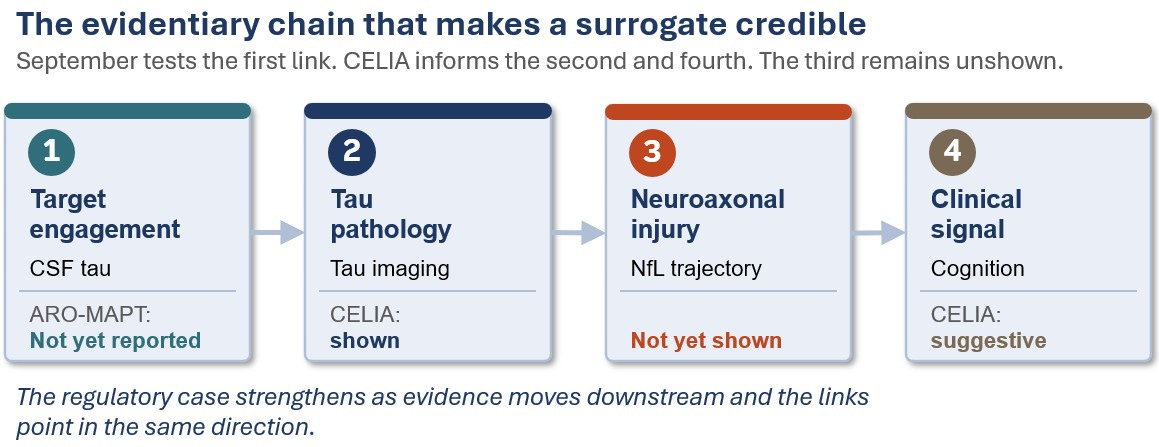
Figure 1: Where the evidence for each link currently comes from. Only the first is what September tests.
The NfL trajectory bending, and considerably more than that. This is the item nobody is discussing, it is the center of the whole case, and the tofersen file shows the bar is far higher than simply getting the number to move.
A surrogate is a measurement that stands in for the thing you actually care about. What anyone actually cares about in Alzheimer’s is whether the patient can still recognize their family in three years. You cannot wait years for that outcome every time you test a drug, so you look for something that moves earlier and reliably predicts it.
Tau reduction is not quite that, on the current evidence. It tells you the drug got in and did its job.
Chess has a word for the position tau is now in. A piece is pinned when it cannot usefully move, because moving it would expose something more valuable sitting behind it. The piece is still valuable. It simply cannot do the work by itself, and the reason has nothing to do with the piece.
That is where the tau number stands after CELIA. It is the figure management benchmarked, the figure September reports, and the figure the market will trade on. Sitting behind it is the ultimate question that matters, which is whether patients end up better off. Tau does not answer that question on its own, and diranersen just demonstrated it by lowering tau further without producing greater clinical benefit.
The consequence matters more than the metaphor. A bigger tau number does not fix this. Pushing harder on a pinned piece accomplishes nothing, because the problem was never how hard you pushed. What breaks a pin is bringing another piece to bear, and the pinned piece then becomes useful again.
NfL is the different piece. It is a marker of axonal injury and neurodegeneration, released when nerve fibers are damaged. When NfL falls, it suggests the rate of neuronal injury is falling. It is not a measure of whether the drug hit its target. It is a measure of what is happening downstream, in the disease itself. Tofersen’s accelerated approval centered on a blood-based biomarker, NfL, which is why the file matters so much here.
One caveat belongs up front. In SOD1-ALS, axons die quickly and in large numbers, so the NfL signal is loud and moves within months. Alzheimer’s is slower and the elevation is milder. The FDA accepting NfL in one disease does not commit it to accepting NfL in the other, and the agency will say so. Other markers have done it, amyloid in Alzheimer’s and dystrophin in muscular dystrophy among them. NfL is unusual because it measures downstream neuroaxonal injury rather than target engagement.
Now the complication, and it is a real one. The only reported human trial of a tau-lowering drug that I am aware of measuring NfL did not find what this argument needs.
In the Phase 1b study of diranersen, published in 2023, CSF NfL was tracked as an exploratory measure. Eight weeks after the last dose it showed no dose-responsive effect. NfL fell in the placebo group and in the lowest dose group, and rose slightly in the higher dose groups. The authors said plainly that the changes were not dose responsive and not concordant, and that assay variability and small sample size limited what could be read into them.
Anyone building a case on NfL has to deal with that, so here is the case.
The study enrolled 46 people across five arms. Individual dose groups had six to thirteen participants. It looked eight weeks past the last dose. That is a small, short experiment, and its own investigators said so.
More importantly, it may have been asking the wrong question. In somebody who already has Alzheimer’s, substantial neuronal and axonal injury has already occurred, and NfL is elevated because of it. A drug working upstream, at the level of tau production, would not be expected to reverse damage that has already happened. The relevant signal may therefore be a reduction in the rate of new injury rather than an immediate fall below baseline.
The right question is therefore probably not whether NfL falls. It is whether the climb slows.
Picture two lines over eighteen months, in illustrative indexed units rather than real values. On placebo, NfL runs 100, then 112, then 124, then 136. On drug, it runs 100, then 104, then 107, then 110. NfL never drops below where it started. That would still be one of the most important results this field has produced, because it would suggest that the rate of ongoing neuroaxonal injury had slowed.
One further caveat belongs here. NfL is not specific to Alzheimer’s disease. It rises with many kinds of neurological injury, climbs with age, and is affected by kidney function among other things. That raises the bar for using it as a surrogate, though a randomized design with repeated within-patient measurements helps mitigate those problems far better than a single absolute reading does.
Stated precisely, the question is whether the longitudinal slope differs from placebo, not whether the treated group’s absolute NfL value falls. Answering it requires a long trial with repeated measurements, which is exactly what the Phase 1b was not. The longitudinal experiment this hypothesis needs has not actually been reported.
One practical note follows from all of it. NfL can be measured in blood as well as spinal fluid. Plasma carries the practical advantage, because it can be drawn at ordinary study visits and repeated as often as the schedule allows, which lets investigators estimate an individual patient’s trajectory rather than relying on a handful of lumbar punctures. A program serious about this question collects plasma NfL longitudinally and treats CSF as complementary.
What the tofersen file actually required. Biogen’s advisory committee materials are public, and they are the clearest statement available of what the FDA wanted before accepting a novel surrogate. The agency’s own guidance, quoted in those materials, says a reasonably likely surrogate depends on two things: the biological plausibility of the relationship between the disease, the endpoint and the desired effect, and the empirical evidence supporting that relationship.
Biogen met the second requirement with roughly a hundred published citations spanning 1996 to 2023. That literature established, independently of any drug, that NfL is elevated in ALS above nearly every other neurodegenerative disease, that it distinguishes ALS from conditions that mimic it, that it correlates with the rate of decline across multiple separate cohorts, and that it predicts survival. Decades of work by people with no stake in the outcome.
They then did something more demanding than showing the marker moved. They built a model estimating how much clinical benefit each unit of NfL reduction bought. For every 10 pg/mL fall in plasma NfL at Week 16, the model predicted 0.77 points of preserved function on the ALS rating scale at Week 28, with a p-value of 0.0038, alongside parallel estimates for quality of life and for the risk of death.
The bar was not that the biomarker moved. It was a quantified relationship between how far it moved and how much the patient benefited, sitting on top of thirty years of independent literature.
There is a mirror-image piece of evidence in the same materials, and it is the kind of thing that makes a regulator believe a marker. A different antisense drug, aimed at a different ALS gene, raised CSF NfL by 37 percent. The patients receiving it did worse. A biomarker that moves the wrong way and drags outcomes with it is powerful confirmation that it tracks something real.
One process detail completes the picture. Biogen held a formal meeting with the FDA in April 2022 specifically to discuss the utility of NfL for accelerated approval, three months before filing. The surrogate was negotiated with the agency in advance and then ratified in public by the committee. It was not sprung on anybody.
Several markers agreeing, not one. The strongest version of this argument is not a single impressive number.
CELIA’s real problem was disagreement. Tau went down, imaging confirmed it, but the strongest clinical signal came from the lowest-dose group. When the biology and the clinical results point different directions, a regulator has no way to know which one to believe.
The fix is not a better single measurement. It is having tau, NfL, imaging and the cognitive scores all move the same way at the same time. Any one of them can be a fluke. Four of them agreeing is a story.
A dose-response that behaves. Regulators look for an exposure-response relationship that makes biological sense. It does not have to be a straight line, and more drug does not have to produce endlessly greater benefit, since real drugs plateau and therapeutic windows exist. What it does have to be is interpretable.
CELIA is hard to interpret on exactly that basis. Across the doses studied, increasing tau reduction did not translate into increasing clinical benefit. That single fact is the hardest thing in its dataset to explain and it is why the trial formally failed. A program that shows benefit rising with exposure has an argument available to it that diranersen currently does not.
The surrogate argued in public. The lesson from aducanumab, where the committee never voted on the surrogate the approval ultimately rested on, is not optional. It is also cheaper to follow than to skip.
For the strongest possible regulatory and reimbursement case, a tau surrogate should be written into the questions put to an advisory committee, debated openly, and endorsed on the record. The FDA is not obliged to convene a committee at all. The argument here is not that it cannot approve without one, but that after aducanumab, nobody should want a contested surrogate approval without transparent outside validation behind it. Approving first and explaining later is what happened in 2021, and the people watching most closely were not at the FDA at all.
They were at the Centers for Medicare and Medicaid Services, which decides whether Medicare pays. CMS is a separate agency with a separate process, and after aducanumab it restricted coverage to patients enrolled in clinical trials. An approved drug that Medicare will reimburse only under highly restrictive conditions, in a disease of the elderly, is not much of a commercial product. Winning the FDA argument and losing the CMS one is the worst outcome available.
The confirmatory trial already running. Accelerated approval is conditional. The company gets to sell the drug while it runs the study that proves the biomarker was telling the truth, and if that study fails, the approval can be withdrawn.
For years, companies collected the approval and let the confirmatory work drift. Congress has since given the FDA explicit authority to require that the confirmatory study be underway before accelerated approval is granted, and current agency policy strongly favors starting that work early rather than waiting until after approval. That pulls a great deal of expensive work forward, which is exactly the point.
The opportunity is not to replace tau with NfL. It is to connect them. Tau shows that ARO-MAPT is doing what it was designed to do. NfL could show that what it is doing matters to the disease.
7. What the current trial is not designed to do
Worth being clear about where things actually stand.
Public trial registries require a company to state, in advance, what a study is designed to measure. For the ongoing ARO-MAPT study, the single primary measure is side effects, tracked through day 270. The secondary measures are twelve readings of how the drug moves through the body, meaning how much gets absorbed, how long it lasts, how it clears, plus three routine safety checks on spinal fluid: total protein, glucose, and cell count.
Neither tau nor NfL appears in that list. That is a statement about what the study is formally designed to prove. It is not a statement that either biomarker is going unmeasured.
That is not a criticism. This is a first-in-human safety and pharmacokinetics study, and it is registered as one. Management has said the update will include tau knockdown in healthy volunteers, so tau is presumably being tracked as an exploratory measure. That is entirely normal, and exploratory biomarker measurements do not necessarily appear among a registry’s primary and secondary outcome measures.
The point is what it tells you about the number the market will trade on. It will arrive as an exploratory result, meaning a measurement taken out of interest rather than one the study was built to prove, from a trial designed to answer a different question, quite possibly in a small number of participants. It is the beginning of the regulatory argument, not evidence that can settle it.
Which also means the question worth asking is forward-looking. Once adequate target engagement is established, whether NfL is being collected now, and whether Arrowhead plans to carry it into the patient cohorts and the Phase 2 design, tells you more about the timeline to approval than the precise magnitude reported in September.
8. The faster door is not Alzheimer’s
There is a route to an accelerated approval that runs around the Alzheimer’s problem entirely, and Arrowhead’s own language already gestures at it. The program is described as being for Alzheimer’s disease and other tauopathies.
The other tauopathies may come first.
Progressive supranuclear palsy is a primary 4R tauopathy. Amyloid is not a defining pathology, unlike in Alzheimer’s disease. It moves fast and you can measure it. It is rare enough that trials run in the low hundreds instead of the thousands. There is no approved disease-modifying treatment. The protein the drug silences is the defining pathological protein in the disease, which makes it an unusually clean test of the mechanism.
Tofersen is the useful analogy here, though the analogy is regulatory rather than biological. A rare, fast-moving, well-defined neurodegenerative disease with major unmet need, approved on a biomarker after a Phase 3 that missed, is a far more applicable precedent for progressive supranuclear palsy than anything in the amyloid history. The disease biology, the biomarker kinetics and the trial endpoints are not interchangeable between the two, and the regulatory argument would still have to be built from scratch.
A tau drug that changes the course of a rare tauopathy could give the FDA a much stronger human precedent for accepting tau biology as part of the regulatory case in the common one. The rare disease is not the consolation prize. It is the argument.
9. The odds, and what would change them
Making a case for something is not the same as predicting it, so here are the odds as I actually see them.
Accelerated approval for ARO-MAPT in Alzheimer’s disease is unlikely. My estimate before CELIA was somewhere around ten to fifteen percent, and CELIA moves it in both directions at once, strengthening the mechanism while weakening the simplest version of the surrogate argument. I would leave it roughly where it was.
That number is not arbitrary, and it is worth showing the parts. Getting there requires deep and durable tau knockdown in patients, which I would put at better than even. It requires a measurable separation in the NfL trajectory, which I would put below even, given the limited human evidence to date rather than because the biology argues against it. It requires the FDA to accept NfL as a surrogate in Alzheimer’s specifically, having only ever accepted it in ALS, which I would put well below even. It requires the biomarkers and the cognitive data to point the same direction. It requires the confirmatory program to be underway early enough to satisfy the FDA’s accelerated approval expectations.
One distinction is worth drawing inside that list. The scientific probability and the regulatory probability are not the same thing, and the second is lower. Even a convincing NfL result would still leave Arrowhead having to establish that NfL is a valid surrogate in Alzheimer’s disease specifically, which is a separate argument from having produced good data.
The chain is long enough that even reasonably plausible probabilities at each step would produce a low-teens result overall. That is a conceptual probability tree rather than a calculated model, and it is offered as one. Any one of those links failing could close this particular route, which is why the number stays small even though several of the individual steps are more likely than not. It would not necessarily close every route, since a different biomarker package, unexpectedly strong clinical data, or a different indication could each open another.
A convincing NfL dataset in patients would move that number more than anything else, plausibly doubling it. That is a real if, given that the one reported tau-lowering trial I am aware of that measured NfL did not deliver it, and it is the single most important thing to watch over the next three years. Convergence across several markers and a clean dose-response would matter nearly as much.
An accelerated approval in progressive supranuclear palsy may be a materially better opportunity than the Alzheimer’s version, and could arrive years earlier if pursued in parallel from the start.
The reimbursement question sits behind all of it. The FDA approving a drug is not the same as patients getting it, and aducanumab is the reason that sentence has to appear in any honest note on this subject.
10. Where this leaves the September readout
The September number is a first step and will be treated as a verdict.
What it can establish is human central nervous system target engagement after subcutaneous dosing, meaning that systemic dosing produced a measurable pharmacodynamic effect within the central nervous system. If that had not worked, nothing else would have mattered. That is worth a great deal, and it is worth more to the platform than to this particular drug.
What it cannot establish is whether lowering tau helps a patient, because CELIA has just demonstrated that the two questions come apart.
The most credible path I can see to patients getting this drug early runs through a biomarker that was not in the headline, in a disease that is not Alzheimer’s, argued in front of a committee that has not yet been convened.
The case for early approval is real. It simply does not run through the number everyone will be looking at in September.

A Note on Supporting Independent Research
If this white paper has been valuable to you, whether it shaped your thinking, validated your conviction, or simply saved you the time of doing this work yourself, a voluntary contribution is genuinely appreciated and directly funds the next paper.
For individual investors and readers
Any amount you feel reflects the value you received is welcome and meaningful. A contribution in the range of what you might pay for a single premium research report is a thoughtful gesture that makes a real difference.
For family offices, investment funds, hedge funds, and research platforms
This paper is the caliber of work that institutional research desks bill significant retainers to produce. If your team referenced it, distributed it internally, or used it to inform a position, a suggested contribution of $1,500 reflects the professional value of the analysis, though any amount is meaningful. Your support makes it possible to continue publishing at this level without a paywall that limits the reach of the ideas. If your organization requires an invoice to process a payment, please reach out directly at bioboyscout@gmail.com and one will be provided promptly.
There is no obligation and no expectation. This is purely a thank you for work that meant something to you.
Zelle: (847) 227-7909
PayPal: paypal.me/bioboyscout
Thank you for reading, and for being part of a community that takes this thesis seriously.
— Robert Toczycki | BioBoyScout
Important Risks, Disclosures, & Disclaimers
The author, Robert Toczycki (aka BioBoyScout), certifies that:
all views expressed in this white paper accurately reflect his personal opinions about the topic discussed;
he was not compensated in any form for producing this white paper; and
he has not received and does not receive compensation from Arrowhead Pharmaceuticals.
This paper is provided for informational and analytical purposes only. It does not constitute investment advice, financial advice, legal advice, or a recommendation to buy, sell, or hold any security, and it is not a recommendation as to any corporate course of action. The author holds a long position in Arrowhead common stock. Past performance is not indicative of future results, and forward-looking analysis is inherently uncertain. The author and BioBoyScout are not registered investment advisors. The author assumes no obligation to update this paper.
About the Author
BioBoyScout is the publishing name for Robert Toczycki, an independent biotech investment research writer based in Chicago. The BioBoyScout series publishes institutional-grade analysis of structural dynamics in RNA-class therapeutics, with particular focus on Arrowhead Pharmaceuticals’ TRiM platform and the broader competitive landscape. Robert is a registered US Patent Attorney with a JD, an Executive MBA completed at the top of his class, and a BS in Mathematics and Computer Science from the University of Illinois at Urbana-Champaign. He has a deep passion for financial analysis, particularly identifying valuation discrepancies and demonstrating them through rigorous, data-driven research and solid analytics.
Comments or questions: bioboyscout@gmail.com.
Copyright © 2026, BioBoyScout. All Rights Reserved.