

Robert Toczycki, JD, MBA
bioboyscout.com
bioboyscout@gmail.com
847.227.7909
X: @BioBoyScout
1. The trade nobody remembers
In July 2008 Roche bought a small Madison company called Mirus Bio for $125 million. Mirus had spun out of University of Wisconsin research in 1995 and had spent more than a decade on nucleic acid delivery, work that predates therapeutic RNAi entirely. That expertise turned out to be unusually valuable once RNAi arrived and the field ran into its defining problem, which was getting the molecule into the right cell.
The year before, Roche had paid Alnylam $331 million for access to the field. Add the milestones and the development spending and Roche had committed something close to half a billion dollars to becoming a leader in RNAi.
In 2010 they changed their minds and exited the field entirely.
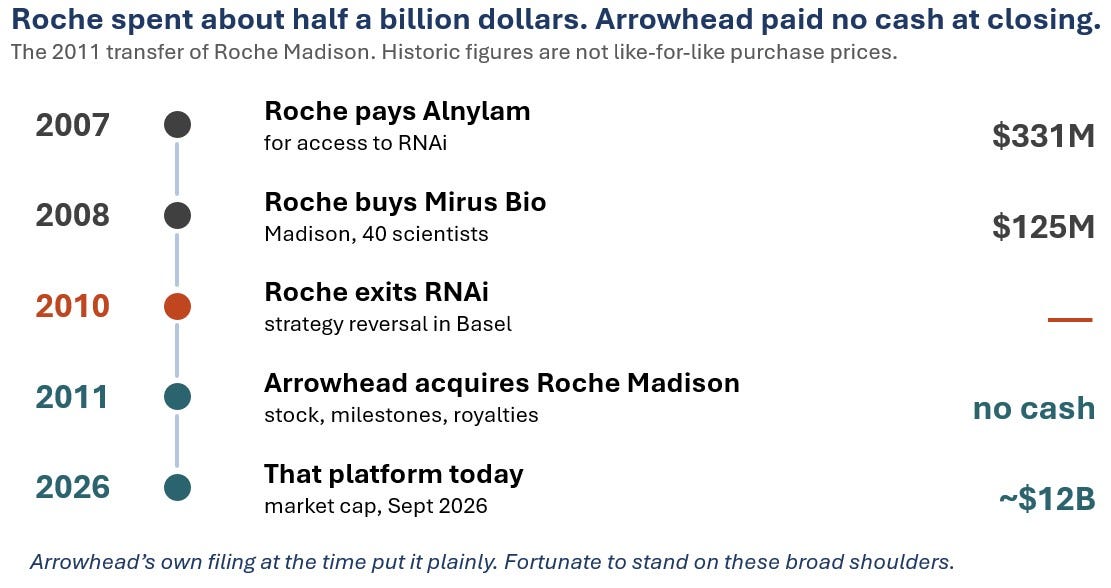
Figure 1. Transaction figures as reported at the time. The 2026 market capitalization is approximate.
In October 2011 Arrowhead acquired Roche’s Madison operation. Not the technology alone, but an operating research site, its equipment, the intellectual property, the licenses from Tekmira and Alnylam, and a team of more than forty scientists.
Those figures are not comparable purchase prices and I do not want to present them as such. What they show is the scale of what Roche spent assembling a capability Arrowhead ended up inheriting.
Arrowhead paid no cash at closing. Roche took a promissory note of fifty thousand dollars and an equity stake of just under ten percent. Arrowhead subsequently recorded total purchase consideration for the transaction at roughly $5.27 million, comprising about $5.13 million in shares, the note, and a small amount assigned to contingent consideration.
That is not the same as paying nothing, and it is worth being precise. Roche also kept rights to negotiate for certain future products, milestone payments that trigger only after regulatory approval, and low single-digit royalties on some sales. The consideration was real. Much of what Roche stood to receive was contingent on success that had not happened yet, which meant Arrowhead committed very little cash at a moment when it had very little cash to commit.
Arrowhead’s own document explaining the deal said it more plainly than I could. “Fortunate to stand on these broad shoulders.”
2. The part that actually mattered
Everyone focuses on the price, which was remarkable. The more interesting question is why the team was still there to acquire.
Picture the same thing happening in Cambridge. Roche announces it is shutting its RNAi site. Forty scientists with deep delivery expertise hit the market on a Tuesday. By Friday they have offers from Alnylam, from Dicerna, from half a dozen startups, from whatever startup raised a Series A that month. The building gets subleased. The knowledge scatters across the ecosystem and stops being a platform.
Now picture it in Madison in 2011. Roche announces the same thing. Where does a delivery chemist go?
This is not a place without scientists. It is a place without competing employers, and those are entirely different problems.
There was almost nowhere local for an RNAi delivery team to go, and that may be the most important part of the story. Isolation did not make the team cheap. It made the team intact.
When Arrowhead arrived with stock and a plan, they were not recruiting forty individuals. They were acquiring a group that had worked together for years and would have been difficult to reassemble anywhere.
The handoff shows up in the personnel records. Within a month of closing, Arrowhead named David Lewis and David Rozema to run biology and chemistry in Madison. Both had held those functions under Roche, Lewis as site head and director of research, Rozema as director of delivery chemistry. The company also granted inducement options to thirty-seven selected new employees at the Madison facility. The intellectual property changed owners and a good deal of the operating organization crossed the bridge with it.
The conventional model treats talent density as the asset. Arrowhead’s history suggests the inverse can also hold. When the product is a platform rather than a molecule, talent stickiness is worth something too.
There is a way of framing that which I think generalizes beyond this company. A patent makes knowledge harder for a competitor to appropriate. Geography can make a team harder for a competitor to take apart.
The moat was never that the scientists could not leave. It was that leaving usually meant changing cities rather than changing badges, and friction is what lets an advantage last long enough to compound.
Geography did not create the capability. It gave the capability time to compound.
3. Why continuity is what compounds
A delivery platform is not a molecule and it is not a patent. It is accumulated knowledge about what works, what fails, and why, most of which never gets written down properly.
Which linker survives the bloodstream. What happens when you change the sugar. Why the third version worked and the second did not. That kind of understanding lives in the people who generated it, and it only compounds if those people keep working on the same problem together.
Boston is optimized for talent liquidity. You can staff a program in a month. You can also lose it in a month. That trade works perfectly well when the value sits in an asset. It works much less well when the value sits in accumulated organizational knowledge.
The Madison lineage was doing the reverse. Decades on the same underlying problem, across three different owners. Under Arrowhead alone, fifteen years of iteration carried that work from liver to lung, muscle, fat and brain, each step informed by the chemistry and delivery work that came before it.
For that kind of company, the ability to hire quickly matters far less than the difficulty of being raided.
4. The same distance, opposite value
Roche’s RNAi effort was spread across Madison, Kulmbach and Nutley inside a global company headquartered in Basel. Madison was not an afterthought, and it is worth correcting the easy version of this story. Roche itself described Madison and Kulmbach as centers of excellence for RNA therapeutics.
What distance did do was put the decision somewhere else. When Roche made a portfolio-level judgment to leave the field, the fate of the Madison organization was settled by people who were not in Wisconsin, and the sites in Germany and New Jersey went the same way.
Under Arrowhead the same geography produced the opposite effect. Madison went from being one node inside a global pharmaceutical company to being a core scientific operation inside a much smaller one, while the thin local labor market likely helped hold the group together long enough for that to happen.
One property, opposite effects, depending entirely on who controls the capital allocation.
5. Building outside the cluster
In December 2021 Arrowhead bought thirteen acres in the Verona Technology Park for just under three million dollars. On that land it built a GMP manufacturing plant and a lab and office building, together running to roughly three hundred thousand square feet. The investment was estimated at two hundred to two hundred fifty million at announcement. By the end of 2025, with the build-out substantially complete, Arrowhead reported costs incurred of approximately $298.5 million.
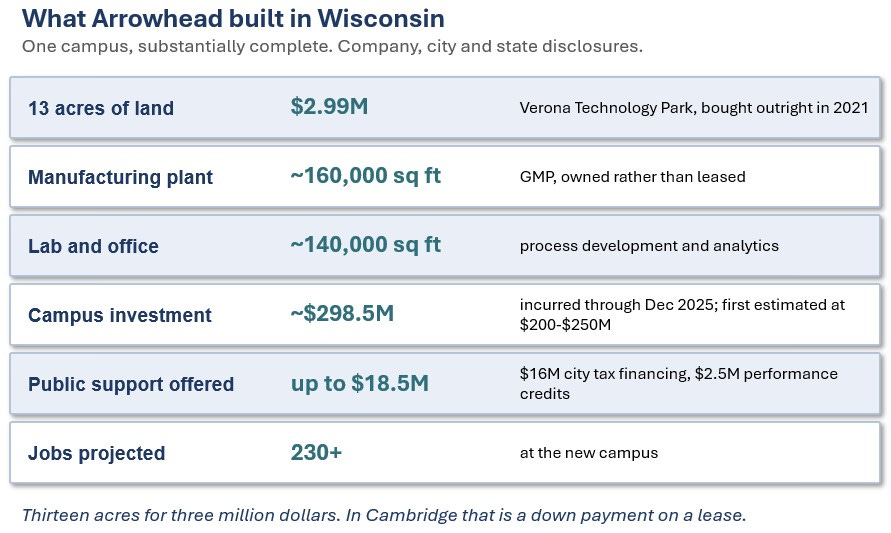
Figure 2. Figures from company announcements and the Wisconsin Economic Development Corporation.
Look at the land number again. Thirteen acres for under three million dollars. There is effectively no comparable transaction available in Cambridge or South San Francisco at anything resembling those economics.
The other half of the ledger is the direction the money flows. Verona authorized up to sixteen million in tax increment financing toward site improvements, repayable out of future tax increment. The state offered up to two and a half million in refundable credits contingent on job creation and capital spending. Neither is a check handed over at closing. Both are public money pointed at a campus Arrowhead owns.
In a place where everybody wants to be, you pay a premium to get in. In a place that wants you, they pay you to stay.
Arrowhead also owns the plant rather than renting capacity from a contract manufacturer. For a company whose platform advantage depends heavily on chemistry and delivery, having the people who make the molecule in the same organization as the people who design it is not a cost saving. It is a feedback loop.
6. The university nobody mentions
The weakest objection to Madison is that there is no talent there, and it is worth taking apart because it is simply wrong.
The University of Wisconsin has been doing serious nucleic acid science for most of a century. Har Gobind Khorana did the work there that helped crack how the genetic code turns RNA into protein, and won a Nobel for it. Howard Temin discovered reverse transcriptase there, which rewrote what everyone thought they knew about how genetic information moves, and won a Nobel for that. James Thomson derived the first human embryonic stem cell lines there.
None of that is a direct lineage into siRNA delivery and I would not pretend otherwise. What it establishes is narrower and sufficient. Madison is not a scientific wilderness, and it has not been one for a very long time.
The university also runs one of the oldest and most successful technology transfer operations in the country, the Wisconsin Alumni Research Foundation (WARF), founded in 1925. The blood thinner warfarin is named after it. Mirus Bio itself spun out of university research in 1995, which is how the delivery expertise that later became central to RNAi took root in Madison.
The state development agency put Arrowhead’s Madison research headcount at roughly two hundred ten in 2022, in a hundred and eleven thousand square foot facility, with intern and trainee pipelines into local institutions. Arrowhead has also disclosed research use of a primate colony housed at the Wisconsin National Primate Research Center, a university affiliate. That is not a company scraping for staff in a scientific vacuum. It is a company sitting inside an ecosystem.
Chris Anzalone talks about the place in the language of a relationship rather than a location decision. “A dedicated member of the biotech community in the greater Madison area” for more than a decade. “Strong local relationships.” A “productive and mutually beneficial relationship” with the local business community for many years.
That is the vocabulary of somebody who has been somewhere long enough for it to matter, which is the asset this whole paper is about.
7. The costs, which are real
None of which makes this free.
Arrowhead is a split company. The executive office is in Pasadena, the delivery chemistry and manufacturing in Wisconsin, more research in San Diego. That is a genuine organizational cost and anyone who has worked across time zones knows it.
Senior recruiting is harder. An accomplished executive who has built a life in the Bay Area will not casually move to Dane County, and Arrowhead has to pay up or wait longer to fill those roles.
The informal information flow is thinner too. In Cambridge you learn what a competitor is doing because somebody’s spouse works there. Arrowhead does not get that, which cuts both ways since nobody learns what Arrowhead is doing either.
8. What a buyer would actually be getting
This is where the argument starts mattering to anybody modeling a bid for this company.
Platform acquisitions carry a peculiar risk. The buyer can acquire every asset and still slowly lose the platform. A large company buys a small one for its capability, integrates it, moves reporting lines, folds the labs into an existing structure, and over a couple of years the people who actually held the capability in their heads take their payout and go. What is left is buildings, patents and an org chart.
Every acquirer of a platform company is really buying a bet that the people stay. The question is not what Arrowhead owns. It is what walks out the door on the Monday after closing.
In Cambridge that bet is a retention package, and retention packages have a known expiry. In Madison the bet is a fact about the map.
There is also an unusually clean natural experiment here, of a kind few platform companies can point to. The Madison organization has already been through one of the harsher versions of what an acquisition can do. Roche bought Mirus in 2008, ran the Madison organization for a little over two years, then reversed strategy and walked away from the field.
The transfer to Arrowhead did not happen until late 2011, and that gap may be the most telling part. The owner had already abandoned the field, and enough of the organization stayed coherent that somebody could still acquire it as an operating group. That is a change of ownership followed by abandonment, which is the failure mode buyers worry about, and the group came out the other side intact enough that Arrowhead retained dozens of them and put two of Roche’s own site leaders back in charge.
Most teams have never been tested. This one has been acquired, abandoned, transferred, and is still working on the same underlying problem in the same city nearly two decades on.
The corporate structure helps too, in a way that looks accidental and is worth noticing. Arrowhead keeps its executive office in Pasadena, its manufacturing and delivery chemistry in Wisconsin, and further research in San Diego. In almost any acquisition the synergies come from eliminating duplicate corporate functions, and those sit in California. A core part of what a buyer would want to preserve sits two thousand miles from the corporate functions it might want to cut.
You can take out a headquarters without anybody in a lab noticing. That is not true of a company where finance and chemistry share a cafeteria.
Which means the geography that looks inefficient in a standalone company becomes unusually efficient in an acquisition. A buyer would not need to relocate the Madison delivery organization or work out where manufacturing should live. Those questions have already been answered by the map, and the answer is Wisconsin.
Then there is the plant. Dedicated GMP capacity for this class of medicine is not easy to come by, and companies without their own remain dependent on outside manufacturers and their schedules. A buyer acquiring Arrowhead gets roughly a hundred and sixty thousand square feet of owned manufacturing built for exactly this chemistry, plus the process development group that knows how to run it. For anybody planning to launch more than one product, that is not a real estate line. It is control over a critical part of the launch schedule.
Roche had already written the playbook, which makes the Madison story stranger rather than simpler. When it acquired the rest of Genentech in 2009 it deliberately kept research and early development as an independent center in South San Francisco, explicitly to preserve the culture that had produced the pipeline. Roche understood the value of organizational continuity. A year later it simply concluded that RNAi itself no longer justified the investment, and Madison went with the decision.
The cheapest way to avoid breaking the factory is to buy one that is already standing somewhere you were never going to move it to.
9. The outpost
Chess has a square worth understanding here.
An outpost is a square deep in the opponent’s half where you can plant a knight and no enemy pawn can ever attack it. Put a knight there and it sits for the rest of the game, controlling squares, impossible to dislodge, growing more valuable with every piece that gets traded off.
The square itself is nothing special. It is a square. What makes it an outpost is that nothing can drive the piece away.
Madison is not a better place to do science than Cambridge. It is a place where a team that is already good is hard to dislodge, and over fifteen years of Arrowhead ownership that may have turned out to be the more valuable property.
The scientific lineage running through Madison can be traced through Arrowhead’s expansion out of the liver and into everything after it. The chemistry that reaches liver cells. The ligand that reaches the airway. A molecule given as a shot under the skin, now being tested in people for whether it can reach the central nervous system and silence tau.
Roche bought the team, funded it, and gave up on the field. Arrowhead took the square and never moved the piece.
Boston and South San Francisco are where you go to hire quickly. Nobody planned Madison as an alternative to either. It simply turned out that a company trying to accumulate one capability for the better part of two decades needed somewhere that would hold still.
Talent density is worth a great deal if you are building a drug. It is worth much less than continuity if you are building a factory that makes them.

A Note on Supporting Independent Research
If this note has been valuable to you, whether it shaped your thinking, validated your conviction, or simply saved you the time of doing this work yourself, a voluntary contribution is genuinely appreciated and directly funds the next paper.
For individual investors and readers
Any amount you feel reflects the value you received is welcome and meaningful. A contribution in the range of what you might pay for a single premium research report is a thoughtful gesture that makes a real difference.
For family offices, investment funds, hedge funds, and research platforms
This paper is the caliber of work that institutional research desks bill significant retainers to produce. If your team referenced it, distributed it internally, or used it to inform a position, a suggested contribution of $1,000 reflects the professional value of the analysis, though any amount is meaningful. Your support makes it possible to continue publishing at this level without a paywall that limits the reach of the ideas. If your organization requires an invoice to process a payment, please reach out directly at bioboyscout@gmail.com and one will be provided promptly.
There is no obligation and no expectation. This is purely a thank you for work that meant something to you.
Zelle: (847) 227-7909
PayPal: paypal.me/bioboyscout
Thank you for reading, and for being part of a community that takes this thesis seriously.
— Robert Toczycki | BioBoyScout
Important Risks, Disclosures, & Disclaimers
The author, Robert Toczycki (aka BioBoyScout), certifies that:
all views expressed in this white paper accurately reflect his personal opinions about the topic discussed;
he was not compensated in any form for producing this white paper; and
he has not received and does not receive compensation from Arrowhead Pharmaceuticals.
This note is provided for informational and analytical purposes only. It does not constitute investment advice, financial advice, legal advice, or a recommendation to buy, sell, or hold any security, and it is not a recommendation as to any corporate course of action. The author holds a long position in Arrowhead common stock. Past performance is not indicative of future results, and forward-looking analysis is inherently uncertain. The author and BioBoyScout are not registered investment advisors. The author assumes no obligation to update this paper. Transaction details are from contemporaneous reporting and from Arrowhead’s own disclosures and filings at the time of the 2011 acquisition. The consideration comprised a promissory note, restricted common stock, negotiation rights, post-approval milestones and royalties rather than cash at closing, recorded by the company at approximately $5.27 million. Verona campus figures reflect the single project announced in 2021, with costs incurred through December 2025 as reported by the company; incentive amounts are authorized maximums contingent on performance rather than payments received. Arrowhead also operates research facilities in San Diego and its corporate office in Pasadena. The characterization of why the Madison team remained available is the author’s interpretation and not a claim about any individual’s decisions.
About the Author
BioBoyScout is the publishing name for Robert Toczycki, an independent biotech investment research writer based in Chicago. The BioBoyScout series publishes institutional-grade analysis of structural dynamics in RNA-class therapeutics, with particular focus on Arrowhead Pharmaceuticals’ TRiM platform and the broader competitive landscape. Robert is a registered US Patent Attorney with a JD, an Executive MBA completed at the top of his class, and a BS in Mathematics and Computer Science from the University of Illinois at Urbana-Champaign. He has a deep passion for financial analysis, particularly identifying valuation discrepancies and demonstrating them through rigorous, data-driven research and solid analytics.
Comments or questions: bioboyscout@gmail.com.
Copyright © 2026, BioBoyScout. All Rights Reserved.