

Robert Toczycki, JD, MBA
bioboyscout.com
bioboyscout@gmail.com
847.227.7909
X: @BioBoyScout
1. The scoreboard
Count the tissues where a company has an RNAi drug in a person, and the list is short.
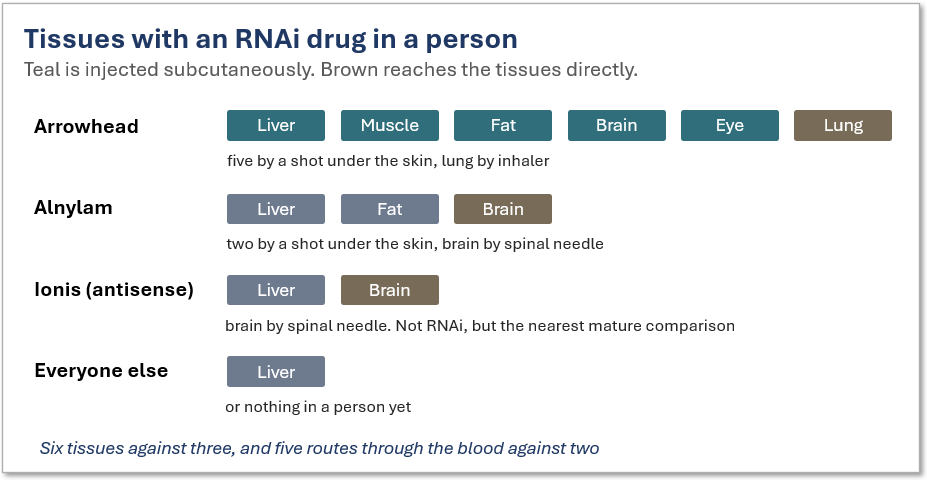
Figure 1. Author’s reading of public pipelines as of September 2026. Spinal injection is marked separately because it is a different problem with a different burden on the patient.
Alnylam is the closest. It got its second tissue by a shot under the skin this year, putting a fat program into Phase 1 alongside its liver franchise, and its brain programs go in through the spine. Ionis works with antisense rather than RNAi, so it is not strictly on this board, but it is the nearest mature comparison and its picture looks the same.
Everybody else is in the liver or not yet anywhere, including the well-funded newcomers whose programs outside the liver have not reached a person yet. One company is in six. Liver for everything the liver does, muscle for a rare wasting disorder, fat for obesity, brain for Alzheimer’s, and the retina for macular degeneration, all five by an injection under the skin. Lung for cystic fibrosis and other pulmonary disease, which goes in by inhaler, straight to the airway, and never has to survive the bloodstream at all.
The sixth one has not been announced. ARO-033 sits on the public trial registry, recruiting since June for macular degeneration, first in healthy volunteers and then in patients. The registration states the route four separate times. It goes in as a shot under the skin, which means Arrowhead is trying to reach the retina from the arm, with the drug traveling through the bloodstream rather than being placed in the eye. Every approved drug for that disease goes in through a needle in the eye.
Chris Anzalone said in September that the company can address seven cell types with clinical programs in five. The registry entry had been updated the day before.
Six tissues against three, and on the harder route, the one where the drug has to travel through the blood and find its way, five against two. That is not a small gap and it is not a permanent one either. Alnylam is doing the work. What separates them right now is years.
2. Why everybody else stayed in the liver
The obvious question is why. If getting outside the liver is so valuable, and it is, why did the biggest and best-funded companies in the field not do it?
Because the liver was enough.
A sugar cluster called GalNAc grabs a receptor that sits on liver cells in enormous abundance and almost nowhere else. The pairing was not discovered by any of these companies. Academics worked out that the liver had this receptor and that the sugar would stick to it decades before anybody put RNA on the end of it. In that sense the handle was lying on the table.
Picking it up was a different matter. Getting from a known sugar to a drug that silences a gene for six months took years of chemistry, and Alnylam did most of that work. What matters is that it only had to happen once. The pattern got published, the patents eventually run out, and now anyone entering the field starts with the basic liver-delivery problem already solved for them.
There was also a scientific reason. The liver is forgiving. It filters blood, so anything you inject ends up passing through it. It has a receptor that recycles fast. It tolerates a lot of drug. Every other tissue is worse on at least one of those counts, and most are worse on all of them.
Staying in the liver was not a failure of ambition. It was the right call for anyone who already had a liver franchise. Which is precisely the point.
3. Why Arrowhead went looking anyway
Arrowhead did not have a liver franchise. In 2011 it had a Madison operation it had picked up from Roche for almost nothing, a delivery chemistry that had just been abandoned by its previous owner, and no approved drugs. Alnylam was years ahead in the liver and better funded.
Competing head-on in the liver meant fighting the incumbent on its home ground with fewer resources. Chris Anzalone said as much in September, looking back. Early on, he said, they decided that to extract real value from the technology they needed to get outside the liver, and that starting around 2010 they began building delivery for other tissues.
Worth being precise here, because the shorthand gets this wrong. Arrowhead never left the liver. It is still there, and the only drug it has on the market is a liver drug. What it did was refuse to be only there, at a moment when it had no approved product and every reason to concentrate on the one tissue that already worked.
The tissue record everybody admires now started as the second front opened by a company that could not win the first one on resources alone.
I want to be honest about what that means, because it is a better story than genius. Arrowhead went looking elsewhere because the good ground was already occupied. Necessity picked the direction. What happened after that is the part worth understanding.
4. What opening a tissue actually takes
Here is why the gap on the scoreboard is as wide as it is.
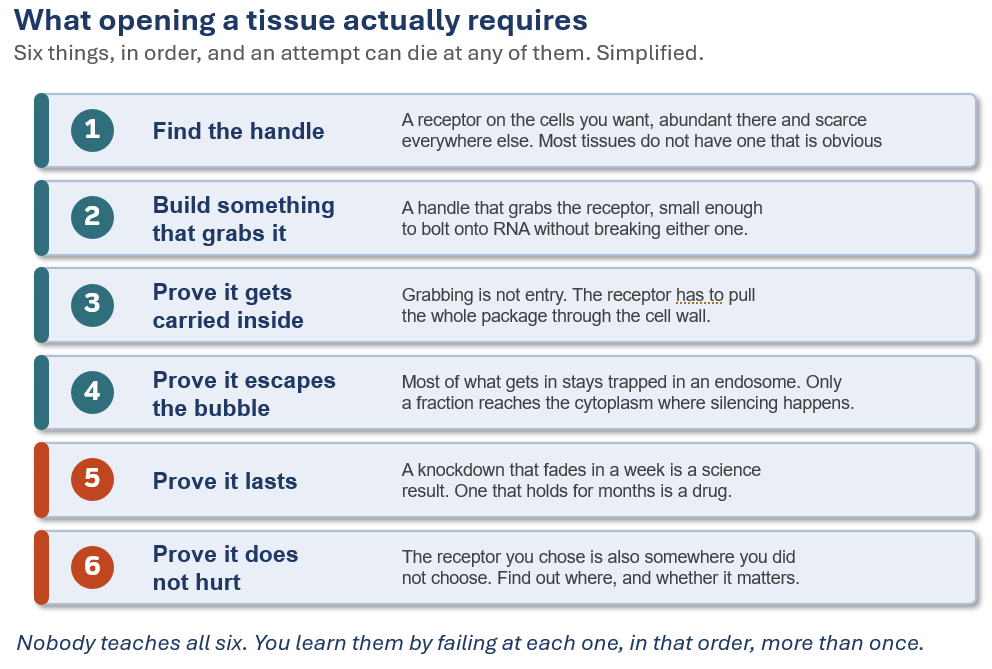
Figure 2. Simplified. Each step has its own literature and its own graveyard.
Opening a tissue is not one problem. It is six, in sequence, and an attempt can die at any of them.
You need a receptor that sits on the cells you want and almost nowhere else, and for most tissues that receptor is not obvious. You need a handle that grabs it, small enough to attach to RNA without wrecking either one. You need proof the receptor actually carries the whole package inside rather than just holding onto it at the surface. You need the package to escape the bubble it gets trapped in once inside, which is where most of what enters a cell stays. You need the silencing to last months rather than days. Then you need to find out where else that receptor lives, because it lives somewhere you did not choose, and whether that matters.
Six steps. No textbook covers all of them together, because no discipline does. The people who can do this learned by failing at each step in order, more than once.
That is the real reason the list is short. The chemistry to hit a target is something you can hire for. The ability to open a tissue is something almost nobody has, because the training does not exist and the only way to acquire it is to spend a decade at it.
5. The people who can do this
Which brings me to the part of this that does not appear in any model and that I think matters more than any single program.
A delivery scientist is not a chemist, though they have to know chemistry. Not a cell biologist, though the bubble that traps the drug inside a cell does not care what your degree says. Not a pharmacologist, though durability is a pharmacology question. It is all three at once, applied to a problem that most of the world has been content to leave alone because the liver was enough.
The number of people who can do that end to end is small. I would guess a few dozen, worldwide, and I am not confident of the second digit. There is no graduate program in it. There is no textbook. You become one by working on it for a long time alongside other people who are working on it, and a surprising number of the people who fit that description have spent their careers in one building in Wisconsin.
I wrote about that building in an earlier note. The short version is that these people came up at a Madison company called Mirus Bio, founded out of university research in the 1990s. Roche acquired Mirus Bio in 2008 and ran the site as part of its own RNAi effort. When Roche abandoned the field two years later, the operation went to Arrowhead. The group stayed together through both changes of owner because there was nowhere local to go. Two of Roche’s own site leaders were put back in charge within a month of Arrowhead taking over. Arrowhead brought aboard thirty-seven employees from the operation.
The platform everyone talks about as if it were a machine is a few dozen people who have been failing at the same six steps together for longer than most biotech companies have existed.
Here is why that word together matters more than it looks. A competitor could go out tomorrow and hire excellent delivery scientists from a dozen companies. It still would not get what Madison has, because a lot of what Madison has does not sit inside any one of them.
Failure makes information, and most of that information never becomes a paper or a patent. It becomes a conversation somebody remembers twelve years later. We tried that receptor. We tried that linker. Here is what happened, and here is why nobody has bothered since. One person remembers the handle that behaved strangely with a particular chemistry. Another remembers the toxicity signal from a receptor that looked perfect on paper. A third remembers the animal result that was going to be a program until somebody looked at where the drug actually ended up.
The clearest example is one the company would rather not be remembered for. In 2016 the delivery chemistry the team had inherited from Roche, which had already put candidates into human trials, came apart after a safety finding in a primate study. The programs were discontinued. Everything built on that chemistry went with them.
Within about two years the same people had a different delivery approach in the clinic. Every tissue on the scoreboard was opened with the one that came after the one that failed, by a team that knew exactly why the first one failed, in a level of detail no publication could capture.
You can hire a scientist. You cannot hire twenty years of shared memory one person at a time.
That makes this a stranger kind of moat than the usual one. Some of it sits in patents and molecules and databases, the way a normal moat does. Some of it sits between people, in the accumulated record of what was tried, what failed, and what was quietly set aside years ago for reasons never written down.
You cannot copy what you cannot see.
6. What six tissues in the clinic actually proves
Be careful here, because the scoreboard is easy to over-read.
Six tissues with a drug in human trials proves that the route into each one works well enough to dose a person. It does not prove that any drug in those tissues will work. Getting into muscle and fixing muscle are different problems, and the second one is not a delivery problem at all.
It also does not prove the six-step process is now routine. Chris puts a new tissue at every eighteen to twenty-four months. Brain and eye both reached the clinic this year, which is faster than that, and one fast year is not a trend. Each one is still a project with its own receptor to find and its own ways to fail.
What it does prove is narrower and still unusual. A group of people has solved the delivery problem in six tissues, five of them by the harder route through the blood. The closest competitor is in three tissues, two by that route. The second of the two arrived this year.
A drug proves a target. A tissue proves a team. Arrowhead has six of the second kind of proof, and the market only knows how to price the first.
There is a consequence of that which most models miss. Investors tend to value the tissues one at a time. Lung is worth something, muscle is worth something, the brain is worth something, add them up. If the argument here is right, that undercounts, because each tissue contains information about the next one.
Not about which receptor will work, or whether the biology will cooperate once you get there. About whether the people looking for that receptor know how to find one. That is what a platform is supposed to mean, if the word means anything. Success in one program changes the odds you should assign to a program that does not exist yet.
7. Where this can go wrong
Three ways, and I would take the first one seriously.
The people can leave. Everything above argues the asset is a team. Teams age, retire, and get recruited. The Madison group stayed together through two changes of owner partly because the labor market kept them there, and a very successful brain readout is exactly what would make that labor market noisier. If the delivery scientists are the platform, then retention belongs on the same page as the science. Most models treat it as boilerplate, the same key-person language every company files.
The next tissue may not open. Six tissues are now in the clinic. Whatever comes next remains unproven, and nobody publishes the attempts that did not.
The route can work and the drugs can still fail. This is the one the scoreboard hides. Six tissues is six opportunities for the biology to disappoint after the delivery succeeds. That would not invalidate the team. It would mean the team solved the part it controls and the disease did not cooperate.
8. The seconds
Chess used to have a custom that computers have mostly made obsolete.
In the era of adjournments and world championship matches that ran for months, a top player brought seconds. These were strong players in their own right, sometimes grandmasters, whose job was to prepare. They analyzed the opponent’s repertoire. They found the novelties. When a game was adjourned overnight with a sealed move in an envelope, the seconds stayed up until dawn working out the position while the champion slept.
The champion walked in the next morning with the winning line already in hand. The public saw the champion. The seconds sat in the back.
Every serious player knew the truth. The name on the trophy was the one who could afford the best seconds.
Chess engines, the programs that now play better than any person alive, ended most of that. Analysis that took a team a night takes a laptop a minute, and the second’s craft became one more job a machine does better.
There is no engine for opening a tissue. No program finds the receptor, builds the handle, and works out why the package will not get out of the bubble. The craft still lives in people, the way it did before the machines, and the number of people who have it is small in the way the number of world-class seconds was always small.
Arrowhead’s seconds have prepared more positions than anyone else in the field. It has had them since before it owned them. When the brain data lands in the next few weeks and everybody looks at the number, the number will belong to the company.
The position was prepared by people who have spent their careers in the back of the room, and who have now opened six doors before the rest of the field.
The champion gets the trophy. Somebody prepared the position.

A Note on Supporting Independent Research
If this white paper has been valuable to you, whether it shaped your thinking, validated your conviction, or simply saved you the time of doing this work yourself, a voluntary contribution is genuinely appreciated and directly funds the next paper.
For individual investors and readers
Any amount you feel reflects the value you received is welcome and meaningful. A contribution in the range of what you might pay for a single premium research report is a thoughtful gesture that makes a real difference.
For family offices, investment funds, hedge funds, and research platforms
This paper is the caliber of work that institutional research desks bill significant retainers to produce. If your team referenced it, distributed it internally, or used it to inform a position, a suggested contribution of $1,500 reflects the professional value of the analysis, though any amount is meaningful. Your support makes it possible to continue publishing at this level without a paywall that limits the reach of the ideas. If your organization requires an invoice to process a payment, please reach out directly at bioboyscout@gmail.com and one will be provided promptly.
There is no obligation and no expectation. This is purely a thank you for work that meant something to you.
Zelle: (847) 227-7909
PayPal: paypal.me/bioboyscout
Thank you for reading, and for being part of a community that takes this thesis seriously.
— Robert Toczycki | BioBoyScout
Important Risks, Disclosures, & Disclaimers
The author, Robert Toczycki (aka BioBoyScout), certifies that:
all views expressed in this white paper accurately reflect his personal opinions about the topic discussed;
he was not compensated in any form for producing this white paper; and
he has not received and does not receive compensation from Arrowhead Pharmaceuticals.
This paper is provided for informational and analytical purposes only. It does not constitute investment advice, financial advice, legal advice, or a recommendation to buy, sell, or hold any security, and it is not a recommendation as to any corporate course of action. The author holds a long position in Arrowhead common stock. Past performance is not indicative of future results, and forward-looking analysis is inherently uncertain. The author and BioBoyScout are not registered investment advisors. The author assumes no obligation to update this paper.
The tissue count is the author’s reading of public company pipelines and trial registries as of September 2026 and counts tissues with at least one RNAi program in human trials. The ocular program ARO-033 is taken from its public registration on ClinicalTrials.gov under NCT07662096, which lists Arrowhead as sponsor, describes subcutaneous administration in both the healthy volunteer and macular degeneration cohorts, and was last updated September 15, 2026. The company has not announced it. Everything stated here about ARO-033 comes from that public registration. Route of administration is marked because it matters: an injection that has to reach a tissue through the bloodstream is a different problem from an inhaled or spinal dose that is placed at or near the target.
Arrowhead’s pulmonary programs are inhaled by nebulizer, and the company has separately shown subcutaneous delivery to lung in animals. Statements attributed to Chris Anzalone are from public conference appearances in September 2026. The Madison history, including the 2008 Roche acquisition of Mirus Bio, the 2011 transfer of the operation to Arrowhead, and Arrowhead’s hiring of thirty-seven employees from the operation, is from contemporaneous Arrowhead announcements and is detailed in a prior BioBoyScout note. The six-step description of tissue delivery is a simplification and is the author’s own. The estimate of how many people can do this work end to end is a guess and is labeled as one. The chess custom described is historical and the analogy is the author’s.
About the Author
BioBoyScout is the publishing name for Robert Toczycki, an independent biotech investment research writer based in Chicago. The BioBoyScout series publishes institutional-grade analysis of structural dynamics in RNA-class therapeutics, with particular focus on Arrowhead Pharmaceuticals’ TRiM platform and the broader competitive landscape. Robert is a registered US Patent Attorney with a JD, an Executive MBA completed at the top of his class, and a BS in Mathematics and Computer Science from the University of Illinois at Urbana-Champaign. He has a deep passion for financial analysis, particularly identifying valuation discrepancies and demonstrating them through rigorous, data-driven research and solid analytics.
Comments or questions: bioboyscout@gmail.com.
Copyright © 2026, BioBoyScout. All Rights Reserved.