

Robert Toczycki, JD, MBA
bioboyscout.com
bioboyscout@gmail.com
847.227.7909
X: @BioBoyScout
The hottest worry in biotech right now is China. Chinese drug companies are rising fast, copying proven Western medicines cheaper and quicker, and selling them to big pharma. A reader asked me a fair question: does this hurt Arrowhead? The honest answer is not a simple no. China is real, it has reached Arrowhead’s field, and it does threaten part of the business. What it cannot touch is the part that actually matters, and this note explains where that line is, in plain terms.
First, take the threat seriously
Any answer that just brushes China off is worthless, so let me give the threat its due. Chinese drug companies signed a record $137.7 billion of licensing deals in 2025, and 2026 is on pace to beat it. Chinese medicines now make up about half of all the big licensing deals in the world. The reason is simple: Western drug giants have huge products losing patent protection, and they can fill the gap by buying Chinese drugs for a fraction of what it costs to buy a Western company. This has already reached Arrowhead’s corner of medicine. Earlier this year, a U.S. company, Madrigal, signed a deal worth up to $4.4 billion with a Chinese firm called Ribo for liver-disease drugs of the same type Arrowhead makes.
These Chinese companies are not amateurs, either. Ribo has raised about $250 million and even runs a lab in Sweden. Another, Sirnaomics, has been at this since 2007. A third, Argo, was started by a scientist who used to work at Arrowhead. The skill is real, then, and some of it has walked right out of Arrowhead’s own door. Any honest look starts by admitting that.
What China can copy, and what it can’t
Here is the key idea, and it is simpler than it sounds. Think of one of these drugs as a package that has to be delivered to a specific address in the body. The medicine itself is the package. The organ it needs to reach, the liver, the muscle, the lung, the brain, is the address. The hard part was never making the package. It was always the delivery.
Delivering to the liver is like dropping a package at a house on a busy main road. Everybody knows how to get there, the route is published, and it is no longer a secret. That is why the liver drugs, the ones for cholesterol and triglycerides, are the copyable part. China is strong at exactly this kind of copying, so over time cheaper Chinese look-alikes can chip away at prices in that area, and that touches a slice of Arrowhead’s income. That much is fair to admit, and admitting it is what makes the rest believable.
The real edge is delivery, and it grows the farther from the liver you go
Beyond the liver, everything changes. Getting a drug into muscle, lung, or brain is not a matter of copying a known route. It is a hard problem that takes years of trial and error to solve, and this is where Arrowhead is ahead. By its own count, and it is a fair one, Arrowhead has spent more than a decade learning to make these drugs potent, long-lasting, and safe, and it now has drugs in human testing across seven different parts of the body. Reaching one hard organ is impressive. Reaching seven is a different league.
Figure 1: The farther from the liver, the fewer competitors
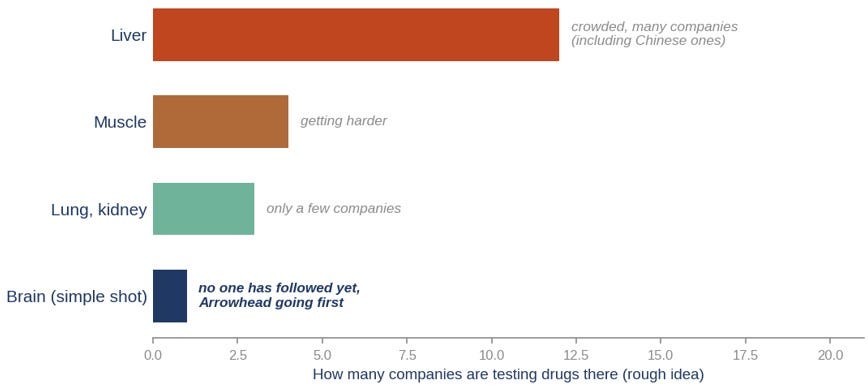
How crowded each part of the body is with companies testing this kind of drug. The liver is crowded and easy to copy, and it empties out as you move away from it. No one has followed Arrowhead into the brain yet. Numbers are a rough illustration; Arrowhead reports drugs in testing across seven parts of the body.
Be fair about what this edge is, though. It is a head start, not a locked door. The leading Chinese companies already have their own delivery methods and are working on organs beyond the liver, and talent moves around, as the ex-Arrowhead scientist at Argo shows. The honest claim, then, is not that no one can ever follow. It is that Arrowhead is years ahead, and the further you get from the liver, the wider that lead becomes.
The brain is where the lead is widest
At the far end sits the brain, and here Arrowhead’s lead is not just wide, no one has reached it the easy way at all. Every RNAi drug ever approved works only in the liver, Arrowhead’s own approved drug included. Getting this kind of medicine past the brain’s natural wall, with a simple shot rather than surgery or a spinal tap, has never been done in people by anyone, Western or Chinese. The Chinese brain work that exists is early lab research in animals, not a real human program. Arrowhead’s brain drug, ARO-MAPT, is on track to be the first to show it can switch off a target gene in the human brain, with early results expected in 2026. Say that plainly: it has not happened yet. That readout is the hinge the whole brain case turns on. If it confirms Arrowhead can reach the brain, being first is not a slogan, it is the whole advantage, because a proven way in works for every drug that follows. If it disappoints, the brain lead is a promise, not a fact. Whether this one drug then goes on to beat the disease is a further question, harder and years away.
Why being first in the brain matters so much
Suppose the readout lands. Being first is often overrated, but in the brain it is unusually powerful, and it snowballs. Here is why it is different from being first with a liver drug.
Figure 2: The head start that keeps growing
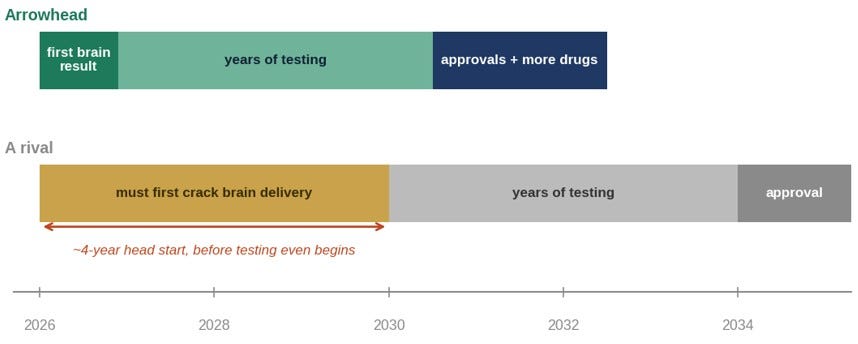
Why a rival lands years behind. It has to crack brain delivery first, the very thing that has stalled the field for years, before it can even begin the long testing process. The timeline is a rough illustration; the order is not.
The delivery problem comes before the clock even starts. A competitor cannot begin the long years of brain-disease trials until it has first figured out how to get the drug into the brain, which is the very thing that has stalled the whole field for a decade. A rival is therefore not one step behind Arrowhead. It is a whole delivery breakthrough plus a full round of trials behind, and brain trials are among the longest in medicine. The head start is measured in years before anyone else even reaches the starting line.
The lead also feeds on itself. By going first, Arrowhead grabs the best targets: it already has drugs aimed at the proteins behind Alzheimer’s, Parkinson’s, and Huntington’s. Being first attracts the big partners who pay to fund the next round, Novartis has already committed up to $2 billion for the brain platform, and that money buys the next drugs, which produce the data that lands the next partner. The first approved brain drug also becomes the standard everyone else is measured against. Each of these advantages makes the next one bigger. That is why a company that reaches the brain first is far harder to catch than one that is merely first in a crowded liver market.
Then comes the part that outlasts all of it. Once a brain drug is actually being prescribed, it digs in. Brain specialists are a small, careful world, and doctors who have learned one treatment, watched it work, and grown comfortable with its quirks do not switch on a whim. Treatment guidelines get written around the drug that got there first. Insurers put it in the preferred slot and make every latecomer fight for coverage. Patients doing well on a long-term medicine are rarely moved off it. A rival showing up years later with a slightly better drug still has to pry all of that loose, one doctor and one insurer at a time. Being first also makes the next drug easier: every brain program teaches Arrowhead something about delivery it can reuse, so its tenth brain drug costs less and moves faster than its first, while a competitor is still struggling through its first.
The patents are hard to get around
There is a legal layer on top of all this, and being first shapes it too. A patent can only protect something new, something no one has done before. In a crowded field, where a lot of similar work already exists, a company can patent only narrow slivers, because everything else is already taken. In a brand-new field, where almost nothing came before, the first company in can patent broadly. Arrowhead is first into the brain, so there is very little earlier work to box in its claims, which means its patents can cover wide ground. It also runs its own in-house patent team, building that protection from the start.
This matters most where the money is. A rival that wanted to sell a copycat brain drug in the United States, the market that counts, would not just have to match the science. It would have to invent a completely different route around a wide wall of Arrowhead patents. Patents are not a magic shield, and a determined competitor can sometimes design around them. Doing so is slow and expensive, though, and it often leaves the copycat a step behind with a weaker drug, while Arrowhead keeps pulling further ahead.
Why China’s rise actually helps Arrowhead
Put the two halves together and something surprising happens. If the brain bet pays off, China’s rise raises Arrowhead’s value instead of lowering it. When everything that can be copied gets copied and turns cheap, the one thing that cannot be copied becomes rarer, and rare is exactly what makes something valuable. This also sharpens the buyout case rather than weakening it. A big drug company can now buy a cheap liver drug from China, which means the reason to buy Arrowhead was never its liver drugs in the first place. It is the delivery skill and the head start in the brain, and those are the two things no amount of money can buy from China. The proof is already on the table, and it is stronger than it first looks. Novartis already owns a liver drug of exactly this kind, called Leqvio, so it had no need of Arrowhead for the liver at all. It still paid Arrowhead $200 million up front and promised up to $2 billion, every dollar of it for the brain platform. Buyers have already shown which part they will pay up for.
What could go wrong
It is only fair to say how this could be wrong. The largest risk is the most basic one: the brain lead is not proven yet. Everything in the brain half of this note rests on the 2026 readout showing that Arrowhead can actually reach the brain. If that result disappoints, there is no first-mover position to defend and the brain advantage does not exist. Even if the delivery works, whether lowering the target treats the disease is a separate and harder question that will take years. The other risks are about how long the lead lasts rather than whether it starts: China is pouring money into reaching organs beyond the liver and learning fast, helped by talent that keeps moving, so the years-ahead lead could shrink quicker than expected, and the copycat pressure on the liver drugs could prove bigger than the modest hit described here. None of these turns the easy-to-copy drugs into the crown jewel. The honest posture is simple: the liver headwind is real and here now, and the brain prize is real but still unproven.
The move no one can copy
Chess has a useful idea here. Every serious player memorizes the openings, the published moves that begin a game. They are free for anyone to study and copy, move for move, which is exactly what the copycats do best. The real edge shows up later, in positions the book has never seen, where the memorized moves run out and only the player who arrived first knows what to do. The liver is the opening. Everyone has it by heart. The brain is a position with no book at all, and Arrowhead is about to make the first move into it.
Here, then, is the whole paper in a breath. China can copy the drug. It cannot copy the move no one has played yet, and the first move into the brain is the one that wins the game. The more the world fills with cheap copies of the openings, the more valuable the one player becomes who is writing a book everyone else will have to study. That player is Arrowhead, and it is the one thing a cornered buyer cannot buy from China at any price.

A Note on Supporting Independent Research
If this note has been valuable to you, whether it shaped your thinking, validated your conviction, or simply saved you the time of doing this work yourself, a voluntary contribution is genuinely appreciated and directly funds the next paper.
For individual investors and readers
Any amount you feel reflects the value you received is welcome and meaningful. A contribution in the range of what you might pay for a single premium research report is a thoughtful gesture that makes a real difference.
For family offices, investment funds, hedge funds, and research platforms
This paper is the caliber of work that institutional research desks bill significant retainers to produce. If your team referenced it, distributed it internally, or used it to inform a position, a suggested contribution of $1,000 reflects the professional value of the analysis, though any amount is meaningful. Your support makes it possible to continue publishing at this level without a paywall that limits the reach of the ideas. If your organization requires an invoice to process a payment, please reach out directly at bioboyscout@gmail.com and one will be provided promptly.
There is no obligation and no expectation. This is purely a thank you for work that meant something to you.
Zelle: (847) 227-7909
PayPal: paypal.me/bioboyscout
Thank you for reading, and for being part of a community that takes this thesis seriously.
— Robert Toczycki | BioBoyScout
Important Risks, Disclosures, & Disclaimers
The author, Robert Toczycki (aka BioBoyScout), certifies that:
all views expressed in this note accurately reflect his personal opinions about the topic discussed;
he was not compensated in any form for producing this note; and
he has not received and does not receive compensation from Arrowhead Pharmaceuticals.
This note reflects the author’s personal opinions, is for informational purposes only. It does not constitute investment advice, a solicitation to buy or sell securities, or a guarantee of future results. The author holds a long position in Arrowhead common stock. Arrowhead Pharmaceuticals (ARWR) is a publicly traded company; investments in its shares involve material risks, including the risk of total loss.
About the Author
Robert Toczycki is an independent analyst and registered US Patent Attorney with a JD, an Executive MBA completed at the top of his class, and a BS in Mathematics and Computer Science from the University of Illinois at Urbana-Champaign. He has a deep passion for financial analysis, particularly identifying valuation discrepancies and demonstrating them through rigorous, data-driven research and solid analytics.
Comments or questions: bioboyscout@gmail.com.
Copyright © 2026, BioBoyScout. All Rights Reserved.